

Dispatch
How does a Society finance itself? How does it screen potential members? Why does it bill its members maintenance charges? Where and when does the member voice his concerns or opinions?
These questions must have popped in your head time and again as a member of a housing society. Look no further than the inconspicuous little book of ‘ Society Bye laws ”.
What are bylaws for a housing society?
Society Bye-laws are rules formed by residential societies to self-regulate their activities and to control the actions of its members. Housing society bye laws are provided and approved by higher authorities (government bodies, legislative authorities). Society Laws could vary from one state to another in their particulars, yet the basic framework and nomenclature remain the same. Let’s briefly explore distinctive categories for each component of the functioning of a society. These are broad categories that cover every aspect of housing society rules and regulations, be it holding a meeting, issuing shares to members, collecting dues from them, conducting Elections, allotting parking spaces or putting out a circular on the notice board.
Purpose of housing society bye-laws
The managing committee of an Apartment Owners Association (or Residents Welfare Association) must have bye-laws in order to ensure adequate upkeep of the apartment building and to swiftly and effectively address the problems residents encounter. Escaping the problems is difficult. Convincing the society to accept the chosen laws and regulations is a challenging endeavour. A set of regulations known as the bye-laws provides a solution to all associated problems. The bye-laws are adopted by each apartment building as soon as it registers. The bye-laws are regarded as the apartment complex’s constitution and regulate how it operates on a daily basis.
Why should you know about the model housing society bye-laws?
The answer to any question you have about the functioning of your society can be found in the model bye-laws of housing society . They may seem verbose or cumbersome, but they should be on your ‘essential reading list’ as they are your ‘set in stone’ legal chaperones that cannot be refuted by any society under any circumstances. As part of a society, you’d be remiss if you are not aware of your basic rights and duties, your society’s foundational policies, its management and the guidelines that dictate its decisions. A lot of homeowners harbour an approach of ‘we’ll cross that bridge when we get to it’ with respect to the rules of a society, thinking all is accomplished once they have occupied their residence inside it. Be that as it may, to avoid being misinformed or manipulated by dishonest committee members, to stop the violation of your rights, or simply to be aware of the workings of the community you’re part of, familiarising yourself with model bye-laws of housing society is necessary. Cooperative society bye-laws are easily available online to peruse in your own time. Otherwise, as a member you have the right to ask for a copy from your society.
List of housing society bye-laws
1. Preliminary- name and address
This section informs us about the procedure for naming, change in name, classification, address change procedure and exhibiting the Name Board of the society.
2. Interpretations
The meaning of the nomenclature, i.e the exact definition of commonly used terms (common areas, sinking fund, active member) is given so as to legally distinguish common usage of words in the context of a housing co-operative.
3. Area of operation, objectives, affiliation
To define the locality of the society within a municipality and to define the main objects of the society as well as declare it as Member of the Co-op Housing Federation of the District / Ward / Taluka, the District Central Co-operative Bank of the district.
4. Raising of funds and their utilisation
Cooperative society bye-laws lay down rules on modes of raising money such as issuing shares, taking loans, voluntary donations & deposits, etc. and explains how to issue shares to members and limit of liability for the society. The ways in which the funds are utilised are also described, such as reserve fund, repair and maintenance, emergency fund and training fund.
5. Rights & duties of a member
This section describes the eligibility, conditions, and procedure of obtaining membership in a society distinguishes between active, non-active, associate, and nominal members. The rights of members elaborated under bye-laws of the society include the right to inspect records, get a copy of RWA bye-laws, right to Occupation of Residence, conditions for and acceptance of Resignation by Members, procedure for Nomination by a Member and its revocation / revision, procedure and requisite documents for Transfer of Shares and interest from a member to another in the Capital/Property of the Society, Transfer of Shares and interest of the deceased Member, and rules on Exchange and Sub-letting of residences.
6. Responsibilities and liabilities of members
This section details the duties of the member, including applying for permission to make additions and alterations in a flat, allowing examination of flats and report about repairs, not to cause inconvenience to other members. It also entails the grounds for expulsion from the society and its procedure, circumstances under which a person ceases to be a member and the follow-up action taken by the society, rules on holding multiple flats, liability limited of members to unpaid amount on shares.
7. Society charges
Bye-laws of society describe the composition and break-up of the society charges, including Property Taxes, Water Charges, Common Electricity Charges, contribution to Repairs and Maintenance Fund, expenses on Repairs. Operation and Maintenance of the lifts contribution to the Sinking Fund, Service Charges, Car Parking Charges, Interest on the defaulted charges, Repayment of the Loan, Installment and Interest, Non-occupancy Charges, Insurance Charges, Lease/Rent, Non-agricultural Tax, Education and Training Fund, Election Fund, and any other charges.
8. Duties and powers of the society
These are rules specific to the common seal and incorporation of the society as holding the power to acquire, hold and dispose of the property, to enter into contracts and other legal proceedings. It also pertains to having a charge on the shares and/or interest of a Member, policy for allotment of flats and cancellation of flats, handing over possession of flats, society’s duty to carry out Structural Audit, allotment of parking lots and its restrictions, marking of parking lots and their eligibility, along with payment of charges for parking of vehicles.
9. General meetings (first general meeting, annual general meeting & special general meeting)
This section gives detailed and specific rules on how to conduct society meetings, including general, annual and special body meetings. Rules regarding the agenda of the first general meeting, the duties of provisional committee and its handover to newly elected committee, the functions of the annual general body meeting, rules for special general body meeting, period of notice and quorum of a general body meeting, voting rights of members, recording of the minutes of meeting, holding of the adjourned General Body Meeting, among others are explicitly stated.
10. Management of society affairs
Rules under this category include opening up of bank account for operations, strength (in numbers) of the Managing Committee, guidelines for Election, First Meeting of new committee, duration of holding office, conditions for cessation of membership of the Committee, and Resignation of Committee Member/Office bearer. There are detailed lists of all the required functions of the Managing Committee, Chairman and Secretary of the society.
11. Book-keeping
Detailed lists of maintaining books of accounts, records and registers are specified, including but not limited to cash books, ledgers, Sinking Fund, Investment, Nomination, Loan Registers, Minutes Books, Applications for membership, resignations, correspondences received from within the society or from external agencies related to property tax, conveyance, electricity, vouchers and counterfoils of share certificates and issued cheques, periodical statement of accounts, audit memos, election papers, service staff payment records.
12. Profit distribution
Rules on how to distribute funds (after paying interest on loans/deposits and after making such other deductions) are prescribed clearly in the bylaws of the cooperative society . The allocation includes a percentage of the amount to be deposited in the Reserve Fund, in dividends of shares to shareholders, compensation paid to office-bearers, and towards Common Welfare Fund.
13. Writing off dues
This section prescribes the conditions under which the Society is allowed to write off its irrecoverable charges due from the members, the expenses incurred on recovery and the accumulated losses.
14. Society accounts audit
The basic procedure for conducting an annual financial audit of the society is described in detail, including the appointment of a registered Auditor/CA, the timeframe to conduct the audit and the steps for completing an Audit Rectification Report before Annual General Meeting.
15. Conveyance, redevelopment and repair/maintenance
This section gives details of getting the deed conveyance under society’s name through an advocate and proceeds to list rules on renovation and repair. Member’s contributions towards repair are stated, along with the procedure of inviting tenders from architects/ developers, and a step-by-step guide to the entire redevelopment process is given. Guidelines on emergency planning schemes, disaster management and response machinery are prescribed as well.
16. Other miscellaneous matters
Minor yet important rules regarding day-to-day operational activities are mentioned in the bye-laws of residential society . These include sending and displaying notices on general meetings and their resolutions, how to fix the Notice Board and what to display on it, penalty amounts for member breaches against the society, regulating the services, amenities as per members’ convenience, fixing timings and rules for use of common areas such as parks, staircases, etc, making available spaces for members to install solar energy electrical systems, making copies of the documents required by the members and the charge per page.
17. Committee redressal of member complaints
Based on the complaint type, the society bye-laws give a list of relevant authorities to approach. They describe the types of complaints handled at the Society’s General Body Meeting. Other than that a variety of complaints are handled by the Registrar, Co-operative Court, Civil Court, Municipal Corporation/Local Authority, Police or the District/State Federation, depending on the nature of the grievance.
Differences between old & new housing society bylaws
Do I have to adopt a new set of housing society bylaws if my society is newly registered? True, your society would adhere to the old model bylaws. If it was previously registered, the year is 2009. Bye-laws have been newly modified following the 97th Constitutional Amendment and the MCS Amendment Ordinance, 2013. This includes cash on hand limits, active member provisions and duties, maintenance rates, AGM, society election tenets, and so on.
Several MCs look for the procedure for adopting new bylaws, while others simply look for bylaw amendments.
Homeowners base a lot of their buying decisions on the availability of good amenities, car parking being one of the top priority needs. With the proliferation of high-rise buildings, parking spots in residential societies are an everyday battle. The lack of uniform parking laws across the board concerning parking rules in societies has created an epidemic of unwritten rules and indiscriminate behavior by everyone at stake. How does one maintain sanity and ensure fair treatment when there are too many cars and not enough space? This is why societies have bye-laws for parking. Read more to find out the car parking rules in housing society.
Apartment car parking problems & their solutions
1. Unofficial parking
If you own a 4-wheeler vehicle, you’re eligible for a parking space or stilt (usually one or two according to your BHK size) at your apartment car parking. Members park more vehicles than allowed in their allotted space/s. For example, the husband already owns a car and parks in his usual spot. When the wife buys a new one or a relative/friend visits for an extended period, they park theirs in the open space or guest parking without permission.
Solution: If you’ve been allotted a car parking space/spaces (according to your BHK size) which you’re already using, and even if it is big enough to allow an extra two-wheeler parking, consult the MC before permanently parking it. Extra cars/ scooters cannot be parked in spaces not allotted to you unless approved by the MC. You have to pay parking charges for an additional four-wheeler parking. A fine may be placed by society for violation of vehicle parking laws in society.
2. Guest parking
A common occurrence is that even though there’s space inside the building for guest parking, security guards, at the behest of MC or out of their own volition, instruct delivery personnel, guests, and visitors to park their vehicles out on the streets. Sometimes such unnecessary measures lead to vandalism and theft of vehicles.
Solution: A building has to keep at least 25% space for visitor parking as per BMC though it recently dropped it to 5%. Give strict instructions to guards regarding visitor parking rules as per your apartment by-laws.
3. Unmarked spaces
Open parking spaces lead to confusion among members if there is no structure or markings for them to follow. Unabiding members can inconvenience the rest regularly.
Solution: Bye-laws require a society to mark and number parking spaces (for bicycles, 2-wheelers/ 4-wheelers separately).
4. Unfair allotment
In societies with limited parking spaces and where some residents own second and third vehicles, they occupy more parking spaces (albeit while paying for it) even though other owners who may own just the one vehicle are not given a parking space and some are made to park outside the building.
Solution: The MC allows parking on a ‘first-come, first-served basis for eligible members who own a vehicle. If unoccupied spots are at society’s disposal, the same member may be allowed second and third stilts/parking spaces on an annual basis, except there are no other eligible members who haven’t even been assigned one spot.
5. Tenant parking
Tenants are sometimes not allowed to park inside the society premises if there is an excess of permanent resident vehicles.
Solution: If the landlord is already eligible for a parking spot, then the tenant should get access to it legally. It is the responsibility of the landlord to ensure that the tenant gets a spot. Only if the landlord isn’t eligible for parking, the tenant may be asked to pay for parking charges, unless the landlord decides to pay it on his behalf.
6. Limited number of parking spots
Due to the parking space deficit and excess of vehicles (especially 4-wheelers), residents are required to park outside in the building vicinity regularly.
Solution: If there are way too many vehicles belonging to eligible members, the society draws a lot every year. Another option is to provide spots on a rotating basis. Everyone is given an equal opportunity to park inside even though they may have to take turns.
Apartment car parking laws in India
According to RERA Act (2016), covered garage space can be sold separately by the builder, however, open or stilt parking spaces are clearly defined as part of common amenities such as lobby, stairs, elevator, garden, etc. Therefore, it is illegal for a builder to charge a buyer for a separate parking space. These become the property of the society as soon as it’s registered, an Occupation Certificate is issued by the municipal corporation and the builder arranges a handover (http://mohua.gov.in/cms/rera.php)
This is per the Supreme Court decision that upheld Bombay HC’s verdict in 2011 in the case of Nahalchand Laloochand Pvt Ltd vs Panchali Cooperative Housing Society. The builders agreed that they can sell parking spaces to outsiders as independent units, to which the society residents disagreed later. The builder approached the court so that the society members don’t object to 25 stilt spaces sold to buyers who weren’t society residents. (https://indiankanoon.org/doc/1359331/)
Model building by-laws developed by the Ministry of Housing and Urban Affairs dictate that permissible ECS ( Equivalent Car Space) per 100 sq meter of floor area in residential premises is 2. This can be translated to 1 space per 3BHK and 2 per 4 BHK. Development Control Regulations of every state mandate that the builder provides parking space to buyers albeit parking provisions may vary state-wise. (http://mohua.gov.in/cms/model-acts.php)
Various apartment acts (e.g. Maharashtra Ownership Flats Act, Delhi Apartment Ownership Act) allow MC to constitute their own parking rules including a parking fee which is decided in the General Body meeting, varies from types of vehicles, and is to be mandatorily paid by members (https://housing.maharashtra.gov.in/Sitemap/housing/housingactnrules.htm)
Types of parking in apartments
Let’s check the types of parking generally available in residential complexes. Different types of parking which you can choose according to your parking lot construction:
1. Angle parking
When cars are parked at an angle, a technique used in open parking where spreads are manageable. The vehicles usually face the same direction (any one direction) and sliding in and out remains easy if all the vehicles are parked with rules and required spaces between all four sides are maintained.
2. Perpendicular parking
This is a type of parking in which the vehicles are parked at a 90° angle and perpendicular to the curb up front, similar to angle parking. In this, the driver needs to ensure that the tires are facing straight ahead. This is a commonly used style in garages and parking bays and in apartment complexes with limited spots.
3. Parallel parking
This is what you commonly see on the roads on the side of the curb where the driver parks between two cars, between the one in the front and one in the back. This type is used when a residential complex has a long pathway with enough space to accommodate cars and bikes without obstructing the path.
4. Tower parking system
This is a fully automated car parking system in which come equipped with parking lifts for cars to move up and down to the designated spot. There must be a lift operator along with the entire set-up since this is used in large complexes in urban areas with narrow spaces.
Role of RWA in parking rules in residential areas India
RWA (Residential Welfare Association) is the managing committee that is registered under the Societies Registration Act, 1860. This means that if you face a parking issue as a resident of a housing society, they are the ones who could come to your help. Since this association is such an important one, RERA ((Real Estate Regulatory Authority) Act emphasises on establishing an RWA within the first 90 days of when the flats are booked.
However, there are some important factors you would need to be aware of, before booking a complaint. You must know that:
- Any Shared/Common Space in the society belong to the apartment complex/housing society.
- Parking spaces are not owned by the RWA members or residents.
- The MC (RWA) or General Body could allocate parking slots to residents who’ve done their registration, since parking allocation comes under the jurisdiction of the housing society’s managing committee.
- Homeowners, their families and associate members could all be registered members.
- The parking spaces in your area are all numbered using the LOP (Lay-Out Plan) that the civic body has approved.
- If you have a sticker on your vehicle, provided to you by the managing committee of the RWA, you would be exempted from security checks when you enter/drive inside the society premises.
FAQs – Parking issues in apartment complexes
How do I keep a track of vehicles allowed in parking space?
You can ask for a copy of the RC book from members and provide them with parking stickers for each vehicle.
Is the parking area considered as FSI?
Open/Stilt parking, visitor parking, and basement parking are not included in the FSI calculation.
Can I cover my parking space or use it for storage?
According to the apartment acts, you are not allowed to cover or repurpose parking spaces.
How much space is allowed for parking?
As per the National Building Code, one car parking space must not be less than 13.75 sq meters. For a 2-wheeler, it must not be less than 1.25 sq meters.
Can a society sell members parking spaces?
No. But they can allot a space for a fee.
What can I do if society doesn’t abide by parking bye-laws?
An appeal in consumer forum or cooperative court.
Can a builder allot open parking space?
No. Society allots parking spaces.
Can a member sell or transfer parking slots?
According to model bye-laws, a member shall have no right to sell or transfer parking slots allotted by the society.
Can the society collect parking deposits?
No. Bye-laws restrict society to raise such funds.
How much does parking space cost typically?
Most societies charge between Rs 100 and Rs 500 for a single vehicle, increasing with second and third vehicles.
Societies try to dot the i’s and cross their t’s when it comes to record-keeping and paperwork, but there are some hits and misses every now and then. Many societies forget to (or simply don’t know that they have to) issue share certificates of society to their members on time or use the housing society share certificate transfer form at the time of resale.
Here’s all you need to know about the share certificate of housing society format and the society share certificate transfer procedure.
What is a housing society share certificate?
A society share certificate is a legal certification given by a housing society that a certain member is the registered owner of shares in the cooperative housing society. It is to be given to the member free of charge. Model bye-laws state that, “Share Certificate, prescribed in bye-laws, bearing distinctive number and indicating the name of the member, the number of shares issued and the value paid thereon, shall be issued by the society to every member for the shares subscribed by him, within six months of the allotment of the shares.” The Registrar decides at the time of the society’s registration the total authorized capital, which is divided into Rs. 50 per share, and share certificates are distributed to the members. The member is issued 10 shares (worth Rs 500), as the total share capital need not be the same as the actual number of shares issued.
Why do you need a society share certificate?
While your sale deed is the proof that the property has been legally transferred in your name, a share certificate is legal proof that you are the rightful owner of the co-operative housing society’s shares. The managing committee must issue share certificates after due diligence. According to the society share certificate rules, in the case of a transfer, the share certificates should be issued to transferee within a period of one month of receipt of the instrument of transfer by such Company.
Checklist for issuing the society share certificate
- The society share certificate has to be collected by the member himself in person.
- The member’s property should be clear of lieu.
- The conveyance deed from the builder should be in possession of the society.
- Every housing society’s share certificate should have the seal of the society and be signed by the Chairman, the Secretary and one member of the committee, and authorised by the committee before being issued by the Secretary.
- The name and the order of names (for primary/associate member) should appear exactly as it is on the original sale agreement between the member and the builder.
- The member has to indemnify the society against any loans against its name, finish any paperwork and clear any arrears that have to be paid to the society.
- The society has to ensure that the member provides an indemnity bond stating that he has not transferred the share certificate to anyone else or created any charge or mortgage on the share certificate in favour of any bank, employer, any person or finance agency.
- The member has to present the original sale agreement while collecting the housing society share certificate.
Transfer of share certificates in case of a resale
In case of a resale, if a person needs to transfer the share certificate, all of the paperwork and necessary requirements pertaining to the transfer of shares must be completed on time. It is the new member who needs to pay the transfer premium and ensure that all the dues are cleared by the previous homeowner.
In case of transfer/resale, the original share certificate has to be given to the society along with the other documents needed. If the share certificate is being transferred to a new member after resale, they have to finished all paperwork prior to handing the share certificate, including the required transfer of shares procedures.
When the ownership of the shares is being transferred to another person, the new member has to pay the transfer premium, produce applications/documents required by the society while it has to ensure that no dues are pending by the former member. In the event of the death of the original member, the heirs have to apply within 6 months of the death for the share transfer to the nominee, along with the issuance of a new share certificate of the society.
Readymade share certificate booklets are available online, from housing federation offices or at book printing agencies.
If the members’ arrears are duly paid, and the documents requested by the society are submitted in proper condition, the society MUST issue the share certificate within the prescribed time limit after allotment of actual shares. If not, the member has the right to file a legal notice/injunction against the society.
Issuing a duplicate housing society share certificate
It is advisable to keep your original housing society share certificate in pristine condition in a safe place. Getting a duplicate society share certificate is not as simple as walking into the society’s office and getting a duplicate copy on the same day. If your share certificate is soiled, misplaced, stolen, destroyed, or lost, you can ask your housing society to issue a duplicate share certificate after following the procedure.
- File an FIR at the local police station, registering a report that the original share certificate has been lost, misplaced or stolen. Retain the copy of FIR acknowledged by the Police.
- Send a written application to the society stating that the original has been lost, misplaced, stolen (is not traceable) and request the society to issue a duplicate share certificate. Also, attach the acknowledged copy of the FIR with the application.
- Submit an indemnity bond of Rs 200 to the society, indemnifying the society of all cost/ results of issuing a duplicate share certificate. The Indemnity Bond should be duly notarized and attached along with the application and FIR copy.
- Once the society receives the application, it is placed before the managing committee in the next general body meeting. In the same meeting, the society examines the application and attached paperwork and approves the request for a duplicate share certificate.
- The society puts out the notice on the society’s notice board and also published notices in two local newspapers (with respect to issuing a duplicate share certificate).
- The society waits for 15 days for any objections after putting out the notice on the society’s notice board and the advertisement in the newspapers.
- If no objections are raised, the society issues a duplicate share certificate to the member. The cost of publishing notices in newspapers has to be borne by the member.
FAQs on housing society share certificate
What is the importance of share certificate in housing society?
The ownership of a share certificate is extremely important for a property owner in a cooperative housing society. It acts as a legal document for your rights as well as proves the allotment of shares of that society on your name.
How do I get a share certificate from society?
As a resident in your cooperative housing society, you have to apply for share certificate as per Cooperative Housing Society Act of your state.
What happens if society does not transfer share certificates?
If the housing society refuses to issue a share certificate to member, then he/she can file a legal notice against the housing society if there is no pending bill.
When can society issue share certificates?
After verification of all the submitted documents, society has to issue society share certificate with in 6 month from the date of shares allotment.
Hyderabad has it all! Telugu Cinema, A+ high-tech culture, delicious biryani, ancient history, and the stunning Charminar! The city is still growing and developing – digitally and in terms of infrastructure. It has proven to be a pleasant place to live. Hyderabad is regarded as one of India’s best metropolitan areas. Read on to know a list of Hyderabad’s upscale neighbourhoods!
Here is the list of the best 13 posh areas of Hyderabad:
1. Banjara Hills
Banjara Hills is located in the northwestern part of Hyderabad, is one of the most affluent and preferred localities. It is a well-developed residential and commercial neighbourhood, That is well-known for its large commercial ventures such as restaurants, shopping malls, and hotels. It has access to the Hyderabad metro’s red and blue lines, which connect to employment hubs such as International Tech Park and Mindspace Madhapur IT Park. This neighbourhood is dominated by independent houses and luxury apartments.
Key points:
- Best Restaurants: Barbeque Nation, Chutneys, Zing Sky Bar, Sahib Sindh Sultan, Our Place, Fusion 9, Southern Spice, Ohris Jiva, Ohris Tadka, 7 Sisters, Exotica, Bikanervala, Journey 1853, Hard Rock Cafe, IQ Bar, Cayenne, Arena, Chinese Pavilion.
- Best Cafes: Aura Cafe, Concu, Sage Farm Cafe, Beyond Coffee, Van Lavino, Roastery Coffee House, The Gallery Cafe, Feranoz Patisserie and Café, Terrassen Cafe, The Joint – Bar and Cafe, Ofen, Waffle House, FullFills – All Day Cafe, Cafe Graffiti, The Pet Cafe Hyderabad.
- Average Property Price: INR 15,270 per sq-ft.
2. Jubilee Hills
Jubilee Hills is a posh neighbourhood in Hyderabad’s western outskirts. It is located between Banjara Hills and Hitech City, a prominent IT hub. It homes many celebrities live there, including actors, politicians, and business magnets. It is also home to major media outlets such as TV 9, NTV, T News, and CVR news. Apart from this it is well connected to the Hyderabad metro’s blue line. Jubilee Hills houses excellent amenities and it also close to amazing healthcare facilities such as Apollo Hospital and Oakridge Hospital. BNR Brilliant High School and Siva Sivani Public School are among the few schools in the area.
Key points:
- Best Restaurants: Tre-Forni, Rayalaseema Ruchulu, Chill Restaurant & Terrace, Sarvi Restaurant, Krishnapatnam, Air Live, Vivaha Bhojnambu, So, The Sky Building, President Dhaba Bar & Kitchen, 36 Downtown, Chubby Cho, Medley.
- Best Cafes: Autumn Leaf Café, Conçu, Theory Café & Dessert Bar, Humming Bird Café, Sage Farm Café, Farzi Café, Foncé Chocolatier, Sobremesa: Bakehouse Café ‘ Kitchen, Nue Café, Bel Posto The Café.
- Average Property Price: INR 21,348 per sq-ft.
3. Gachibowli
Gachibowli is a well-known and affluent residential district in Hyderabad. It is close to Hitech City and is home to a number of well-known corporations (Accenture, Microsoft, TCS, Amazon, and so on), making it a popular working professional destination. It has everything you need for social and retail activities. It is well-known for its sports facilities, as well as IT companies. It offers residents a comfortable living environment complete with all amenities.
Key points:
- Best Restaurants: Amara, Daily Treats, Kanak, Prego, Indus – Coffee Shop & Multi-Cuisine Restaurant, Raise The Bar, The Globe Grub, Elsewhere Lounge & Kitchen, Flechazo, ABs- Absolute Barbeques, 10 Downing Street, Buffalo Wild Wings.
- Best Cafes: Good Vibes Only Cafe, Heart Cup Coffee, Skyhy Live, The Tilt Republic Bar, 3Bs- Buddies, Bar & barbecues, Drunkyard, Kangan, Mazzo, Ohm, Casbah, Mix.
- Average Property Price: INR 6,968 per sq-ft.
4. HITECH City
HITECH City is another upscale neighbourhood spread across 200 acres. It is just 2 kilometres away from Jubilee Hills. In 1998, the then-Indian prime minister, late Atal Bihari Vajpayee, inaugurated this well-planned area founded by former Andhra Pradesh chief minister N Chandrababu Naidu. HITEC City is an abbreviation for the Hyderabad Information Technology and Engineering Consultancy City, and the name is self-explanatory. This area is not only the city’s IT nerve centre, but it is also a hub of healthcare and financial services.
Key points:
- Best Restaurants: Pakka Telugu, Red Lion, Buddha Bowl, Goosebumps- Bar & Grill, A’La Liberty, Exotica, Ohri’s Sahib’s Barbecue, Red Rhino, Hard Rock Cafe, Little Italy, Pi, Seasonal Taste, Rotis, Deccan Serai, Ming Ustad, Prego.
- Best Cafes: Cafe Eclat, The Old Madras Baking Company, Waffle House, Barista Lavazza, rCaisse Cafe, Whiteboard Cafe, The Chocolate Room, Tea Lounge, Karachi Cafe, La cafe, Digital IT cafe.
- Average Property Price: INR 12,247 per sq-ft.
5. Manikonda
Manikonda, which is home to many upscale apartment complexes, has emerged as a top choice for young and affluent professionals. The area is home to the headquarters of several IT behemoths, as well as Lanco Hills, a USD 1.5 billion high-rise luxury residential development.
This location is popular among high-income professionals and businessmen due to its proximity to Hyderabad’s IT hubs and the availability of swanky properties with breathtaking interiors.
Key points:
- Best Restaurants: Asian Aroma, Mehfil, Beijing Bites, Raju Gari Biryani, Pachi Pulusu, Grand Kakatiya Multicuisine Restaurant, Zomoz, Firewood Biryanis, H2O Eat Palm Train.
- Best Cafes: Good Vibes Only Cafe, Auberry The Bake Shop, The Thickshake Factory, Swiss Cafe, Euphoria Bakers, 180 Oven Cafe And Bistro.
- Average Property Price: INR 7,068 per sq-ft.
6. Kondapur
Kondapur is one of Hyderabad’s most affluent neighbourhoods. It is located halfway between HITEC City and Gachibowli. The neighbourhood has grown dramatically in recent years. The best part is that the area is well connected to various employment centres such as HITEC City and Cyberabad Information Technology Zone. Another advantage is that it has a variety of well-planned and developed residential layouts, which makes it easy for property buyers to find the property of their choice.
Key points:
- Best Restaurants: Gandikota’s Coastal Spices, Platform 65, Manchi Baphe, Bikanervala, 7 Sisters Hitex, Air Live, Palamuru Grill, Maryada Ramanna, Myboli Maharashtrian Kitchen.
- Best Cafes: Desi Chai Adda Cafe, Heart Cup Coffee, Glocal Junction, Punjabi Affair, China Bistro, Blue Fox, Barbeque Holic, The Night Bird Bar & Cafe, 1989 Pizza & Thick Shakes, ZZA Cafe, Caffe Ritazza, World Of Tortillas, The Bake Factory,
- Average Property Price: INR 7,931 per sq-ft.
7. KothaGuda
KothaGuda is located in Hyderabad’s southern zone. It is another popular posh neighbourhood. The location is an incredible coastal lifestyle destination with ideal climate conditions, charming regions, and stunning beaches.
KothaGuda has an excellent social infrastructure that is packed with useful amenities such as schools, colleges, medical centres, shopping malls, and commercial establishments. It also provides good access to the city’s major areas. The neighbourhood is surrounded by major cities such as Ghatkesar, Uppal, Shamshabad, Nalgonda, and Gachibowli.
Key points:
- Best Restaurants: Barbeque Nation, Ju Yuan, Artistry, Salaam Namste, Lazeez Khana, Biryani Vs Pulav, Saharsh Udupi Grand.
- Best Cafes: Heart Cup Coffee, Proxy Bar & Cafe, Barista.
- Average Property Price: INR 8,794 per sq-ft.
8. Abids
Abids, Hyderabad’s well-known commercial district, has a number of apartments as well. The region, which is one of the city’s oldest districts, provides easy access to historical structures. Shopping malls, bustling marketplaces, banks, ATMs, restaurants, and other important services and resources are available in this posh area of Hyderabad.
Key points:
- Best Restaurants: G. Pulla Reddy, Abids Bistro, Kamat Hotel Restaurant, Prem Di Rasoi, Barbeque Spice, Scotchman, Bench Cafe & Restaurant, Palace Heights, Mini Punjab.
- Best Cafes: Oye Rock N Roll, Cafeine, The Great Bawarchi.
- Average Property Price: INR 5,883 per sq-ft.
9. Begumpet
Begumpet is well-known for its commercial and residential areas. It was once considered insignificant, but it has undergone significant transformation over the years and is now a posh neighbourhood in Hyderabad. A number of government offices as well as other multinational corporations are located in this area. The area is convenient for residents and reasonably priced.
Key points:
- Best Restaurants: Ohri’s Jiva, Jalpaan, Downing Street, Mezbaan Restaurant, Hashi Izakaya- Asian Bar & Kitchen, Ohri’s Eatmor, Pyramid- Lounge & Pub, Tulips, Saffrom Soul, The Bar Project.
- Best Cafes: Brew Bakes Cafe, Bambai Tapri, Cafe Elaichi, Cafe Coffee Day.
- Average Property Price: INR 8,055 per sq-ft.
10. Ameerpet
Ameerpet is a commercial and residential district in Hyderabad’s northwest. There are numerous commercial and residential units. This location is convenient to schools, clinics, pharmacies, supermarkets, banking, parks, and other amenities. There are software education and training institutes in Ameerpet. It is popular among students and bachelors. Despite being a key Hyderabad posh area, undergraduates and students may find affordable PGs here. Families like the neighbourhood because of the affordable housing. Other Hyderabad neighbourhoods appear to like Ameerpet.
Key points:
- Best Restaurants: Country Dine, Country Oven, Fishland Restaurant, Rayalaseema Ruchulu, Lazeez Khaana, Chinese Wok, Aritaaku Bhojnam, Promenade, Biryanis and More.
- Best Cafes: Harry’s- The Pub, The Milkshakes Factory, House of Milkshakes, Petoo, The French Caffe.
- Average Property Price: INR 11,772 per sq-ft.
11. Kukatpally
Kukatpally is a neighbourhood in Hyderabad. It has more people and better facilities. Despite being one of Hyderabad’s wealthiest areas, Kukatpally offers plenty of affordable housing, infrastructure, and public services. The location provides easy access to HITEC City and other cities. Due to its low rental and property prices, Kukatpally is one of Hyderabad’s most popular residential areas.
Key points:
- Best Restaurants: Gravity Restro Bar, Gravity Tarrance Lounge, Krishnapatnam, Platform 65, Barbeque Nation, Flechazo, Panch Sau.
- Best Cafes: Bhookmark, Cafe Cupz, Cafe Coffee Day, Destination Cafe.
- Average Property Price: INR 8,241 per sq-ft.
12. Somajiguda
Somajiguda is a well-known commercial and corporate district in Hyderabad. It’s a quiet residential neighbourhood with excellent infrastructure and public services. Excellent schools, corporations, healthcare, banks, restaurants, parks, and lodging are all nearby. The area is popular with both bachelors and families. Somajiguda has good access to other cities. Buses and subways make city travel more convenient.
Key points:
- Best Restaurants: Headquarters, Alsh, Verandah, Kismet, Esthio Eat more, Seven Spices, Kuchipudi, Kasuall,
- Best Cafes: Roastery Coffee at Sicca Bar, Adda- The Cafe & Club, Eagles Pizza, Cafe Coffee Day, Ice n Spice, Rocket Fuel Cafe,
- Average Property Price: INR 8,743 per sq-ft.
13. SR Nagar
Sanjeeva Reddy Nagar is also known as SR Nagar in Hyderabad. It is mostly residential. It was named by India’s sixth president, Neelam Sanjeeva Reddy. It’s a peaceful, lovely neighbourhood with lots of trees and is beautifully scenic. The neighbourhood is well-connected and planned for major highways. The number of houses and apartments in this neighbourhood is growing. Here’s a budget for low-cost housing. Property prices and rentals are low in this area of Hyderabad. Bachelors and families like the neighbourhood because of the low rental and property prices. The region has parks, playgrounds, and recreation centres.
Key points:
- Best Restaurants: Gayathri Bhavan, Santosh Dhaba, Captain Cook, Pizza Hut, Nandhini Restaurant & Bar.
- Best Cafes: Cafe Coffee Day, Makers of Milkshakes, Cream Shakes, Loventila, The Tim Cafe,
- Average Property Price: INR 7,899 per sq-ft.
Hyderabad’s IT industry and real estate market are thriving. As a result, the city provides numerous job opportunities. Hyderabad is also a reasonably priced city to live in. The blog above clearly states the posh areas in Hyderabad as well as their real estate prices.
The Central Park South Society can be likened to the Phoenix rising from the ashes in the aftermath of the Chennai floods in 2015. The natural disaster opened the residents’ eyes to the unfortunate reality of waste management in India. What followed is a story that can inspire many societies around the country.
The apartment complex is spread over 2,86,344 sq ft with 172 apartments in 11 blocks. It is difficult to miss as it is centrally located and has direct access to the main road. But this location proved to be a bane during the 2015 floods when the society was among the worst affected apartment complexes in the city. More than 5 feet of stormwater entered the complex and wreaked havoc.
“The floods did however, make us sit up and question why this happened. Some of the answers were very obvious. Unplanned development, encroachment of wetlands which are natural sinks, poorly designed drainage systems, increasing landfills, and so on,” says Sumitha Iyer, resident waste warrior, who led a brave new movement from the front. The society decided to solve its problem from the roots rather than fix it superficially.
From awareness to action
Even before the flood,s the society members had understood that waste segregation was the way forward to reduce our ever-growing landfills. They had a process in place for segregating household waste but it entailed separating dry waste only. There was no provision for wet waste management. “After the floods, we decided to take it to the next level by implementing 3-way segregation”, Sumitha says.
Getting started
They adapted the 2bin-1bag model, which was introduced to them by a Bangalore-based waste management company called WasteWinn. This model uses two-coloured bins (green and red) to collect organic and reject/hazardous domestic waste, respectively, and a bag to collect the recyclables. Once the implementation plan was formulated, the core team carried out an extensive door-to-door campaign to educate the residents, housekeeping staff, and domestic hel,p such as house help and cooks. For the first 50 days, active resident-volunteers accompanied the housekeeping staff to every house to clear the doubts and re-educate residents wherever required.
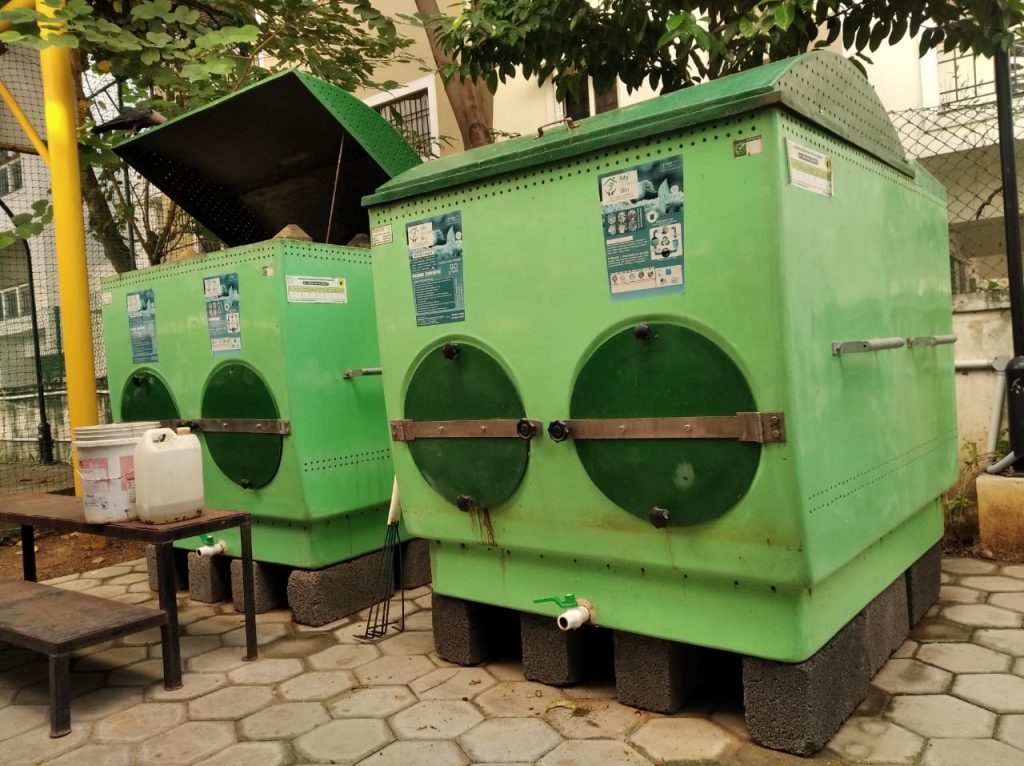
Central Park South Society produces about 80-100 kg of organic waste every day, making it a bulk generator required to handle wet waste management and disposal onsite. After the awareness generation campaign was done, the team began the research and groundwork in order to begin composting. They eventually zeroed in on My Green Bin composters, investing in two composting units of 2,000 litres capacity each. The composting process was started in earnest.
Trench composting (burying waste directly into trenches in the garden) was initiated as well. The team used one part of the organic waste in trench composting, wherein a pit about 4X4 with a depth of 2-3 ft was dug, and every day about 20 kgs of organic waste was dumped into it. This was then covered with dry leaves and mud. This process is continued till the pit is full and closed.
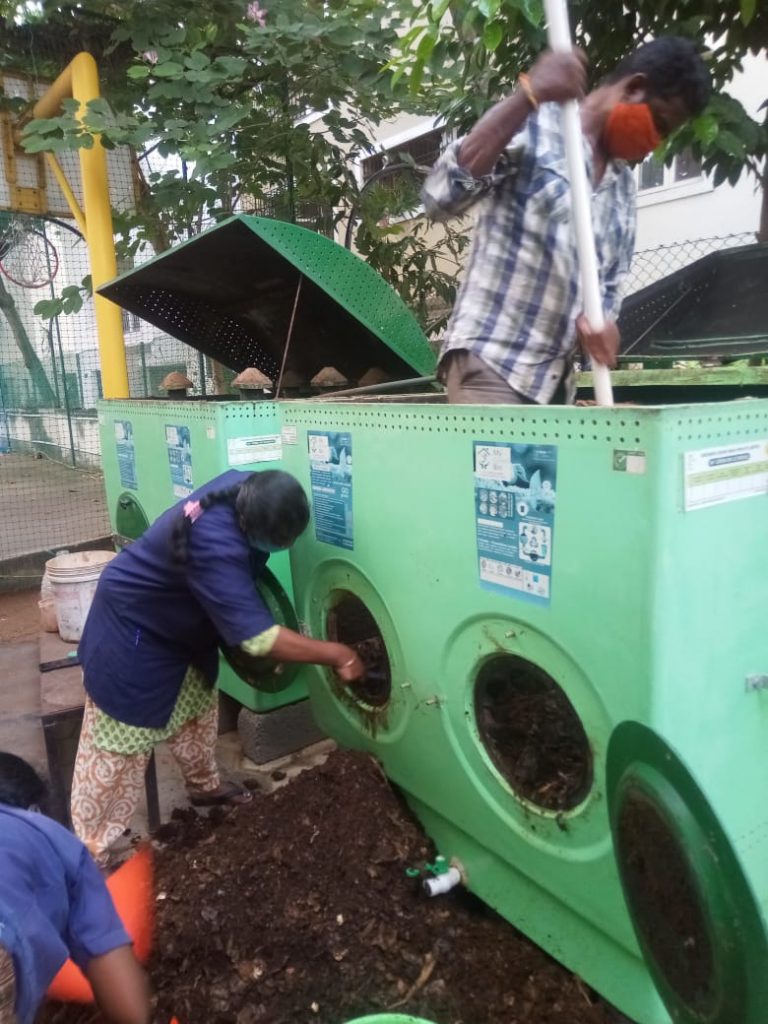
The team of volunteers worked closely with the housekeeping staff to ensure the smooth functioning of the composting system. Reports were sent daily via a WhatsApp group between the block representatives and the housekeeping staff. The team members continued to educate newcomers since it was imperative to keep the positive momentum going without missing any links in the chain. The society also monitored the different aspects of the whole process to see if any corrective measures were required. The wet, recyclable, and other waste was regularly weighed and recorded.
Tasting success
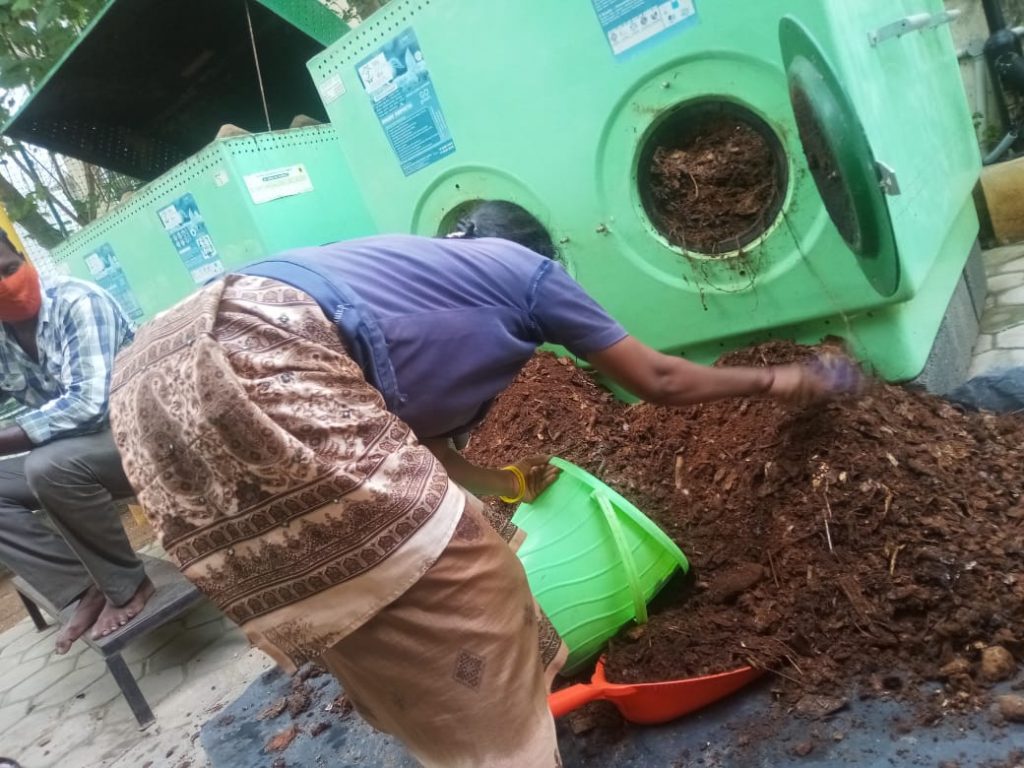
At first, there were challenges such as bad odour, but after tweaking the composting procedure and identifying loopholes in the system, the process took off smoothly.
Today, Central Park South Society produces about 300-400 kgs of compost per month. The society provides the compost to the residents for free. The compost is also used for vegetable gardening and for building a green belt of plants around the buildings. Dry waste is recycled. The society gets Rs 2000-3000 per month from the sale of its recyclables. The proceeds are distributed among the housekeeping staff as an incentive.
Sumitha says, “Our efforts are bearing fruit. Residents who were hesitant earlier are now active participants in this initiative. Most importantly, it’s overwhelming to see our kids learning the right practices of waste management at a young age. The real icing on the cake is when we received the Green Award from the Chief Minister of Tamil Nadu last year. This award was instituted by the Tamil Nadu Pollution Control Board for RWAs doing exemplary work in the field of solid waste management, among other things.
The society, led by Sumitha and team, plans to sustain its efforts and expand them further. They are already minimising the amount of hazardous waste generation and sharing their waste management practices with other apartment complexes that are willing to start their own journeys towards green living.
Lessons for other societies
“Composting is not an exact science. Sometimes we need to learn by trial and error to get the process running smoothly. Communities looking to do in-house composting should not give up when there are small hiccups. Always try to find practical solutions and keep it going,” says Sumitha.
She recounts the initial hurdles in convincing fellow residents to segregate waste into 3 categories. “Those who were used to using plastic liners had to now spend some time and effort to put the waste in the correct bins or bags. They had to clean their bins every day as no liners were allowed. Sanitary and medical waste had to be wrapped in newspapers before disposal, while all recyclables had to be cleaned and dried before placing them in the disposal bag. All this requires patience and perseverance, especially since it is a long-term behaviour change. But the residents showed true dedication to the cause from inception to execution.
Central Park South Society has successfully created a waste management system that not only works efficiently but also serves as a fine example of the spirit of a community that never gave up on the collective vision of clean and green India.
It is impossible to exaggerate how crucial it is to maintain safety and security in our communities in a world where change is continual. The thorough screening of renters, with a focus on tenant police screening, is a crucial component of maintaining a secure environment. This crucial procedure is vital for upholding safety requirements, averting dangers, and giving people a sense of security. The article explores the benefits of tenant police verification in further detail and illuminates the potential repercussions of omitting this crucial step. In addition, we will concentrate on the intricate police verification procedure in Hyderabad, an active and developing city in India.
Benefits of tenant police verification
1. Elevated security and prevention of criminal activity
Chief among the benefits of police verification for tenants is its significant contribution to heightening overall security and deterring criminal activities within residential communities. Landlords and property owners can successfully reduce the likelihood of renting to people with a history of criminal conduct by thoroughly screening prospective renters. This proactive approach is crucial to establishing a more secure environment for all occupants. These places usually have lower crime rates and a greater sense of security.
2. Safeguarding property and assets
Effective tenant screening, made possible by police inspection, significantly reduces the chances of theft, vandalism, and property damage. Property owners can put the appropriate measures in place to secure their investments and assets by being aware of a tenant’s criminal background or potential risk factors.
3. Fostering community harmony
Leasing to people with clean records promotes neighborhood peace and a sense of community. The assurance that neighbors have through thorough verification processes alleviates worries and fosters a more peaceful living environment. When residents’ sense of safety and security is valued, they are more likely to interact positively and create a welcoming community.a
4. Mitigating legal liabilities
A noteworthy benefit of extensive tenant verification is the potential reduction of legal entanglements and obligations, particularly through police channels. Making sure tenants have a spotless criminal record lowers the likelihood of disagreements and legal challenges, resulting in more amicable relationships between landlords and tenants. This preventive step also protects property owners from future legal actions resulting from housing those with criminal records.
5. Cultivating trust and longevity
The implementation of tenant police verification underscores dedication to safety and security, fostering trust between property owners and their tenants. Tenants are more inclined to treat the property with respect and follow local ordinances if they believe that their needs come first. Long-term benefits for property owners include extended lease terms and favorable recommendations as a result of this fostered trust.
Downsides of neglecting tenant police verification
1. Risk of criminal activity
The increased possibility of criminal activity taking place on the property or in the neighborhood is the main drawback of skipping police tenant verification. Without adequate screening, landlords can unintentionally rent to somebody with a criminal history, putting other tenants and neighbors in danger. This may result in theft, violence, and criminal activity in the neighborhood.
2. Property damage and neglect
Without sufficient tenant screening, landlords could unintentionally rent to people who have a track record of mistreating or disregarding rental properties. Due to the potential expense of necessary repairs and modifications due to property damage, this might cause substantial financial losses.
3. Disturbance to neighbors
Tensions between neighbors might arise from renting to troublesome tenants that disturb the quiet and tranquillity of the community. The quality of life for inhabitants can be negatively impacted by noise complaints, disruptions, and disorderly conduct that can make living conditions unpleasant for everyone.
4. Legal consequences
Legal problems and disagreements may arise if tenant verification is neglected. Property owners might become engaged in legal disputes and be subject to fines and penalties if a renter engages in illegal activity that negatively impacts the neighborhood.
5. Financial losses
Due to unsatisfactory tenant screening, landlords may experience financial hardships in the form of unpaid rent, property damage, or expensive legal fees. The expense of fixing any damage left behind by unreliable tenants can seriously affect a landlord’s bottom line.
Process of tenant police verification in Hyderabad
1. Submission of application
The procedure starts when a potential renter gives the landlord or the property management company a thorough rental application. Personal information, past housing history, employment information, references, and official identity documents are normally included in this application.
2. Scrutiny of documents
Upon receiving the application, the landlord carefully examines the supporting documentation. In order to ensure that the information provided by the renter is accurate, this stage entails confirming the provided identity, cross-referencing job information, and contacting references.
3. Initiation of police verification
Following the initial document validation, the landlord initiates the process of tenant police verification by forwarding the tenant’s information to local law enforcement authorities. This stage serves as the foundation for gaining a thorough understanding of the tenant’s background, including any possible criminal history.
4. Thorough background check
Local law enforcement authorities use their databases and records to conduct a thorough background investigation on the tenant. This comprehensive process comprises cross-checking the tenant’s personal information with any prior arrests, ongoing legal matters, or prior criminal activity. This stage is crucial for figuring out whether the tenant is a good fit for the rental.
5. Issuance of verification report
When the background investigation is finished, law enforcement agencies put together a complex verification report. This thorough report explains the tenant’s criminal past, if any, and provides details about their background in general. This report is then delivered to the landlord or the in charge property management organization.
6. Decision-making and communication
The landlord wisely decides whether to proceed with renting the property to the applicant after considering the information in the verification report. The landlord reserves the right to reject the tenant’s application if the report raises any questions or warning signs. On the other hand, a clear verification report can result in the tenant’s rental application being approved.
7. Tenant notification
The decision of the landlord is promptly communicated to the renter, along with a clear explanation of the reasons behind it. If approved, the renter is given the necessary instructions to proceed with the rental agreement and the next move-in procedure. The tenant is given the chance to resolve any anomalies or concerns raised throughout the verification process in cases where the application is rejected.
Conclusion
As the global landscape evolves and communities flourish, the adoption of proactive measures such as tenant police verification remains quintessential. Property owners, landlords, and residents all contribute to the creation of lively, secure living environments that serve as examples of the effectiveness of responsible tenant verification by emphasizing security and fostering a culture of safety.