

Delhi-NCR
Formed under the Societies Registration Act, 1860, these bylaws guide how housing societies in Delhi manage shared spaces, finances, security, and day-to-day operations. They clearly define the roles of the management committee and residents, helping maintain order, accountability, and smooth conflict resolution.
Managing modern residential societies is no longer a job for volunteers alone, it’s complex, demanding, and requires professionals. Society managers are paid experts who handle the daily operations of housing societies, from paperwork and maintenance to finances, resident issues, and legal compliance.
Without a society manager, gated communities often face chaos like delayed maintenance, financial confusion, and overworked committee members. A good manager brings structure, ensures legal compliance, supervises staff, manages vendors, and keeps residents informed.
Introduction
We’ve been working in housing society management for years now, and let me tell you – things have changed a lot. Back in the day, a few volunteers could handle most society work. Not anymore. These residential complexes have gotten huge and complicated. Residents want everything done perfectly and fast. That’s why almost every decent-sized society needs a proper manager these days.
Who is a society manager?
Think of them as the person who runs your building day-to-day.
They’re not volunteers like your RWA committee folks – they’re paid professionals who’ve learned how to handle all this stuff.
Some societies hire their own dedicated manager. Others use companies that send managers to handle multiple buildings.
Why a society manager is crucial
Here’s what happens without proper management – we’ve seen it plenty of times. Complaints pile up. Maintenance takes forever. Vendors show up whenever they feel like it. Nobody knows what’s going on with the money. Your volunteer committee members get burned out trying to handle everything.
A good manager fixes all this. They know the housing laws, deal with municipal authorities, and let your committee focus on making decisions instead of chasing contractors around.
Key responsibilities of a society manager
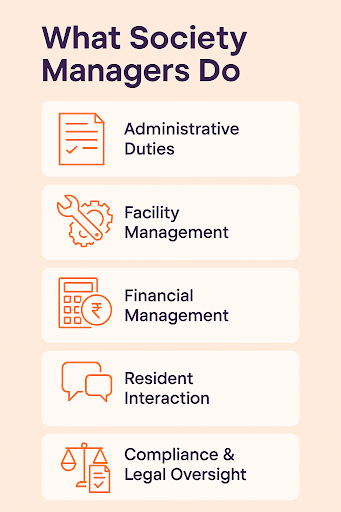
1. Daily operations & administration
Every meeting needs minutes. Every vendor needs a contract. Officials want notices. Someone has to track all this stuff and file it properly. During audits or legal issues, you’ll thank God someone kept proper records.
2. Facility maintenance
Cleaning staff need supervision. Gardens need maintenance. Something’s always breaking and needs fixing. Annual maintenance contracts need monitoring. When your elevator stops working or the generator fails, residents call the manager – not you.
3. Financial management
Budgets need planning. Maintenance fees need collecting. People who don’t pay need reminding (politely but firmly). Vendors need paying on time. Accountants need help during tax season. Without proper financial management, societies go broke fast.
4. Resident interaction
Residents complain about everything – noise, parking, maintenance, neighbors. New people move in and need orientation. Others move out and want deposits returned. Everyone wants updates on what’s happening. Managing all these personalities and expectations is honestly the hardest part.
5. Compliance & legal oversight
Fire safety inspections can’t be ignored. Structural audits are mandatory. Sewage treatment needs checking. Society registration must stay current. Labor laws apply to your staff. One missed compliance and you’re in serious trouble.
Tools and software society managers use

Most managers use apps now for communicating with residents. Visitor management systems track who comes and goes. Service requests get logged digitally instead of random phone calls.
Accounting software keeps financial records straight and generates reports automatically. Digital notice boards replace those paper notices that always fell down. Complaint tracking systems ensure nothing gets forgotten.
Put it all together and you get proper management systems instead of chaos.
Common challenges faced
- Residents expect different things. Some want immediate fixes, others complain about costs. During monsoons or festivals, everyone gets extra demanding.
- Collecting overdue payments without creating enemies requires serious diplomatic skills.
- Committee members often interfere or have unrealistic expectations.
- Vendors sometimes don’t show up or do shoddy work.
- Emergency situations – floods, power failures, medical emergencies happen at the worst possible times and need immediate handling.
Skills required to be an effective society manager
- Communication skills matter more than anything else. You’re constantly talking to residents, vendors, committee members, and officials. Poor communicators fail quickly in this job.
- Problem-solving under pressure separates good managers from mediocre ones. When three things break simultaneously during a festival weekend, panic doesn’t help – creative solutions do.
- Technology skills are becoming essential. You can’t avoid computers, smartphones, and management software anymore. Basic knowledge of housing laws and regulations prevents expensive mistakes.
Qualifications and hiring tips for RWAs
Most societies want college graduates, preferably with relevant diplomas in property management or business administration. Professional certifications help but aren’t always necessary.
Background verification is crucial – they’ll handle money and have building access. During interviews, give them real scenarios. How would they handle a major water leak? What if residents refuse to pay maintenance? How do they deal with difficult people?
Decide whether you want your own dedicated manager or prefer outsourcing to a management company. Your own manager gives personal attention but costs more. Management companies provide backup support and standard procedures.
FAQs
Is hiring a manager legally required?
No, but practically necessary for anything over 50-100 units. Volunteer committees simply can’t handle the workload effectively beyond that size.
Salaries range from ₹25,000 to ₹60,000 monthly, depending on location, society size, and experience. Mumbai and Delhi pay more than smaller cities.
Can residents become managers?
Yes, but they must quit any committee positions first. Otherwise, conflicts of interest become inevitable.
How do facility managers differ?
Facility managers focus mainly on building maintenance and infrastructure. Society managers handle broader responsibilities including finances, resident relations, and administration.
What if the manager doesn’t perform?
Submit written complaints to your managing committee. If problems persist, contact your state’s society registrar or housing authority.
Conclusion
Good society management makes everyone’s life easier. Residents get better service, committee members avoid daily headaches, and property values stay stable. The investment usually pays for itself through smoother operations and fewer conflicts.
Most importantly, professional management prevents small problems from becoming major crises. Prevention costs less than fixing disasters later.
Maintenance management of property is a key part of general property management since it helps to maintain the longevity and value of assets. The term “property maintenance management” refers to a vast array of activities, all directed to maintaining properties in the best possible condition. These consist of routine inspections, corrective action where necessary, repair work in emergency situations, seasonal repairs, and preventive maintenance. These initiatives ultimately function to maintain standards of safety and compliance, ensure high tenant satisfaction levels, and protect property value in the long run.
What particular goals do property managers anticipate having through maintenance?
One of the primary objectives is to prevent depreciation so that market value of the property over a period can be sustained or even enhanced. Also, properly maintained properties tend to have happier tenants, and that tends to result in longer tenancies and a lower rate of turnover. Most significant, perhaps, is the fact that it keeps houses safe for everyone who lives there, to codes and regulations that are put in place to protect residents and owners alike.
What sets property maintenance apart from overall property management?
Although property management entails a variety of duties such as leasing operations, rent payments, and interactions with tenants, property maintenance specifically focuses on the maintenance and repair functions of the property. Although related, many professions call for different techniques and expertise to be executed to be successful.
A number of important aspects of property maintenance management are blended to form a complete care plan. Regular inspection and assessment are the foundation of successful maintenance since they enable problems to be addressed before they turn into serious issues. In this way, minor problems are resolved before they become expensive repairs, thus saving time and money in the long run.
Preventive maintenance is another important component that entails planned activities such as the checkup of plumbing and HVAC systems to prevent unexpected breakdowns. Corrective maintenance fixes things when they arise, such as leaky faucets or roofs. Emergency maintenance procedures delay damage by responding to emergency repair situations in a timely manner, such as burst pipes. By preparing properties for varying weather conditions with work such as cleaning gutters and winterizing pipes, seasonal maintenance prevents season damage.
In order to expedite maintenance work, today’s property managers are increasingly depending on specialist software. Through expediting the processing of maintenance requests and monitoring issues so that nothing gets lost in between, these computer programs provide centralized management of maintenance requests. On top of that, these systems are ideally designed to monitor and schedule routine maintenance works, which enable users to remember what needs to be done when. Property managers can monitor the amounts of supplies, equipment, and tools to ensure they have everything in hand when the need arises with inventory and asset management systems.
Vendor management and coordination are much improved with centralized software while addressing service providers and contractors, cutting miscommunications and delays. Inventory and asset management technologies enable property managers to monitor the quantities of supplies, equipment, and tools to ensure all is at hand when needed.
There are a number of advantages to owners and property managers who utilize sound maintenance management. To begin with, routine maintenance prolongs the effective life of buildings and maintains them in superb condition, which maximizes their worth. As tenants are more likely to stay in well-managed places, properties with regular maintenance also have higher tenant satisfaction and retention rates. Therefore, there is less expensive turnover and downtime that saps profitability.
Have you ever thought about the cost of preventive maintenance?
By not allowing repairs to become so costly and straining your budget, addressing little problems before they can have time to get worse can save you loads of money. Other than maintaining properties in line with health and safety regulations, routine maintenance also protects tenants and prevents property managers from getting into hot water. Property management in general becomes more effective and productive if maintenance procedures flow like clockwork.
Property maintenance management has a number of issues, despite its obvious advantages. Maintaining a number of qualities at once can quickly become challenging, calling for careful planning and reliable methods. Managing crises and emergencies and making odd repairs is also an issue that can overtax resources and necessitate rapid, successful solutions. An added level of complication arises when property managers have to deal with multiple vendors and contractors to provide timely and quality service from complex third-party service providers.
Most property managers are constantly confronted with economic constraints and cost control, balancing between the need for maintenance and financial requirements. Staying abreast of innovations in technology also requires perpetual learning and adaptation, as introducing new technology to maintenance techniques can be problematic, the need to implement such to be competitive in today’s market is present.
Developing an overall maintenance plan tailored to each piece of property and detailing routine and preventive maintenance work is the first step in maintaining a property correctly. The best property management software that improves maintenance processes from task assignment to request management can be chosen and executed to establish a more efficient approach. Effective maintenance management entails assembling an experienced maintenance staff by recruiting qualified individuals and conducting ongoing training. Operations continue to be optimal in the long run if maintenance schedules are continuously reviewed and modified based on performance data and shifting needs.
Preserving property value, pleasing tenants, and optimizing overall operational performance all depend on successful property maintenance management. Emerging technology in property management software significantly enhances maintenance and makes organization and efficiency easier. As property managers aim to optimize maintenance and achieve maximum long-term performance, itis a smart strategic move to invest in efficient management solutions that will pay dividends through improved operation and property performance.
The right software does make a world of difference. It puts all your financial records in one spot, generates ready-to-audit reports with a few mouse clicks, cuts down on human error, and creates a clear trail of transactions. When the auditor raises an eyebrow about something, you can pull up the details instantly rather than diving into a mountain of papers.
At the end of the day, getting your audit closed properly remains one of the management committee’s most important jobs. When you understand what affects the timeline and take steps to make things go smoothly, you’ll avoid those audit nightmares we all dread.
Remember, timely audits show everyone you’re taking good care of the community’s money. They build trust with your neighbors and help keep your society financially healthy for years to come. With some planning and the right tools, audit time can actually become a chance to show off how well you’ve managed things rather than a stressful season everyone dreads.
Property Management Services are an essential part of the real estate and property management business. Property Management Services include management of different segments of residential, commercial, or industrial properties, usually by a third party such as a professional property manager. Property management includes various jobs such as financial handling, coordination of maintenance, regulatory adherence, and many more functions that can prove too much for any manager to manage individually. This is precisely where property management services come in to simplify these complicated tasks and render them more efficient and manageable for management companies or property managers.
The range of property management services extends to a number of critical areas that need ongoing focus and knowledge. Tenant acquisition is a core task where property managers are supposed to market their property well and acquire suitable tenants. The process is usually done by formulating attractive property postings, advertising vacant space, thoroughly vetting potential tenants, and showing them the property.
Rent collection becomes significantly streamlined with modern property management services. Gone are the days of going door-to-door collecting payments. Managers can now send automated reminders and collect rent from residents online, making the process much simpler, especially when managing properties with numerous residents.
Repair management takes a significant leap forward with committed services that allow managers to maintain accurate records of all property assets. The thorough approach encompasses safely storing electronic records of assets, tracking every repair and maintenance expenditure, and creating scheduled maintenance reminders. The outcome? Lower costs and less asset downtime.
Property safety is near the top of every resident’s list of concerns, and management services meet that demand by making secure security systems a standard. These systems replace the unreliable and antiquated manual record-keeping methods with a system that enables residents to track and approve visitors and deliveries. This strategy places control of security in the hands of the residents while ensuring overall property security.
Ever thought about the potential for change in your property?
Refurbishment services tend to be packaged with property management services. Some of these service providers have vast networks of experienced painters, architects, and interior designers who can assist in developing perfect living spaces in the property.
Managing legal procedures is made easier with professional management services. Property managers are responsible for compliance with all existing laws and regulations set by local governments. These services enable proper documentation and the keeping of records of changes in housing laws, building codes, and safety standards. Managers also need to ensure that tenant-landlord relationships comply with all applicable regulations.
Property management becomes more efficient through services that record and monitor property ownership information. This involves keeping track of leases, contracts, and insurance policies so that these documents go through routine review and renewal. Managers also gain from the capacity to produce routine reports on property performance and costs, enabling improved financial and managerial decision-making.
The benefits of adopting property management services are considerable and extensive.
- One of the most tangible advantages is how these services save precious time. -Property managers are able to outsource tasks that consume much time and are complicated, giving them more time to concentrate on other, more significant duties directly relevant to the welfare of communities. Managers can hire specialized firms to carry out individual tasks or use software solutions to automate the tasks. Most property managers acknowledge that they feel more at ease using extensive management services.
- Rapid maintenance is another key benefit as such services assist in monitoring assets, maintenance contracts, and repair schedules effectively. By outsourcing asset management to a property management firm, repairs and maintenance can be dealt with urgently. This reduces expensive maintenance or replacement bills while maximizing asset lives. It also eliminates the responsibility from managers who would otherwise have to monitor many community assets manually.
Tenant retention significantly increases when property management services are done well. When all goes smoothly within a community, from locating and placing high-quality tenants to keeping financials accurate, abiding by laws, and keeping the property in good shape, residents have a quality, satisfactory experience. This usually results inhigher retention, which works to the advantage of both property owners and management staff.
As much as there are many advantages, property management services also have some disadvantages that need to be considered. The most apparent disadvantage is the extra cost they incur for the community. The services are often accompanied by charges expressed either as a proportion of rentals collected or a fixed fee. Property managers should fully analyze whether the cost is worth the benefits obtained. They should also ensure that the cost of the service is not beyond the budget for the community and its inhabitants.
It should be mentioned that services and software complement each other to provide maximum property management solutions. Although selecting specialized property management services may resolve most management challenges, adopting suitable technology ensures these functions become effective. Embracing the right technology solutions ensures optimal utilization of financial as well as human resources, eventually enhancing the quality of the property and the well-being of the residents.
Managing committee members of housing societies often face the challenge of dealing with irrecoverable dues. These financial complications include outstanding loans and interest, charges due from society members, funds spent on recovery efforts, and accumulated losses. To address these issues, many housing societies establish a bad debt fund specifically designed to cover amounts that may need to be written off. These financial matters must be properly documented during housing society accounting audits.
The Model Society Bye-Laws 148 and 149 provide important guidance on handling irrecoverable dues. According to Bye-Law 148, a society may write off charges due from members, expenses incurred for recovery, and accumulated losses that have been certified as irrecoverable by the statutory auditor appointed under section 81 of the Act.
However, Bye-Law 149 establishes specific conditions that must be met before writing off these amounts. The process requires three key approvals:
- The General Body meeting must provide proper sanction for writing off the amounts through a formal vote.
- If the society has outstanding debt with a financing agency, that agency must approve the write-off.
- The Registering authority must approve the write-off.
There are notable exceptions to these requirements that housing society managers should understand. If the society maintains an affiliation with a District Central Cooperative Bank or another financing agency but doesn’t carry debt with that institution, obtaining permission from the bank or financing agency becomes unnecessary.
Furthermore, societies classified as A or B category in their most recent audit receive additional flexibility. If these societies maintain sufficient balance in a specially created Bad Debt Fund, they can proceed without securing permission from the bank, financing agency, or Registering Authority.
Understanding these regulations helps committee members navigate the complex process of managing irrecoverable dues effectively. When handled correctly, writing off genuinely uncollectible debts allows the society to maintain accurate financial records and focus on sustainable operations moving forward.
The ability to properly manage irrecoverable dues represents an important aspect of financial governance for housing societies. By following established procedures and maintaining appropriate documentation, committee members fulfill their fiduciary responsibilities while ensuring the society’s long-term financial health.
Housing society management committees should regularly review outstanding dues, work diligently on collection efforts, and only resort to write-offs when truly necessary. This balanced approach protects the interests of all members while maintaining the community’s financial stability.
Managing finances in a housing society requires more than just collecting monthly maintenance fees. With increasing expenses, audits, and compliance requirements, Resident Welfare Associations (RWAs) must adopt a robust housing society financial framework. At the heart of this lies an important choice: should your society follow single entry accounting or double entry bookkeeping?
This guide breaks down both methods, their pros and cons, and why modern society accounting software in India is making double-entry the smarter option.
What is single entry accounting
Single entry accounting in housing societies is the simplest bookkeeping method. Each transaction is recorded only once, usually in a cash or income-expense book.
For example:
- Monthly maintenance received → entered once as income.
- Payment to the security agency → entered once as an expense.
Best suited for: Small housing societies or RWAs with limited transactions.
Limitations: Doesn’t provide detailed insights, balance sheets, or error detection.
What is double entry accounting?
Double entry bookkeeping for RWAs ensures every transaction is recorded twice once as a debit and once as a credit.
For example:
- Monthly maintenance collected → recorded as debit in cash/bank and credit in income account.
- Vendor payment → recorded as debit in expense account and credit in cash/bank.
Best suited for: Medium to large societies where financial complexity is higher.
Advantages:
- Detects errors easily.
- Produces detailed reports like balance sheets, ledgers, and profit-loss accounts.
- Aligns with audit requirements under cooperative housing society laws.
Limitation: Slightly complex without professional help or software.
Single entry vs double entry
| Feature | Single Entry | Double Entry |
|---|---|---|
| Ease of Use | Very simple | More structured |
| Error Detection | Difficult | Easy |
| Reports Available | Only income/expenses | Full balance sheet, ledgers |
| Audit Readiness | Limited | Comprehensive |
| Best For | Small societies | Medium/large societies |
Why double entry is the smarter choice for housing societies
In today’s environment of rising expenses, compliance, and digital audits, RWAs need transparency and control. Double entry bookkeeping provides the accuracy, accountability, and reporting necessary for efficient governance.
Moreover, many state cooperative housing society bye-laws recommend double-entry systems for official audits, making it a future-proof financial framework.
Role of society accounting software in India
While single entry is easy on paper, it doesn’t scale. That’s where society accounting software in India comes in. Tools like RWA ERP accounting platforms (such as Mygate) automate:
- Double-entry journal posting.
- Maintenance billing and collections.
- GST/TDS compliance.
- Balance sheet and audit-ready reports.
With software, societies get the simplicity of single entry with the accuracy of double entry without manual errors or the need for deep accounting expertise.
Conclusion
For RWAs aiming for financial transparency, audit readiness, and long-term efficiency, double entry accounting is the smarter choice. Combined with modern housing society ERP accounting software, it ensures every rupee is tracked, every report is ready, and residents get full transparency.
FAQs
What is single entry accounting in housing societies?
Single entry accounting is a basic bookkeeping system where each transaction is recorded only once either as income or expense. While it’s simple and suited for small societies, it doesn’t provide complete financial transparency or audit-ready reports.
Why is double entry bookkeeping better for RWAs?
Double entry bookkeeping records every transaction twice (debit and credit). This method ensures accuracy, prevents errors, provides detailed reports like balance sheets, and is compliant with cooperative housing society audit requirements.
Do housing societies in India need to follow double entry accounting?
Yes. According to most state cooperative housing society bye-laws, RWAs must follow double entry accounting for proper audits, compliance, and financial reporting. It ensures transparency and protects the society from disputes or mismanagement.
Can small housing societies continue with single entry accounting?
Smaller societies with limited income and expenses can manage with single entry, but as the society grows, shifting to double entry is strongly recommended for better compliance, accuracy, and governance.
How does society accounting software make double entry easier?
Modern society accounting software in India (like Mygate) automates double entry postings, generates invoices, calculates GST/TDS, tracks overdue payments, and creates audit-ready financial reports without requiring advanced accounting knowledge.
What are the risks of using single entry accounting in RWAs?
The risks include incomplete records, difficulty in detecting fraud or errors, lack of proper balance sheets, and challenges in passing audits. This often leads to disputes within societies and compliance penalties.
How can an RWA switch from single to double entry accounting?
RWAs can migrate by adopting ERP-based society accounting systems. These tools automatically set up ledgers, convert old records, and align the society’s books with double entry standards ensuring a smooth transition.
Is double entry accounting mandatory for society audits in India?
Yes, for most states, cooperative housing societies are required to maintain books using the double entry system to pass annual audits conducted by government-registered auditors.
What financial reports does double entry generate for housing societies?
It generates balance sheets, income & expenditure statements, ledgers, trial balances, and audit-ready reports. These help RWAs maintain transparency and plan budgets effectively.
Why should housing societies use ERP accounting software instead of manual bookkeeping?
ERP software reduces errors, automates repetitive work, ensures compliance, speeds up audits, and improves resident trust by providing transparent financial reports all of which are difficult with manual books.