

Chennai
Societies try to dot the i’s and cross their t’s when it comes to record-keeping and paperwork, but there are some hits and misses every now and then. Many societies forget to (or simply don’t know that they have to) issue share certificates of society to their members on time or use the housing society share certificate transfer form at the time of resale.
Here’s all you need to know about the share certificate of housing society format and the society share certificate transfer procedure.
What is a housing society share certificate?
A society share certificate is a legal certification given by a housing society that a certain member is the registered owner of shares in the cooperative housing society. It is to be given to the member free of charge. Model bye-laws state that, “Share Certificate, prescribed in bye-laws, bearing distinctive number and indicating the name of the member, the number of shares issued and the value paid thereon, shall be issued by the society to every member for the shares subscribed by him, within six months of the allotment of the shares.” The Registrar decides at the time of the society’s registration the total authorized capital, which is divided into Rs. 50 per share, and share certificates are distributed to the members. The member is issued 10 shares (worth Rs 500), as the total share capital need not be the same as the actual number of shares issued.
Why do you need a society share certificate?
While your sale deed is the proof that the property has been legally transferred in your name, a share certificate is legal proof that you are the rightful owner of the co-operative housing society’s shares. The managing committee must issue share certificates after due diligence. According to the society share certificate rules, in the case of a transfer, the share certificates should be issued to transferee within a period of one month of receipt of the instrument of transfer by such Company.
Checklist for issuing the society share certificate
- The society share certificate has to be collected by the member himself in person.
- The member’s property should be clear of lieu.
- The conveyance deed from the builder should be in possession of the society.
- Every housing society’s share certificate should have the seal of the society and be signed by the Chairman, the Secretary and one member of the committee, and authorised by the committee before being issued by the Secretary.
- The name and the order of names (for primary/associate member) should appear exactly as it is on the original sale agreement between the member and the builder.
- The member has to indemnify the society against any loans against its name, finish any paperwork and clear any arrears that have to be paid to the society.
- The society has to ensure that the member provides an indemnity bond stating that he has not transferred the share certificate to anyone else or created any charge or mortgage on the share certificate in favour of any bank, employer, any person or finance agency.
- The member has to present the original sale agreement while collecting the housing society share certificate.
Transfer of share certificates in case of a resale
In case of a resale, if a person needs to transfer the share certificate, all of the paperwork and necessary requirements pertaining to the transfer of shares must be completed on time. It is the new member who needs to pay the transfer premium and ensure that all the dues are cleared by the previous homeowner.
In case of transfer/resale, the original share certificate has to be given to the society along with the other documents needed. If the share certificate is being transferred to a new member after resale, they have to finished all paperwork prior to handing the share certificate, including the required transfer of shares procedures.
When the ownership of the shares is being transferred to another person, the new member has to pay the transfer premium, produce applications/documents required by the society while it has to ensure that no dues are pending by the former member. In the event of the death of the original member, the heirs have to apply within 6 months of the death for the share transfer to the nominee, along with the issuance of a new share certificate of the society.
Readymade share certificate booklets are available online, from housing federation offices or at book printing agencies.
If the members’ arrears are duly paid, and the documents requested by the society are submitted in proper condition, the society MUST issue the share certificate within the prescribed time limit after allotment of actual shares. If not, the member has the right to file a legal notice/injunction against the society.
Issuing a duplicate housing society share certificate
It is advisable to keep your original housing society share certificate in pristine condition in a safe place. Getting a duplicate society share certificate is not as simple as walking into the society’s office and getting a duplicate copy on the same day. If your share certificate is soiled, misplaced, stolen, destroyed, or lost, you can ask your housing society to issue a duplicate share certificate after following the procedure.
- File an FIR at the local police station, registering a report that the original share certificate has been lost, misplaced or stolen. Retain the copy of FIR acknowledged by the Police.
- Send a written application to the society stating that the original has been lost, misplaced, stolen (is not traceable) and request the society to issue a duplicate share certificate. Also, attach the acknowledged copy of the FIR with the application.
- Submit an indemnity bond of Rs 200 to the society, indemnifying the society of all cost/ results of issuing a duplicate share certificate. The Indemnity Bond should be duly notarized and attached along with the application and FIR copy.
- Once the society receives the application, it is placed before the managing committee in the next general body meeting. In the same meeting, the society examines the application and attached paperwork and approves the request for a duplicate share certificate.
- The society puts out the notice on the society’s notice board and also published notices in two local newspapers (with respect to issuing a duplicate share certificate).
- The society waits for 15 days for any objections after putting out the notice on the society’s notice board and the advertisement in the newspapers.
- If no objections are raised, the society issues a duplicate share certificate to the member. The cost of publishing notices in newspapers has to be borne by the member.
FAQs on housing society share certificate
What is the importance of share certificate in housing society?
The ownership of a share certificate is extremely important for a property owner in a cooperative housing society. It acts as a legal document for your rights as well as proves the allotment of shares of that society on your name.
How do I get a share certificate from society?
As a resident in your cooperative housing society, you have to apply for share certificate as per Cooperative Housing Society Act of your state.
What happens if society does not transfer share certificates?
If the housing society refuses to issue a share certificate to member, then he/she can file a legal notice against the housing society if there is no pending bill.
When can society issue share certificates?
After verification of all the submitted documents, society has to issue society share certificate with in 6 month from the date of shares allotment.
Homeowners base a lot of their buying decisions on the availability of good amenities, car parking being one of the top priority needs. With the proliferation of high-rise buildings, parking spots in residential societies are an everyday battle. The lack of uniform parking laws across the board concerning parking rules in societies has created an epidemic of unwritten rules and indiscriminate behavior by everyone at stake. How does one maintain sanity and ensure fair treatment when there are too many cars and not enough space? This is why societies have bye-laws for parking. Read more to find out the car parking rules in housing society.
Apartment car parking problems & their solutions
1. Unofficial parking
If you own a 4-wheeler vehicle, you’re eligible for a parking space or stilt (usually one or two according to your BHK size) at your apartment car parking. Members park more vehicles than allowed in their allotted space/s. For example, the husband already owns a car and parks in his usual spot. When the wife buys a new one or a relative/friend visits for an extended period, they park theirs in the open space or guest parking without permission.
Solution: If you’ve been allotted a car parking space/spaces (according to your BHK size) which you’re already using, and even if it is big enough to allow an extra two-wheeler parking, consult the MC before permanently parking it. Extra cars/ scooters cannot be parked in spaces not allotted to you unless approved by the MC. You have to pay parking charges for an additional four-wheeler parking. A fine may be placed by society for violation of vehicle parking laws in society.
2. Guest parking
A common occurrence is that even though there’s space inside the building for guest parking, security guards, at the behest of MC or out of their own volition, instruct delivery personnel, guests, and visitors to park their vehicles out on the streets. Sometimes such unnecessary measures lead to vandalism and theft of vehicles.
Solution: A building has to keep at least 25% space for visitor parking as per BMC though it recently dropped it to 5%. Give strict instructions to guards regarding visitor parking rules as per your apartment by-laws.
3. Unmarked spaces
Open parking spaces lead to confusion among members if there is no structure or markings for them to follow. Unabiding members can inconvenience the rest regularly.
Solution: Bye-laws require a society to mark and number parking spaces (for bicycles, 2-wheelers/ 4-wheelers separately).
4. Unfair allotment
In societies with limited parking spaces and where some residents own second and third vehicles, they occupy more parking spaces (albeit while paying for it) even though other owners who may own just the one vehicle are not given a parking space and some are made to park outside the building.
Solution: The MC allows parking on a ‘first-come, first-served basis for eligible members who own a vehicle. If unoccupied spots are at society’s disposal, the same member may be allowed second and third stilts/parking spaces on an annual basis, except there are no other eligible members who haven’t even been assigned one spot.
5. Tenant parking
Tenants are sometimes not allowed to park inside the society premises if there is an excess of permanent resident vehicles.
Solution: If the landlord is already eligible for a parking spot, then the tenant should get access to it legally. It is the responsibility of the landlord to ensure that the tenant gets a spot. Only if the landlord isn’t eligible for parking, the tenant may be asked to pay for parking charges, unless the landlord decides to pay it on his behalf.
6. Limited number of parking spots
Due to the parking space deficit and excess of vehicles (especially 4-wheelers), residents are required to park outside in the building vicinity regularly.
Solution: If there are way too many vehicles belonging to eligible members, the society draws a lot every year. Another option is to provide spots on a rotating basis. Everyone is given an equal opportunity to park inside even though they may have to take turns.
Apartment car parking laws in India
According to RERA Act (2016), covered garage space can be sold separately by the builder, however, open or stilt parking spaces are clearly defined as part of common amenities such as lobby, stairs, elevator, garden, etc. Therefore, it is illegal for a builder to charge a buyer for a separate parking space. These become the property of the society as soon as it’s registered, an Occupation Certificate is issued by the municipal corporation and the builder arranges a handover (http://mohua.gov.in/cms/rera.php)
This is per the Supreme Court decision that upheld Bombay HC’s verdict in 2011 in the case of Nahalchand Laloochand Pvt Ltd vs Panchali Cooperative Housing Society. The builders agreed that they can sell parking spaces to outsiders as independent units, to which the society residents disagreed later. The builder approached the court so that the society members don’t object to 25 stilt spaces sold to buyers who weren’t society residents. (https://indiankanoon.org/doc/1359331/)
Model building by-laws developed by the Ministry of Housing and Urban Affairs dictate that permissible ECS ( Equivalent Car Space) per 100 sq meter of floor area in residential premises is 2. This can be translated to 1 space per 3BHK and 2 per 4 BHK. Development Control Regulations of every state mandate that the builder provides parking space to buyers albeit parking provisions may vary state-wise. (http://mohua.gov.in/cms/model-acts.php)
Various apartment acts (e.g. Maharashtra Ownership Flats Act, Delhi Apartment Ownership Act) allow MC to constitute their own parking rules including a parking fee which is decided in the General Body meeting, varies from types of vehicles, and is to be mandatorily paid by members (https://housing.maharashtra.gov.in/Sitemap/housing/housingactnrules.htm)
Types of parking in apartments
Let’s check the types of parking generally available in residential complexes. Different types of parking which you can choose according to your parking lot construction:
1. Angle parking
When cars are parked at an angle, a technique used in open parking where spreads are manageable. The vehicles usually face the same direction (any one direction) and sliding in and out remains easy if all the vehicles are parked with rules and required spaces between all four sides are maintained.
2. Perpendicular parking
This is a type of parking in which the vehicles are parked at a 90° angle and perpendicular to the curb up front, similar to angle parking. In this, the driver needs to ensure that the tires are facing straight ahead. This is a commonly used style in garages and parking bays and in apartment complexes with limited spots.
3. Parallel parking
This is what you commonly see on the roads on the side of the curb where the driver parks between two cars, between the one in the front and one in the back. This type is used when a residential complex has a long pathway with enough space to accommodate cars and bikes without obstructing the path.
4. Tower parking system
This is a fully automated car parking system in which come equipped with parking lifts for cars to move up and down to the designated spot. There must be a lift operator along with the entire set-up since this is used in large complexes in urban areas with narrow spaces.
Role of RWA in parking rules in residential areas India
RWA (Residential Welfare Association) is the managing committee that is registered under the Societies Registration Act, 1860. This means that if you face a parking issue as a resident of a housing society, they are the ones who could come to your help. Since this association is such an important one, RERA ((Real Estate Regulatory Authority) Act emphasises on establishing an RWA within the first 90 days of when the flats are booked.
However, there are some important factors you would need to be aware of, before booking a complaint. You must know that:
- Any Shared/Common Space in the society belong to the apartment complex/housing society.
- Parking spaces are not owned by the RWA members or residents.
- The MC (RWA) or General Body could allocate parking slots to residents who’ve done their registration, since parking allocation comes under the jurisdiction of the housing society’s managing committee.
- Homeowners, their families and associate members could all be registered members.
- The parking spaces in your area are all numbered using the LOP (Lay-Out Plan) that the civic body has approved.
- If you have a sticker on your vehicle, provided to you by the managing committee of the RWA, you would be exempted from security checks when you enter/drive inside the society premises.
FAQs – Parking issues in apartment complexes
How do I keep a track of vehicles allowed in parking space?
You can ask for a copy of the RC book from members and provide them with parking stickers for each vehicle.
Is the parking area considered as FSI?
Open/Stilt parking, visitor parking, and basement parking are not included in the FSI calculation.
Can I cover my parking space or use it for storage?
According to the apartment acts, you are not allowed to cover or repurpose parking spaces.
How much space is allowed for parking?
As per the National Building Code, one car parking space must not be less than 13.75 sq meters. For a 2-wheeler, it must not be less than 1.25 sq meters.
Can a society sell members parking spaces?
No. But they can allot a space for a fee.
What can I do if society doesn’t abide by parking bye-laws?
An appeal in consumer forum or cooperative court.
Can a builder allot open parking space?
No. Society allots parking spaces.
Can a member sell or transfer parking slots?
According to model bye-laws, a member shall have no right to sell or transfer parking slots allotted by the society.
Can the society collect parking deposits?
No. Bye-laws restrict society to raise such funds.
How much does parking space cost typically?
Most societies charge between Rs 100 and Rs 500 for a single vehicle, increasing with second and third vehicles.
The Central Park South Society can be likened to the Phoenix rising from the ashes in the aftermath of the Chennai floods in 2015. The natural disaster opened the residents’ eyes to the unfortunate reality of waste management in India. What followed is a story that can inspire many societies around the country.
The apartment complex is spread over 2,86,344 sq ft with 172 apartments in 11 blocks. It is difficult to miss as it is centrally located and has direct access to the main road. But this location proved to be a bane during the 2015 floods when the society was among the worst affected apartment complexes in the city. More than 5 feet of stormwater entered the complex and wreaked havoc.
“The floods did however, make us sit up and question why this happened. Some of the answers were very obvious. Unplanned development, encroachment of wetlands which are natural sinks, poorly designed drainage systems, increasing landfills, and so on,” says Sumitha Iyer, resident waste warrior, who led a brave new movement from the front. The society decided to solve its problem from the roots rather than fix it superficially.
From awareness to action
Even before the flood,s the society members had understood that waste segregation was the way forward to reduce our ever-growing landfills. They had a process in place for segregating household waste but it entailed separating dry waste only. There was no provision for wet waste management. “After the floods, we decided to take it to the next level by implementing 3-way segregation”, Sumitha says.
Getting started
They adapted the 2bin-1bag model, which was introduced to them by a Bangalore-based waste management company called WasteWinn. This model uses two-coloured bins (green and red) to collect organic and reject/hazardous domestic waste, respectively, and a bag to collect the recyclables. Once the implementation plan was formulated, the core team carried out an extensive door-to-door campaign to educate the residents, housekeeping staff, and domestic hel,p such as house help and cooks. For the first 50 days, active resident-volunteers accompanied the housekeeping staff to every house to clear the doubts and re-educate residents wherever required.
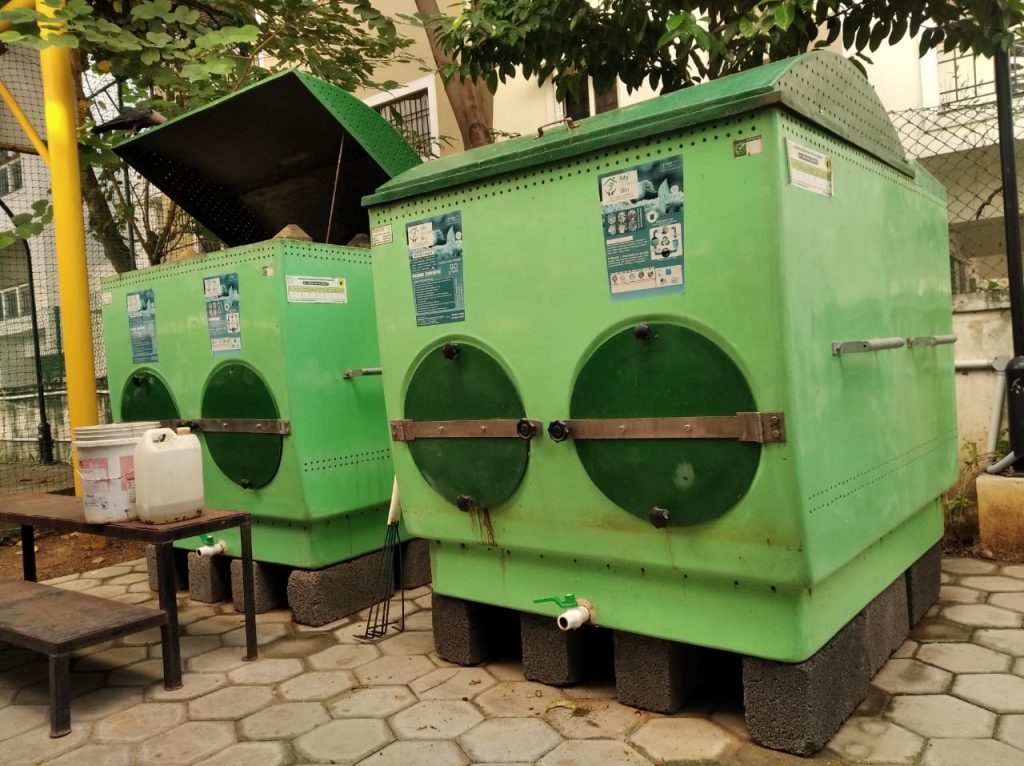
Central Park South Society produces about 80-100 kg of organic waste every day, making it a bulk generator required to handle wet waste management and disposal onsite. After the awareness generation campaign was done, the team began the research and groundwork in order to begin composting. They eventually zeroed in on My Green Bin composters, investing in two composting units of 2,000 litres capacity each. The composting process was started in earnest.
Trench composting (burying waste directly into trenches in the garden) was initiated as well. The team used one part of the organic waste in trench composting, wherein a pit about 4X4 with a depth of 2-3 ft was dug, and every day about 20 kgs of organic waste was dumped into it. This was then covered with dry leaves and mud. This process is continued till the pit is full and closed.
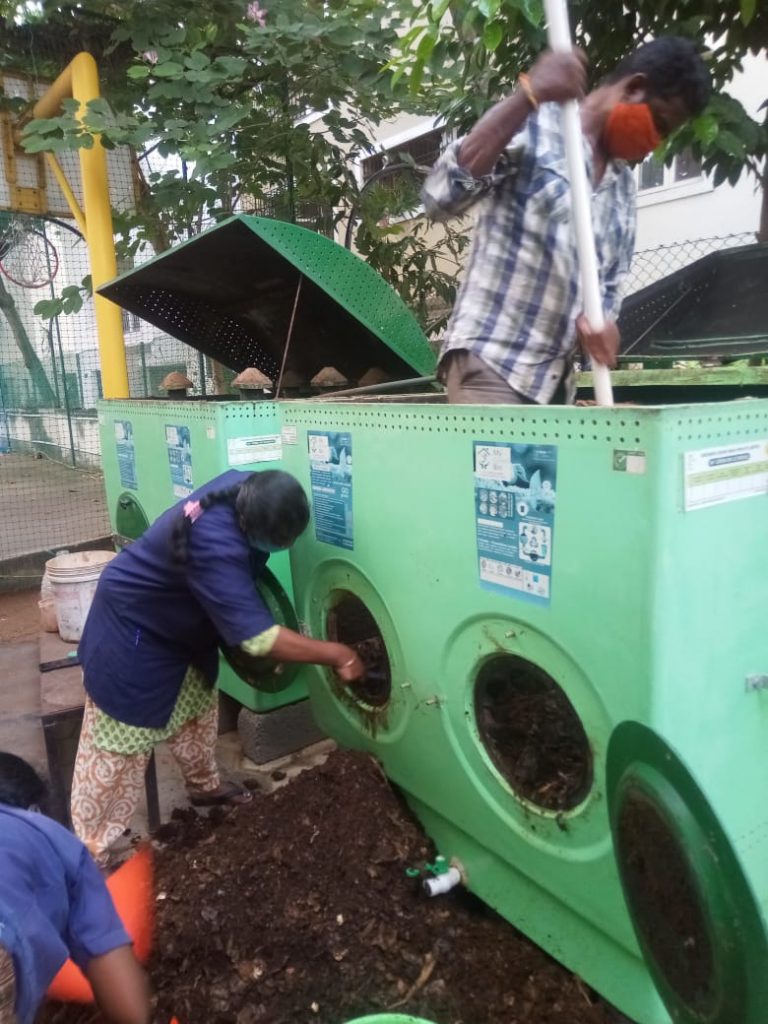
The team of volunteers worked closely with the housekeeping staff to ensure the smooth functioning of the composting system. Reports were sent daily via a WhatsApp group between the block representatives and the housekeeping staff. The team members continued to educate newcomers since it was imperative to keep the positive momentum going without missing any links in the chain. The society also monitored the different aspects of the whole process to see if any corrective measures were required. The wet, recyclable, and other waste was regularly weighed and recorded.
Tasting success
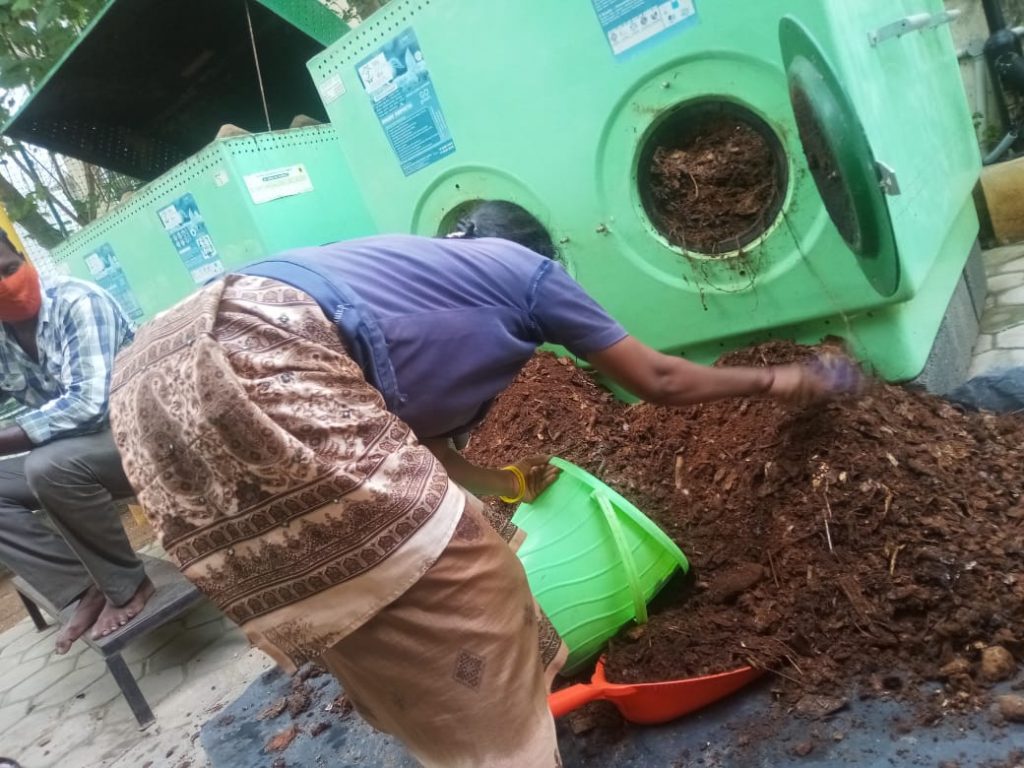
At first, there were challenges such as bad odour, but after tweaking the composting procedure and identifying loopholes in the system, the process took off smoothly.
Today, Central Park South Society produces about 300-400 kgs of compost per month. The society provides the compost to the residents for free. The compost is also used for vegetable gardening and for building a green belt of plants around the buildings. Dry waste is recycled. The society gets Rs 2000-3000 per month from the sale of its recyclables. The proceeds are distributed among the housekeeping staff as an incentive.
Sumitha says, “Our efforts are bearing fruit. Residents who were hesitant earlier are now active participants in this initiative. Most importantly, it’s overwhelming to see our kids learning the right practices of waste management at a young age. The real icing on the cake is when we received the Green Award from the Chief Minister of Tamil Nadu last year. This award was instituted by the Tamil Nadu Pollution Control Board for RWAs doing exemplary work in the field of solid waste management, among other things.
The society, led by Sumitha and team, plans to sustain its efforts and expand them further. They are already minimising the amount of hazardous waste generation and sharing their waste management practices with other apartment complexes that are willing to start their own journeys towards green living.
Lessons for other societies
“Composting is not an exact science. Sometimes we need to learn by trial and error to get the process running smoothly. Communities looking to do in-house composting should not give up when there are small hiccups. Always try to find practical solutions and keep it going,” says Sumitha.
She recounts the initial hurdles in convincing fellow residents to segregate waste into 3 categories. “Those who were used to using plastic liners had to now spend some time and effort to put the waste in the correct bins or bags. They had to clean their bins every day as no liners were allowed. Sanitary and medical waste had to be wrapped in newspapers before disposal, while all recyclables had to be cleaned and dried before placing them in the disposal bag. All this requires patience and perseverance, especially since it is a long-term behaviour change. But the residents showed true dedication to the cause from inception to execution.
Central Park South Society has successfully created a waste management system that not only works efficiently but also serves as a fine example of the spirit of a community that never gave up on the collective vision of clean and green India.
When dealing with buying or selling property, the possession certificate of that property is extremely important. It is essential that the seller of the property hands over the possession certificate to the buyer of the property, which will state the date of possession. In rural areas, the possession certificate is usually issued by the Tahsildar. In urban areas, the possession certificate is issued by the RDO (Revenue Divisional Officer).
The possession certificate has many uses besides confirming the ownership of the property and the date of possession. It is used as proof when securing a home loan from a bank. It is also important when entering the property in the land revenue records.
Without the proper issuance of a possession certificate, it becomes unclear whether the possession of a property has in fact been transferred from one party to another. This can lead to complicated legal issues regarding possession and ownership.
If you are planning to buy property, it’s essential you know how to obtain a possession certificate, what it contains and all the documents required to obtain it to ensure your purchase is hassle-free.
What is a possession certificate?
A possession certificate is a legal document that hands over the possession of land from the owner to the buyer. Once the land has been bought by the buyer for a sum of money, the possession certificate is given to the buyer by the previous owner to signal the transfer of the property.
The possession certificate is extremely important when it comes to buying a home or property as it proves that the property has been sold legally to the buyer and that they (the buyer) own all the rights to the concerned property.
When it comes to buying property from a builder or developer, the possession certificate is usually issued within 30 days. It is important that a resident obtains it as, without a possession certificate and registration documents, the buyer cannot prove to have rights to the property and the builder still owns it by law. This is problematic as the builder can then vacate the buyer (resident) lawfully.
The possession certificate will be issued only if the building has been constructed according to the proposed plans and adheres to the design rules and fire safety rules. It will also need to have a certificate of completion. The laws regarding this may vary from one state to another so it is best to check with your local authorities about how to go about getting the possession certificate in your area.
What are the contents in a possession certificate?
The possession certificate indicates the change in ownership – it is issued by the buyer. The ownership certificate will show that the property ownership has been given to the buyer. This ensures that the buyer has full interest in the property. Both parties have to register for the property. So, the developer has to sign the declaration that the property is no longer his and the buyer signs to take over the property. The possession certificate also includes the additional features of the property (parking area, garage, etc) that have been mentioned in the sales agreement.
What is a conditional possession certificate?
A conditional possession certificate or a conditional possession letter is a document that is used when the buyer of a property is not completely satisfied with the conditions of the property.
For example, reasons for dissatisfaction could include things such as repairs needed, low-quality construction, the wrong materials used or even a delay in the occupancy certificate. When the buyers are not happy with certain aspects of the property, they can send their concerns to the seller or builder along with the possession letter so that the seller or builder makes the needed changes that we agreed upon.
If the project happens to be delayed, the buyer can also ask for compensation from the builder for the losses incurred due to the delay.
Documents required
If you need to get the possession certificate of a property, you need the following documents:
- Sale deed agreement copy
- Identification proof of the applicant
- Signature proof of the applicant
- Encumbrance certificate
- Registered sale agreement copy
What are the rights of the holder of the possession certificate?
The person who has the possession certificate has certain rights with regard to the property. These are listed below.
- It gives the purchaser complete authority on the property. They can decide to do as they wish with the property.
- They have the right to sell the property.
- The purchaser can do enhancements to raise the value of the property.
- They have the right to rent out the property and take the rent money.
- The seller of the property has no rights and cannot claim any benefits regarding the property.
- The buyer has rights to the details of the property plans by the regulatory authorities in charge, as well as the schedule, the structure plan and other documents that may be relevant.
Differences between possession certificate, occupancy certificate & completion certificate
1. When are each of these certificates issued?
Possession certificate: After the initial paperwork has been submitted and a down payment has been made.
Occupancy certificate: The builder applies for this document (the occupancy certificate) after obtaining the completion certificate.
Completion certificate: The completion certificate is issued when the property has been constructed and is by the state’s regulations and norms.
2. Which authority issues each certificate?
Possession certificate: The possession certificate is issued by the RDO (Revenue Divisional Officer) in urban areas. In rural areas, it is issued by the Tehsildars.
Occupancy certificate: The municipal body of the area where the property is in will issue the occupancy certificate.
Completion certificate: The authority that is in charge of declaring that the construction process of the property has ended will issue the completion certificate of that property.
3. What are the key contents of each certificate?
Possession certificate: It includes all the timelines that the new owner has to adhere to regarding making the final payments of the property.
Occupancy certificate: It states that the property follows all the necessary building codes and is ready to be occupied.
Completion certificate: It will state that the project has been finished according to the building plans that were submitted. It also states that the property adheres to the state norms and lists the clearances that the property has.
4. What does each of these certificates signify?
Possession certificate: It shows that the property rights have been transferred from one party to the other party.
Occupancy certificate: It signifies that the property can be occupied by the buyer.
Completion certificate: Completion certificate implies that the property is constructed fully according to the building plans that were proposed and agreed upon.
Checking the status of the possession certificate online
It is easy to track the status of the possession certificate of your property online through these ways:
1. E-district portal
Go to the E-District portal from the state you are from. Click on “Transaction History” and enter the application number. You can then see the status of your possession certificate.
2. Meeseva portal
You can see the status of the possession certificate of your property on the Meeseva portal. Log in to your Meeseva account. Click on the option to track your application status – this will be on the homepage. Fill in the application number and click “Track Application Status” to see the status of your application.
If your society’s basement turns into a swimming pool every monsoon, you’re not alone. Urban flooding is no longer an occasional inconvenience, it’s a recurring problem across major Indian cities. According to the National Disaster Management Authority (NDMA), while natural causes like extreme rainfall and storms play a role, most urban floods are driven by human factors such as poor drainage systems, encroachments, and lack of maintenance.
For societies, the basement is often the first space to flood. Water creeps in, damages vehicles, affects electrical systems, and weakens the structural integrity of buildings. So while the city works on large-scale flood prevention, here’s what you can do as a resident or RWA member to protect your basement from flooding.
1. Installing and maintaining a sump pump
A sump pump is your most reliable ally when it comes to basement flooding. It works by collecting water in a pit (or sump) and pumping it out through a pipe to a storm drain or soak pit. In India, especially in flood-prone zones like Mumbai, Chennai, or Gurugram, sump pumps are common in newer buildings.
Choose an automatic sump pump with a battery backup, so it keeps running even during power cuts. Regular maintenance is a must—clean the pit, remove debris, and ensure the valve and float switch aren’t jammed. You can also add a water level sensor or alarm to alert security in case water starts accumulating.
2. Choosing the right waterproofing method
If your society hasn’t waterproofed its basement, it’s time to act. One of the most widely used techniques is box-type waterproofing. This involves laying limestone slabs (often Shahabad stone), grouting, and sealing joints with integral plasticizers. It typically costs ₹25 to ₹40 per square foot and takes 7 to 15 days for proper curing.
Other options include crystalline waterproofing, which grows water-resistant crystals within the concrete, and liquid membrane waterproofing, which is applied with a brush or roller. Some societies also waterproof exterior walls to stop moisture before it enters the structure.
3. Adding a backwater valve to prevent sewage backup
One of the most dangerous forms of basement flooding happens when rainwater overwhelms city drains and causes sewage to flow backward into homes. To prevent this, a backwater valve can be installed on the basement drainage line. It automatically closes when water tries to flow the wrong way, keeping your basement free from contaminated water.
This is especially useful for older societies where the sewer system isn’t separated from stormwater lines.
4. Keeping your drainage system clean and functional
Flooding often starts with something as simple as a blocked drain. Make it a routine to clean roof gutters, stormwater outlets, and basement floor drains at least twice a year—ideally before and after the monsoon. Ensure downspouts and drainpipes are not clogged with dry leaves or waste.
Also, check where your basement drains lead. Some are connected to the sewer system, while others might link to a sump pit. Either way, regular maintenance is the best preventive step.
5. Redirecting rainwater through harvesting and landscaping
Rainwater harvesting not just recharges groundwater but also helps prevent flooding. By redirecting rooftop runoff to soak pits or recharge wells, you reduce water pressure around the building foundation.
In your society premises, you can also design swales or rain gardens. These shallow, landscaped depressions help absorb rainwater and reduce surface runoff. You can connect the roof or terrace downspouts directly to them, or extend the piping away from the basement to these collection zones.
6. Creating gentle slopes and adding flood barriers
Many societies retrofit their parking areas and basement entries with flood prevention features. This can include small ramps or flood humps that create a barrier at the entry point. These can deflect rainwater or reduce the volume that enters.
Additionally, check that the surrounding landscape gently slopes away from the building so water naturally drains outward.
7. Taking preventive steps to protect your car
Cars parked in flooded basements often suffer long-term damage. One basic way to reduce this is by disconnecting the battery and elevating the car on a jack if water starts seeping in. Cover the vehicle with a tarpaulin sheet to prevent water from reaching the engine and interiors.
If your society regularly faces this issue, consider adding parking platforms or raised concrete pads. Some societies have also installed wheel ramps with a central flood hump to protect multiple vehicles.
8. Inspecting and repairing weak spots before the rains
Don’t wait for water to enter your basement to look for cracks and leaks. Before the monsoon, get a structural inspection done. Look out for cracks, mold, damp spots, peeling paint, rusted steel, and signs of water seepage on walls and floors.
It’s best to have a professional conduct this inspection so you don’t miss weak points like the rooftop, building corners, or pipe junctions. Catching and repairing these early reduces the chance of structural damage later.
9. Understanding your insurance coverage
Most homeowners and RWAs in India are not aware that standard property insurance often doesn’t cover flood damage unless specifically added. Make sure your personal home insurance includes flood or water damage clauses.
RWAs can also purchase society-level building insurance that includes basement areas, electrical panels, and common amenities. This can make a big difference in post-flood recovery costs.
10.Knowing when to call the professionals
If your basement does get flooded, especially with water mixed with sewage, don’t attempt to clean it yourself. Such water may contain pathogens, bacteria, and chemical residue. Instead, alert your municipal water department or call a licensed flood restoration contractor.
Also, ensure that the electricity to the flooded area is switched off before anyone enters.
Your quick checklist to stay flood-ready
-
Install and test sump pumps with battery backup
-
Clean drains, spouts, and floor traps before every monsoon
-
Waterproof basement floors and walls
-
Add a backwater valve to prevent sewage backup
-
Build gentle slopes and flood humps at basement entry points
-
Create rain gardens or recharge pits for excess rainwater
-
Check and repair structural damage early
-
Raise parked vehicles or install flood barriers
-
Confirm insurance covers flood-related damage
-
Avoid entering flooded areas and always call professionals
Elevator accidents don’t discriminate; rich or working class, they can happen anywhere. In January 2020, the managing director of PATH India, an industrialist, died in a negligently maintained elevator that crashed from a height of 70 feet. In February this year, a lift technician was killed while repairing a residential elevator in Mumbai. Last year, a young man died in Gurugram due to faulty elevator equipment.
Although elevator deaths are rare, they are entirely possible without proper vigilance and foresight. It is disturbing to think how an absolutely useful tool for transportation can claim lives unexpectedly when not maintained and used with proper care. While mishaps cannot always be avoided, we can at least exercise appropriate caution when using elevators for our safety and that of our neighbors and loved ones.
elevator safety tips for residential use
- Always adhere to the overload warning; overloading the lift can cause serious malfunctions.
- Never press the stop button unless instructed by maintenance personnel.
- Do not try to stop the door from closing by inserting your hand or any object; use the buttons provided instead.
- Avoid allowing water to enter the lift while cleaning the shaft, interiors, or adjacent lobby, as it may cause short circuits and damage electrical components.
- If trapped inside, do not panic. Press the emergency call button or use the emergency phone inside the panel.
- Do not pry open the door to exit; this can be extremely dangerous. Also, avoid trying to escape through the safety hatch on top, as it is meant only for trained engineers.
- A trained building manager or watchman should assist trapped persons or immediately call professional help. Untrained volunteers should avoid risking their own safety.
- Report any jerky movements, unusual noises, or other suspicious elevator behavior to the maintenance team immediately.
- Do not allow children to play inside or around the elevator.
- Avoid using elevators during power outages (even if emergency power is available) or during fire or other emergencies.
Elevator maintenance guidelines
Safety measures aside, regular maintenance is critical to keep apartment elevators accident-free. The main reasons for lift breakdowns are improper use, intentional vandalism, poor servicing, and lack of budget for repairs and maintenance.
Elevator maintenance contracts generally come in three types: full service, partial service, and oil and greasing contracts. It is essential to ensure your maintenance contract covers repairs, preventive maintenance, breakdown assistance, and part replacements by a registered, experienced, and credentialed company with highly trained professionals.
The managing committee should provide the maintenance agency’s action checklist along with the AMC documents to the building manager, who must ensure every item on the checklist is serviced. Maintenance varies by contract but typically includes:
- Monthly to quarterly tasks: Inspect doors, alarms, buttons, pump units, relief valves, starter contacts, car guide shoes, emergency phone, switches, grease governors and pulleys, clean ropes, oil brakes, check and adjust traction ropes, door motor brushes, dust panels, indicator lamps, and voltage of rectifiers.
- Biannual to annual tasks: Includes all above plus inspection and replacement of safety circuits and gears, oil buffers, cleaning and greasing sheaves and counterweights, checking wear on guide shoes, cleaning wire connection boxes, inspecting cables for fraying, cleaning and painting the hoistway, elevator pits, machine rooms, and checking firefighter operation modes (Phase I and Phase II).
Partial maintenance contracts exclude repairs and breakdown assistance, which are billed separately. Oil and greasing contracts only cover lubrication.
After each visit, a detailed report should be provided, documenting serviced and repaired components. A contract with comprehensive preventive maintenance is ideal for long-term safety and cost savings. The managing committee should budget for elevator AMC during annual financial planning and seek General Body consensus as it is an essential safety expense, not optional.
Emergency power systems and electrical safety
Many modern elevators come equipped with emergency power systems or uninterruptible power supplies (UPS) that allow limited elevator operation during power outages. While this enhances safety, it is still advisable not to use elevators during blackouts unless necessary.
Regular electrical safety audits should be conducted alongside mechanical inspections. Faulty wiring or electrical components can cause malfunctions or fires and must be promptly addressed.
Firefighter operation mode
Elevators in residential buildings are often equipped with firefighter operation modes, known as Phase I and Phase II operations, designed to facilitate safe evacuation and emergency response during fires. These modes allow firefighters to take control of the elevator, override normal functions, and prevent use by residents during emergencies.
The maintenance team should ensure these functions are tested regularly as part of biannual or annual inspections, complying with local fire safety regulations.
Training for building staff
It is crucial to provide periodic training for building managers, watchmen, and other staff members on elevator safety and emergency protocols. Trained personnel can assist trapped residents safely, coordinate with maintenance teams, and respond effectively during emergencies.
This training reduces panic and improves overall safety in elevator-related incidents.
Legal and regulatory compliance
Various state lift acts, such as the Bombay Lift Act and Delhi Lift Rule,s mandate that government-appointed Inspectors of Lifts visit buildings once or twice a year to verify that elevator operations comply with the Bureau of Indian Standards guidelines.
These inspections check maintenance records, safety systems, and ensure compliance with safety standards. The managing committee must cooperate with these inspections and keep records updated.
Selecting the right elevators for your residential building
The typical lifespan of an elevator is around 15 years, but with full maintenance and depending on the quality, it can last 10 years longer. Builders are required to install elevators according to the National Building Code of India and state Development Control Regulations, in cooperation with electricity boards.
Factors determining elevator type include building height, load capacity, energy efficiency, speed, number of stops, and shaft size. It is advisable to select reputable manufacturers with strong brand reputations to ensure safety and durability.
Modern residential elevators typically carry around 680 kg (6-8 people) and aim to provide eco-friendly, smooth transportation of residents and goods.