

Analysis
Every housing society or apartment community in Chennai operates within a legal framework set by the Tamil Nadu government. At the heart of this framework lies the Tamil Nadu Cooperative Societies Act, 1983, and its accompanying Rules of 1988. Whether you are forming a new Resident Welfare Association (RWA) or managing an existing one, understanding this Act is essential to ensure compliance, transparency, and smooth governance.
What is the Tamil Nadu Cooperative Societies Act?
The Tamil Nadu Cooperative Societies Act, 1983, is the law that regulates the formation, management, and dissolution of all cooperative societies in Tamil Nadu, including housing societies. It defines:
- How a society is registered
- The powers and duties of the managing committee
- Member rights and liabilities
- Election procedures for office bearers
- Audit and compliance requirements
- Penalties for non-compliance
For RWAs, this Act provides the foundation for how to run day-to-day affairs, conduct elections, handle finances, and maintain order within the community.
Why is it important for RWAs in Chennai?
In cities like Chennai, RWAs often act as the backbone of community living. They manage maintenance funds, security, and amenities, and coordinate with government departments like Greater Chennai Corporation (GCC) and CMWSSB (Chennai Metro Water Supply and Sewerage Board).
Following the Cooperative Societies Act ensures:
- Legal recognition of your society.
- Protection against disputes with members or builders.
- Eligibility to access government schemes and financial benefits.
- Transparent operations that foster trust among residents.
How to register a Housing Society in Chennai
Registration of a cooperative housing society (or RWA) in Chennai is done with the Registrar of Cooperative Societies. Here’s the process:
- Application submission:
Fill Form I (application for registration) with details like society name, address, objectives, and list of founding members. - Prepare bylaws:
Draft the society’s by-laws, covering membership criteria, maintenance rules, elections, and penalties. - Submit required documents:
- Copy of bylaws (signed by all members).
- Address proof of the society.
- Identity proof of office bearers and members.
- Proof of ownership of the land/building (from builder or developer).
- Pay registration fees:
Registration fees typically include a nominal society registration fee (around ₹5,000 – ₹6,000) and document charges. - Approval and certificate:
Once approved, the society receives a Certificate of Registration along with the registered by-laws.
Management committee & elections
The Act defines how an RWA’s managing committee must function.
Key rules:
- A committee usually consists of President, Vice-President, Secretary, Treasurer, and 5–9 executive members.
- Elections are to be held every 3–5 years, depending on the by-laws.
- The Tamil Nadu Cooperative Election Commission supervises elections in case of disputes or irregularities.
- A quorum (minimum number of members) is required to validate election meetings.
Always issue written election notices and maintain proper minutes of meetings. These are legally required.
Audit and financial compliance
Under the Act, every housing society must conduct an annual audit.
Key financial compliance steps include:
- Preparing an income and expenditure statement for the financial year.
- Passing the audited accounts during the Annual General Meeting (AGM).
- Submitting audit reports to the Registrar’s office.
Failure to conduct audits or submit reports can lead to penalties or government intervention.
Member rights & responsibilities
The Act empowers society members with specific rights:
- The right to vote during elections.
- The right to inspect records and accounts.
- The right to challenge unfair decisions of the managing committee.
It also defines member responsibilities, like paying maintenance charges on time and following society rules.
In extreme cases, the Act allows the expulsion of a member if:
- They repeatedly violate rules.
- Engage in activities harmful to society.
- Fail to pay dues despite repeated notices.
However, such actions require a two-thirds majority vote in the general body and proper documentation.
Special officers & dissolution
If an RWA fails to conduct elections or maintain proper accounts, the Act allows the appointment of a Special Officer by the Registrar. This officer temporarily takes over management until the issues are resolved.
In extreme cases, if a society becomes non-functional or violates laws, it can be dissolved under Section 89 of the Act.
Penalties for non-compliance
Non-compliance with the Act or its rules can attract:
- Fines under Section 150.
- Suspension of the managing committee.
- Denial of legal benefits or grants.
For example, failure to file annual audit reports can result in penalties and possible takeover by the Registrar.
To dive deeper into the Act and rules, here are the official downloadable PDFs
Renting out your home is a common way to earn a steady second income. But if you’re a flat owner in a cooperative housing society, there’s one charge you shouldn’t overlook non-occupancy charges.
This is a fee that applies when your flat is not occupied by you or your immediate family, and instead is rented out to tenants. While it’s not a very large charge, it’s important to understand when it’s applicable, how it’s calculated, and what to do if you’re being overcharged.
What are non-occupancy charges?
Non-occupancy charges are levied by housing societies when a flat owner rents out their property to a person who is not a close family member. This fee is collected in addition to your usual monthly maintenance charges.
The purpose of this charge is to ensure that members who are earning rental income from their property also contribute a little extra to the upkeep of common services used by the tenant, such as security, lifts, water, and other shared facilities.
When are non-occupancy charges applicable?
These charges are applicable only if your flat is rented out to someone who is not your immediate family.
You will not be charged non-occupancy fees if:
- You, the owner, are living in the flat.
- The flat is occupied by close family members, such as your parents, spouse, children, siblings, in-laws, or grandchildren.
- The flat is locked, vacant, or unoccupied.
The charge becomes applicable when the flat is used to earn a commercial benefit (i.e., rent) by giving it to non-family members.
In such cases, the society usually requires you to:
- Complete police verification of the tenant (mandatory in many cities).
- Inform them in writing about the tenancy.
- Submit a copy of the lease or leave-and-license agreement.
- Fill out any society-required tenant forms.
How is the non-occupancy charge calculated?
Earlier, societies used to charge a flat amount as a one-time non-occupancy fee. This led to disputes and overcharging in many cases. To address this, the Maharashtra government issued a circular under Section 79A of the Maharashtra Cooperative Societies Act, which clearly states that:
Non-occupancy charges cannot exceed 10% of the service charges paid by the member.
This rule has since been upheld by the Supreme Court and is now followed by most cooperative housing societies, especially in Maharashtra and major metro cities.
Let’s break this down with an example:
- Suppose your total maintenance bill is ₹3,000 per month.
- Out of this, ₹2,000 is considered “service charges” (expenses such as security staff, society staff salaries, electricity for common areas, housekeeping, etc.).
- You will be charged 10% of ₹2,000 = ₹200 as non-occupancy fees.
Important: Service charges do not include sinking fund, repair fund, property tax, or water charges.
What if you are overcharged?
This is unfortunately not uncommon. In many housing societies, members have raised complaints that the management committee has either:
- Charged non-occupancy fees even when the flat is used by a relative
- Charged more than 10% of service charges
- Not provided clarity on the breakup of the charges
In such cases, here’s what you can do:
- Write to the managing committee and request an explanation with supporting calculations.
- If you don’t receive a proper response, escalate the issue to the Registrar of Cooperative Societies in your area.
- You can also approach a Consumer Forum for redressal if the charges are unfair or violate the law.
It’s illegal for societies to charge more than what is permitted under the rules. And it is equally illegal to collect non-occupancy charges when the flat is used by a family member.
Is GST applicable on non-occupancy charges?
Yes. As per recent GST clarifications, if the total maintenance charges (including non-occupancy) exceed ₹7,500 per month per member, then 18% GST is applicable.
However, this GST is not paid by the owner to the government directly. The society is responsible for calculating and collecting the GST and remitting it to the government. Make sure your maintenance bill reflects this clearly, especially if you cross the ₹7,500 threshold.
Do tenants have to pay the charge?
By default, non-occupancy charges are the responsibility of the flat owner, not the tenant.
However, if you want your tenant to cover this cost, you can mention it clearly in the rental agreement. That way, you can legally recover it from them along with rent and other maintenance charges. But societies will only deal with the owner for collecting this charge.
Is this rule the same across India?
The 10% rule originates from the Maharashtra government circular and is strictly enforced in cities like Mumbai, Pune, and Nagpur.
In other states like Karnataka, Telangana, Delhi, and Tamil Nadu, most societies either follow similar rules by internal agreement or choose not to charge non-occupancy fees at all. But unless there is a clear by-law stating otherwise, housing societies cannot arbitrarily fix this charge.
In Bangalore, for example, many RWAs do not charge non-occupancy fees unless it has been included in the society’s registered bye-laws.
Why should committee members understand this?
If you’re part of your RWA’s managing committee, you’re expected to:
- Inform members about non-occupancy charges when they rent out their flat
- Collect it as part of the maintenance bill
- Explain how the amount is calculated
- Ensure the society stays within the legal limits
Many disputes between owners and societies arise due to lack of communication or incorrect billing. Being transparent and following the law helps keep things smooth for everyone.
What if the owner refuses to pay?
If a flat owner does not pay the non-occupancy fee when it is due, the society can:
- Issue a payment reminder notice
- Declare the member as a defaulter for society billing purposes
- Withhold the No Dues Certificate required for property sales or rentals
However, societies must still act within the legal limit and cannot use coercive tactics or harassment.
Non-occupancy charges are legal and necessary but they must be applied fairly, transparently, and within the limits defined by law.
If you’re a homeowner renting out your flat:
- Check your society’s by-laws
- Inform the committee and submit documents
- Verify your monthly bill for correctness
- Know your rights if you’re being charged unfairly
If you’re on the committee:
- Know the rules
- Educate members
- Stay accountable
Understanding non-occupancy charges helps everyone avoid unnecessary conflict and ensures smoother community living.
Managing modern residential societies is no longer a job for volunteers alone, it’s complex, demanding, and requires professionals. Society managers are paid experts who handle the daily operations of housing societies, from paperwork and maintenance to finances, resident issues, and legal compliance.
Without a society manager, gated communities often face chaos like delayed maintenance, financial confusion, and overworked committee members. A good manager brings structure, ensures legal compliance, supervises staff, manages vendors, and keeps residents informed.
Introduction
We’ve been working in housing society management for years now, and let me tell you – things have changed a lot. Back in the day, a few volunteers could handle most society work. Not anymore. These residential complexes have gotten huge and complicated. Residents want everything done perfectly and fast. That’s why almost every decent-sized society needs a proper manager these days.
Who is a society manager?
Think of them as the person who runs your building day-to-day.
They’re not volunteers like your RWA committee folks – they’re paid professionals who’ve learned how to handle all this stuff.
Some societies hire their own dedicated manager. Others use companies that send managers to handle multiple buildings.
Why a society manager is crucial
Here’s what happens without proper management – we’ve seen it plenty of times. Complaints pile up. Maintenance takes forever. Vendors show up whenever they feel like it. Nobody knows what’s going on with the money. Your volunteer committee members get burned out trying to handle everything.
A good manager fixes all this. They know the housing laws, deal with municipal authorities, and let your committee focus on making decisions instead of chasing contractors around.
Key responsibilities of a society manager
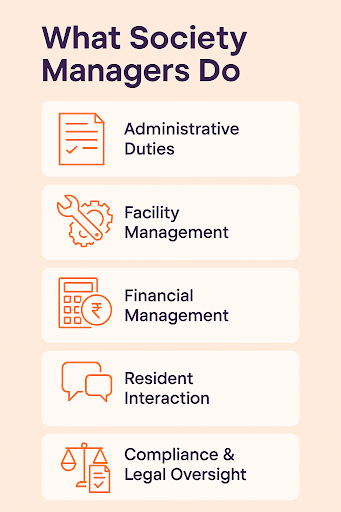
1. Daily operations & administration
Every meeting needs minutes. Every vendor needs a contract. Officials want notices. Someone has to track all this stuff and file it properly. During audits or legal issues, you’ll thank God someone kept proper records.
2. Facility maintenance
Cleaning staff need supervision. Gardens need maintenance. Something’s always breaking and needs fixing. Annual maintenance contracts need monitoring. When your elevator stops working or the generator fails, residents call the manager – not you.
3. Financial management
Budgets need planning. Maintenance fees need collecting. People who don’t pay need reminding (politely but firmly). Vendors need paying on time. Accountants need help during tax season. Without proper financial management, societies go broke fast.
4. Resident interaction
Residents complain about everything – noise, parking, maintenance, neighbors. New people move in and need orientation. Others move out and want deposits returned. Everyone wants updates on what’s happening. Managing all these personalities and expectations is honestly the hardest part.
5. Compliance & legal oversight
Fire safety inspections can’t be ignored. Structural audits are mandatory. Sewage treatment needs checking. Society registration must stay current. Labor laws apply to your staff. One missed compliance and you’re in serious trouble.
Tools and software society managers use

Most managers use apps now for communicating with residents. Visitor management systems track who comes and goes. Service requests get logged digitally instead of random phone calls.
Accounting software keeps financial records straight and generates reports automatically. Digital notice boards replace those paper notices that always fell down. Complaint tracking systems ensure nothing gets forgotten.
Put it all together and you get proper management systems instead of chaos.
Common challenges faced
- Residents expect different things. Some want immediate fixes, others complain about costs. During monsoons or festivals, everyone gets extra demanding.
- Collecting overdue payments without creating enemies requires serious diplomatic skills.
- Committee members often interfere or have unrealistic expectations.
- Vendors sometimes don’t show up or do shoddy work.
- Emergency situations – floods, power failures, medical emergencies happen at the worst possible times and need immediate handling.
Skills required to be an effective society manager
- Communication skills matter more than anything else. You’re constantly talking to residents, vendors, committee members, and officials. Poor communicators fail quickly in this job.
- Problem-solving under pressure separates good managers from mediocre ones. When three things break simultaneously during a festival weekend, panic doesn’t help – creative solutions do.
- Technology skills are becoming essential. You can’t avoid computers, smartphones, and management software anymore. Basic knowledge of housing laws and regulations prevents expensive mistakes.
Qualifications and hiring tips for RWAs
Most societies want college graduates, preferably with relevant diplomas in property management or business administration. Professional certifications help but aren’t always necessary.
Background verification is crucial – they’ll handle money and have building access. During interviews, give them real scenarios. How would they handle a major water leak? What if residents refuse to pay maintenance? How do they deal with difficult people?
Decide whether you want your own dedicated manager or prefer outsourcing to a management company. Your own manager gives personal attention but costs more. Management companies provide backup support and standard procedures.
FAQs
Is hiring a manager legally required?
No, but practically necessary for anything over 50-100 units. Volunteer committees simply can’t handle the workload effectively beyond that size.
Salaries range from ₹25,000 to ₹60,000 monthly, depending on location, society size, and experience. Mumbai and Delhi pay more than smaller cities.
Can residents become managers?
Yes, but they must quit any committee positions first. Otherwise, conflicts of interest become inevitable.
How do facility managers differ?
Facility managers focus mainly on building maintenance and infrastructure. Society managers handle broader responsibilities including finances, resident relations, and administration.
What if the manager doesn’t perform?
Submit written complaints to your managing committee. If problems persist, contact your state’s society registrar or housing authority.
Conclusion
Good society management makes everyone’s life easier. Residents get better service, committee members avoid daily headaches, and property values stay stable. The investment usually pays for itself through smoother operations and fewer conflicts.
Most importantly, professional management prevents small problems from becoming major crises. Prevention costs less than fixing disasters later.
A recent Bombay High Court ruling has brought attention to the challenges of forming cooperative housing societies across India, particularly spotlighting Maharashtra’s requirement that 51% of flat purchasers must consent for registration. While this ruling directly affects Maharashtra, it reflects broader variations in how states across India regulate society formation.
Housing societies play a critical role in India’s urban landscape, providing a legal structure for residential self-governance and property management. However, each state operates under its Cooperative Societies Act. Maharashtra follows the Maharashtra Co-operative Societies Act, Delhi adheres to the Delhi Cooperative Societies Act, and Karnataka has its own version. Despite these legal differences, the objective remains the same, enabling residents to collectively manage their community and its affairs.
Registration thresholds vary widely across states. Maharashtra mandates that over half of the flat owners must sign off before a society is registered. In contrast, states like Haryana and Uttar Pradesh require as few as seven members, while others follow majority-based thresholds similar to Maharashtra.
The registration process typically requires an application detailing the members, proposed bylaws, and supporting documents. Once submitted, the registrar assesses whether all statutory conditions are met before granting legal status. Upon registration, societies gain formal rights to collect maintenance, sign contracts, and manage the premises according to the approved bylaws.
For homebuyers, confirming the registration status of a society has become a key factor during property purchases. Unregistered societies limit the community’s ability to enforce rules, address disputes, or carry out essential maintenance. Many buyers now inquire specifically about occupancy levels and society registration before finalizing deals.
Threshold rules, like Maharashtra’s 51%, are designed to ensure societies have sufficient participation before they gain legal standing. They serve to stabilize governance by reducing risks associated with societies formed by small or inactive groups of owners.
For developers, differing thresholds across states create operational challenges. A builder working in Maharashtra, Delhi, and Karnataka must navigate distinct legal processes, often adjusting timelines based on local regulations before transitioning management to residents.
As Indian cities continue to expand and more residents shift to gated communities and apartment complexes, understanding these thresholds and legal frameworks has become vital. The process marks a shift from builder-led operations to resident-driven governance, with active stakeholder participation crucial for smooth community management.
Across India’s metropolitan hubs, these legal prerequisites remain a fundamental step in creating transparent and effective housing societies, regardless of state-specific variations.
In recent years, a notable trend has emerged across gated communities in India, the implementation of standardised rate cards for domestic workers. These cards establish fixed prices for specific household tasks such as cleaning and cooking, aiming to create consistency in payments and prevent what some residents refer to as “bidding wars” between households competing for reliable help. This practice has gained traction, particularly in upscale residential areas across major Indian cities.
“Before implementing the rate card system, we often found domestic workers negotiating higher wages by citing better offers from other households,” explains Anita, an RWA president from a society in Gurugram. For many residents, especially senior citizens on fixed incomes, these standardized rates offer financial predictability. “On a limited pension, keeping up with rising wage demands has become difficult. The rate card gives us some stability,” shares Ramesh, a retired government employee living in a high-rise in Bengaluru.
However, the system has not been without controversy. “While maids and cooks are demanding higher pay, a proposed 20% wage increase faced strong opposition from residents. Many worry that revising the rates will lead to further demands,” admits a member of an operations committee from a large complex.
For domestic workers, the impact of rate cards extends beyond their monthly earnings. “I work in two homes, earning ₹4,000 from each. To make ends meet, I also drive a taxi at night,” says Latha, a 32-year-old single mother. Meena, a cook and cleaner with ten years of experience, echoes similar frustrations: “When I ask for a raise because everything is getting more expensive, residents point to the rate card and say their hands are tied.” Workers’ primary concerns include limited negotiating power, lack of input in setting rates, and the risk of replacement if they demand wages above the established figures.
Some communities are adopting middle-ground approaches. A growing number of residential complexes are shifting toward hourly wages instead of fixed monthly salaries. “Residents relocating from Western countries have introduced this concept, and many domestic workers prefer it since it provides clearer compensation for their time,” notes a resident from a prestigious society in Koramangala. Other communities are revising their rate cards to account for inflation and incorporate benefits like paid leave and festival bonuses. “We consulted with domestic workers’ representatives before updating our rate card,” shares an RWA secretary from Chennai. “Now, we review it annually and ensure the wages are fair and not exploitative.”
The debate surrounding domestic worker rate cards highlights broader issues of labor rights and economic fairness. While India lacks a central law governing domestic workers’ wages, some states including Maharashtra, Karnataka, and Kerala have established minimum wage regulations for domestic work. The International Labour Organization recognizes domestic work as formal employment, advocating for proper contracts, fair wages, and social security benefits.
As urban India navigates these evolving socioeconomic dynamics, striking a balance between residents’ desire for consistency and domestic workers’ right to fair compensation remains an ongoing conversation.
Recently, a notable Karnataka high court ruling directed the Bruhat Bengaluru Mahanagara Palike (BBMP) to implement stringent preventive measures against illegal building activities. The court mandated that property owners, architects, and supervisors submit affidavits at various construction stages, confirming adherence to sanctioned plans. Additionally, the BBMP is required to conduct periodic inspections every 30 days to ensure compliance.
The Karnataka HC ordered the demolition of unauthorized floors in a residential complex in Bengaluru’s Peenya area. The court instructed the Bangalore Development Authority (BDA) to dismantle the illegally constructed 14th and 15th floors of a tower in IBC Platinum City, emphasizing the necessity for strict enforcement of building regulations. This shows even if its a luxury apartment nobody has the authority to bypass laws.
The legal framework governing construction modifications varies across Indian states. The Karnataka Municipal Corporations Act, 1976, requires that any structural changes receive prior approval from municipal authorities. Similarly, the Maharashtra Real Estate (Regulation and Development) Act mandates obtaining prior written consent from relevant authorities before making alterations. The Delhi Development Authority’s Master Plan 2021 explicitly prohibits structural modifications that deviate from approved building plans, with Section 14 of the Delhi Apartment Ownership Act allowing associations to challenge violations affecting common areas or structural stability.
Despite clear regulations, enforcement remains challenging. A legal expert in property law, stated that while laws are explicit, enforcement often involves multiple authorities, leading to jurisdictional overlaps and delays. This complexity necessitates coordinated efforts between RWAs, municipal bodies, and regulatory agencies to effectively address unauthorized constructions.
Proactive measures are being adopted in various regions. In Bengaluru, the BBMP has been directed to integrate its database with the Bangalore Water Supply and Sewerage Board (BWSSB) and Bangalore Electricity Supply Company (BESCOM). This integration aims to monitor new water and electricity connections, ensuring they correspond with approved building plans and helping to identify unauthorized constructions.
As this regulatory landscape continues to evolve, the focus is shifting from reactive enforcement to preventive compliance. With courts providing clearer guidelines and municipal bodies strengthening their monitoring systems, the framework for managing unauthorized constructions is becoming more robust. The growing collaboration between RWAs, regulatory bodies, and residents suggests that the future of urban housing may lie in finding the delicate balance between individual needs and structural integrity – but who will take the lead in this transformation?