

Air conditioners are a great respite from extreme outdoor weather conditions. With emerging technology, there are many types of ACs being launched in the market for every need. But, two dominating models still remain the same – Split AC and Window AC.
If you’re planning on buying an AC, you must be well aware of the difference between both units. Split ACs are being overwhelmingly preferred by consumers due to their ease of usage and cooling capacity. Learn what a split AC is, how a split AC works, and what makes it a good choice for your home.
What is a split AC?
A split system AC has two units – indoor and outdoor. The indoor unit, having the evaporator coil, absorbs the hot air and humidity inside the room. The outdoor unit, having the condenser coil, cools the hot air and pumps it back into the indoor unit. The two units are connected to each other with insulated ducts.
How does a split system AC work
In simple terms, a split AC works by absorbing the heat and humidity from the room and releasing excess heat to the external environment. There are four main components in an AC system – Condenser Coil, Compressor, Evaporator Coil, and Expansion Valve. Let’s see how these different components are involved in the split AC working principle.
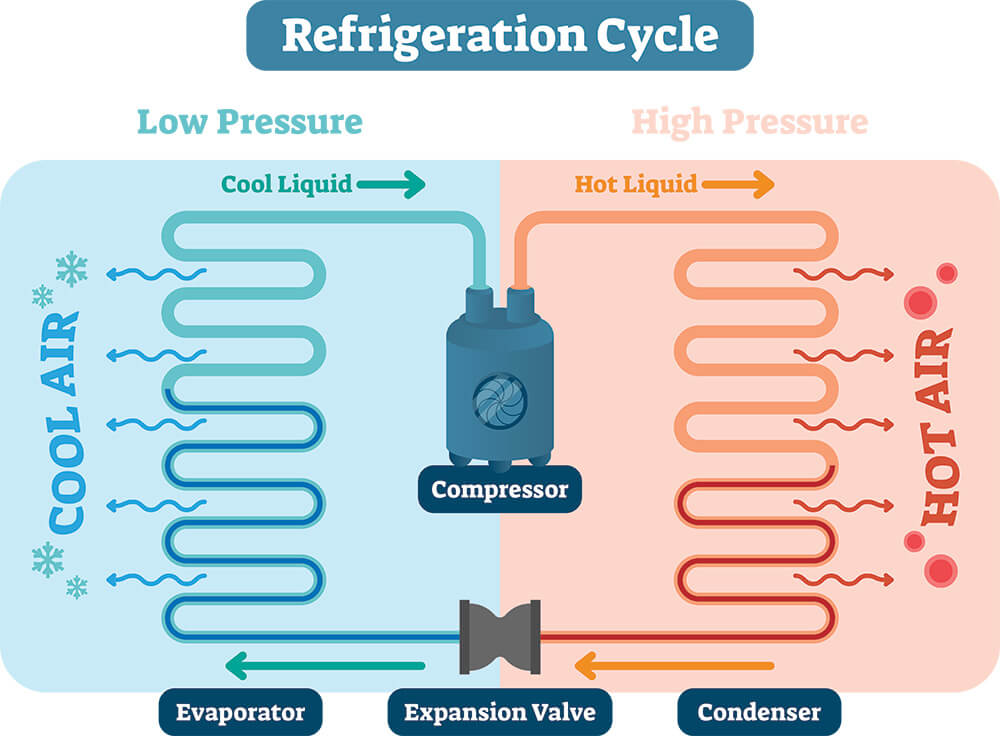
- The indoor unit absorbs heat and circulates it around the evaporator coil, which has the refrigerant. The refrigerant passes to the compressor.
- The compressor starts and creates high pressure to heat up the refrigerant. The hot liquid is then passed to the condenser coil in the outdoor unit.
- The outdoor unit circulates outside air, heats it up, and releases it back into the external environment.
- The hot refrigerant then passes through the expansion valve, which cools it up. And it is then sent back to the evaporator coil, thus completing a cycle.
- This cycle is repeated till the desired temperature in the room is maintained. The temperature is set and measured by the Thermostat. After the cooling is done, the compressor shuts down. It switches on again when the temperature rises.
Interesting note: Energy can neither be created nor be destroyed. So, every time the AC removes energy (heat) from the room, it has to release equal energy outside. That’s the basic split AC working principle.
Do split ACs heat and cool?
Split ACs are generally meant to cool the room. But there are new-age all-weather split AC systems in the market that do both heating and cooling. This is achieved by a reverse valve in the AC unit which reverses the flow of heat.
The inside unit simply extracts the cold air from the room and a reverse cycle happens. The air is heated up inside the chambers and released back into the room. These are often known as the HVAC (heating, ventilation, and air conditioning) systems.
Difference between Split AC and Window AC
There are several differences between split AC and portable/window AC systems. We have listed some key points of difference:
- Window AC generally has all its components in one metallic cabinet, unlike the split AC, which has two units. Since key components like evaporator coil and air filters are placed in indoor units, split ACs also have a longer life span.
- Split AC is more space-efficient and can be easily installed at any location. Window ACs require more ductwork and need specific locations to be installed. Installation costs of split ACs may be higher than window ACs. But the overall operating cost is much lower.
- Since the compressor is located in the outdoor unit of split AC, all the noise remains outside. This is not the case with window ACs which can be a lot noisier.
- Split ACs also have larger compressors, so greater capacity, as compared to window AC units. They can heat up larger spaces faster than window AC systems. Window ACs are only used to heat up small spaces like a room.
- Window ACs also consume more power than split AC systems, which can be run on inverters too. That’s why split ACs are much more energy-efficient than window ACs.
- Many companies are now also offering inverter ACs which can handle voltage fluctuations well, unlike window AC units.
- Due to several advantages, split ACs will cost you a lot more than window ACs. The cost can sometimes be double the average cost of window ACs in the market.
How to choose the right split AC for yourself?
Split ACs come in different sizes (also called ‘tonnage’) based on their cooling capacity. Their compressors differ in tons of air they can cool. To choose the right AC size for you, you must consider three key factors:
Room size
Floor space and the volume of the room determine the size of the AC required to properly heat the room. Higher ceilings need greater cooling capacity. Generally, 100 to 150 sq ft of the area can be easily cooled by a 1-ton AC. A higher cooling capacity is needed for more than 200 sq ft of the room area.
Insulation
Insulated walls and ceilings require less cooling capacity as they can hold the cold air for longer. But if your room isn’t insulated, you will need higher cooling compressors.
External temperature
If your house is in a location that experiences extreme weather, like Northern India, you will require a higher cooling capacity. Regions will have milder temperatures like coastal areas need lower ton split ACs.
Conclusion
Now that you have a thorough idea of what is split AC and how split AC works, you can make more informed decisions about buying and maintaining your AC. The kind of AC you choose should be dependent on various factors, apart from cost. You should also take good care of your air conditioning systems, with regular checkups and repairs.
Imagine spending a day with a faulty refrigerator not functioning correctly. Spoiled food, warm drinks, stale fruits, wilted vegetables, and other related nuisances will quickly emerge. However necessary to our daily life, refrigerators are still electronic appliances. So, it’s likely that you may encounter refrigerator repair problems sometime. Some refrigerator problems are more common than others, and you can diagnose them correctly, even fix them on your own. Others will require expert assistance from electronics repair professionals. In this article, we’ll cover the most common refrigerator repair issues and how to solve them.
1. Frost accumulation
Frost buildup is a common issue you will encounter with refrigerators. Thankfully, you do need to seek external help to solve the problem. The first accumulation happens in your refrigerator’s ice dispenser (also called the freezer).
The freezer door is called a damper door, lined with material making it airtight. It seals the freezer door, ensuring no humid air enters the freezer through gaps. If there’s any dent or dirt on the lining of the damper door, damp air will enter the freezer. With the freezer operating for a long time, this air will turn into ice, covering the entire unit.
A similar situation may also arise if the freezer door is left ajar for a long time. The best solution to this refrigerator problem is to check the lining of the damper door. Always ensure the refrigerator doors shut properly. If there’s any dust on the lining, clean it with a cotton cloth. Call a technician to fix the material if you see cracks or dents.
2. Continuous refrigeration cycle
Your refrigerator continues running cooling cycles to keep the food cool. Nonetheless, sometimes it may start running cooling cycles too frequently. This issue creates noise and consumes substantial electricity, thus, adding to your monthly bills.
This refrigerator problem is a dust or debris buildup around the condenser coil. To check if that’s where the issue lies, first plug off the refrigerator. Next, access the condenser coil unit, commonly at the bottom or back of the machine.
A grill often shields the coil unit. Carefully remove the grill by loosening it to access the coil. Use a clean cotton cloth or a low-power vacuum cleaner to clear dust and debris thoroughly. After cleaning, check if the refrigeration cycle has gone back to normal.
If the problem persists, check the temperature of your refrigerator. If set too low, it may cause frequent cycles. If none of the DIY solutions works, it’s time to call a technician.
3. Water leakage
Water leakage is a common and dangerous refrigerator repair issue in domestic places. With excess water spilt around the unit, anyone can slip and sustain injuries. There are several reasons behind a water leakage, and most of them have DIY fixes.
The most common reason is a blockage in the defrosting drain passage of the refrigerator. The defrost drain system is inside the freezer, and food particles may drop into the drain, clogging them. This blockage can lead to ice buildup, resulting in water leakage.
Try accessing the drains from the inside to unclog them by hosing hot water. Alternatively, you can also use a pipe cleaner to clear any hard particles. After cleaning the drain, wash the refrigerator hose properly before re-installing.
Another reason for water leakage is an ice-clogged water supply line. You will need to close the shut-off valve behind the refrigerator at the bottom to check for any clogs in the supply line. You can also seek external assistance from a repairman if you cannot find it.
4. Refrigerator not cooling
Your refrigerator may cool adequately at times, despite setting the right temperature. In such cases, your food and other items will go rancid quickly, and the fridge will have a more challenging time making ice. Touch its interior walls to check if your refrigerator has a cooling problem. If they are cold enough, pay attention to the motor sound. If you don’t hear the motor sound, or it is very feeble, the problem may lie with the compressor.
The compressor coils of your refrigerator may be covered with dust or debris, preventing it from cooling the unit. To clean out the coils, first, plug off the refrigerator. Use a cotton cloth or vacuum cleaner to remove the dirt.
Now, turn on your refrigerator again and wait for some time if the cooling is back to normal; congratulations! However, if the problem remains, you should quickly call a maintenance specialist to help you sort out the issue.
5. Loud noises
A refrigerator has components that produce some sound while functioning. But if you are experiencing odd noises from the fridge, it’s time for a problem-check.
There are several reasons behind the noises coming from a refrigerator. To accurately detect the cause, check from where the sound emits. It may be a loose drain pan if it’s coming from the inside. You can easily fasten it back to its place with some bolts.
In another case, a scraping sound may suggest issues with the freezer. Check if there’s excess frost accumulation in the freezer. If there’s some, the chances are that you may need to replace the freeze timer.
If the sound is coming from behind the refrigerator, the problem may be with the compressor fans. Turn off the refrigerator before accessing the fans behind the fridge. You can clean them with a cloth to remove any dust particles. If the noise persists, call a technician to get professional help.
6. Water dispenser malfunctioning
Only high-end modern refrigerators provide the feature of a built-in water dispenser. It makes cold drinking water from your refrigerator accessible. But sometimes, the water dispenser may not work correctly by restricting water flow.
A common reason for the water dispenser malfunction is a clogged water tube. Access the water tube from the refrigerator door and blow air into it. If the air doesn’t pass through, the pipe is clogged. You can remove the frost blockage by running some hot water through it.
Make sure that the freezer temperature is optimum. If the temperature is set too low, the water tube may freeze frequently. Another reason for this refrigerator problem may be a faulty water valve in the inlet pipe.
A dent in the valve may restrict the water supply. If you can’t figure out the solution, don’t try to do it your way. Call a technician who will detect the exact cause of the problem.
7. Refrigerator freezing instead of cooling
Now, this can cause quite a tricky problem. Sometimes, you may open the refrigerator and find your food wholly frozen. But the temperature settings seem just fine. Don’t worry. It’s a prevalent refrigerator repair issue.
The main reason behind excessive freezing is a faulty thermostat. It is a device that controls the compressor and evaporator coils to maintain the desired temperature in the unit. If the thermostat doesn’t work properly, the refrigerator won’t be able to maintain optimum temperatures.
To check if the thermostat is working correctly, rotate the thermostat knob to the lowest temperature. Now turn it back to the highest temperature. Both times, you should hear a click sound. If you don’t, it means the thermostat isn’t working.
Changing or fixing the thermostat may not be easy to do independently. You may also end up causing more issues. So, it’s best to call a technician for help who can tackle the problem well.
Conclusion
That’s a wrap on common refrigerator problems, causing unnecessary hassles. Always check for the source of the problem. Usually, issues occurring inside the unit are easier to fix. On the other hand, you must be careful while dealing with the technical parts of the appliance. Make sure you clean your appliances regularly to avoid malfunctioning any component. It would be best to opt for regular refrigerator servicing to prevent any serious issues in the longer run.
Franking in a bank is one of the most common ways to get commissioned banks or agents to stamp your legal documents. We explore the franking technique and the corresponding franking fees.
You must shell out various fees in the form of taxes to the government and facilitating agencies when you purchase real estate. This includes the tax on stamps and the registration fee. So what is franking? Franking charges are another expense that one must pay throughout the property acquisition. Although stamping and franking are sometimes confused, they are strictly distinct words.
Here is a complete guide to franking charges.
What are franking charges?
What is bank franking? Using a franking machine to stamp a property document defines Franking charges. Only commissioned banks and agencies can simplify the franking procedure by stamping your legal papers or affixing a specific denomination that indicates that the transaction’s stamp duty has been paid. Franking fees are typically 0.1% of the entire purchase amount.
In other terms, a franking charge is a cost that one must pay to the bank or agency for stamping the property documents that serve as legal evidence of stamp duty payment.
Franking meaning
The word franking is derived from affranchir – a French word which means ‘free.’ In 1660, the House of Commons (British) demanded the free delivery of letters addressed or sent by its members as a privilege. In exchange for creating a post office, this was provided.
Today, franking papers is a method of stamp duty in which a commissioned bank or agency uses an automated franking machine to frank the documents. The device imprints a red mark or a specific denomination on the paper. The stamped record indicates that the consumer has paid the necessary stamp duty.
Before the introduction of franking, people used stamp sheets to confirm the payment of stamp duty. However, they were susceptible to misuse, manipulation, and fabrication, which resulted in several cons. As a result, the government ceased the practice and introduced franking machines.
Typically, the state government purchases and standardises the franking machines. They then distribute the credentials to banks or approved agencies.
Anyone desiring authorisation to use franking machines must submit a franking license application to a state government branch (often a superintendent of stamps or post office) and acquire the formal authorisation/license from them.
But what motivates private people or banks to get franking licenses? To frank papers, banks and commissioned franking agencies assess a franking fee.
Franking charges
Franking fees are the processing or operational costs that entities with franking licenses or approved franking entities assess for using franking machines. Every time a document is franked, the consumer pays a nominal fee.
State-specific franking fees differ. In Karnataka, the costs are 0.1% of the total stamp duty paid; however, in other states, such as Maharashtra, the fees are 3% of the total purchase price.
How are franking charges calculated?
An example of franking charges calculator: If a consumer purchased a house in Karnataka for 20 lakhs, the franking fees would be Rs 2,000. Franking fees are included in stamp duty. If the stamp tax in Karnataka is 8%, the stamp duty is 7.9%, and the remaining 0.1% is franking expenses.
The following are the factors that are taken into consideration by a franking charges calculator:
- The market value of the property
- The kind of property as well as the number of floors attached to it
- The intended use of the property; residential or commercial
- The exact location of the property
- The age and gender of the owner of the property
Are franking charges applied on loan agreements?
Additionally, franking fees are applied to loan agreements. The percentage of modifications for this varies. Also, the franking charges calculator varies as per the state.
Is GST applicable on franking charges?
According to the 2017 GST Act, GST is not applied to judicial documents, including those sold by government agencies or commissioned sellers. Therefore, franking charges are exempt from GST. Similarly, it is not subject to TDS (Tax Deduction at Source).
What is difference between franking charges and stamp duty?
There is much ambiguity around the phrases’ franking costs’ and ‘stamp duties.’ The primary distinction is that stamp duty is a government-imposed levy on papers. On the other hand, the franking charge is a nominal fee paid to the franking authority for stamping the documents. The franking procedure occurs after the document’s stamp duty has been paid.
The amount of state stamp duty varies per state. The proportion varies by urban vs rural regions and gender within a state. Similarly, franking prices differ between states; in Karnataka, franking charges are only 0.1% of the transaction amount. In certain instances, franked documents resemble non-judicial eStamp paper.
For conventional stamping in the setting of agencies, stamp duty is often paid to the stamp paper seller when purchasing stamp papers, at the sub-office, registrar’s, or in real-time online for eStamping.
In contrast, franking fees are paid at approved franking agencies or banks. With government authorisation, the franking stamp can only be affixed to papers by a small group of banks or agencies.
To summarise the distinctions-
| STAMPING | FRANKING |
|---|---|
| It is a government-imposed levy on legal papers and contracts. | A franking machine is used to stamp a legal document and imprint a particular denomination. |
| This is a required fee for all legal papers. | It is one of the stamp duty payment methods. |
| It is paid at the sub-registrar’s office. | It is paid at authorised banks and agents. |
| eStamping is paid for online through official websites. | eStamp paper has already been franked. |
| Depending on the state, stamp duty rates range from 4 to 10 percent. | Franking fees are less than stamp duty and can range between 0.1% and 3%, depending on the state. |
When should documents be franked?
Before signing the document, the customer must type all of the information and facts on plain paper and have it franked. They must fill out an application form with all their franking information and then contact the franking authorities.
Banks are given a quota for franking and are not allowed to frank any more documents beyond that. Customers must thus visit an approved bank at a specific time or contact an agency that can frank their documents.
Is franking preferable to alternative methods of stamp duty payment?
Is franking preferable to alternative methods of stamp duty payment?
Is franking preferable to alternative methods of stamp duty payment?
Before signing the document, the customer must type all of the information and facts on plain paper and have it franked. They must fill out an application form with all their franking information and then contact the franking authorities.
Banks are given a quota for franking and are not allowed to frank any more documents beyond that. Customers must thus visit an approved bank at a specific time or contact an agency that can frank their documents.
How does franking differ from eStamping? What is the preferable option between franking and eStamping?
E-stamp is safer and more inviolable than any other method of paying stamp duty. Only approved banks can produce online eStamp paper; regular citizens are not permitted to do it. Customers may transact online using net banking or with a bank challan.
Physical stamps and physical stamp duty payments are inconvenient at times. They are a lengthy procedure with a protracted TAT. Digital stamping is a more practical and convenient solution.
The eStamping method is as simple as transmitting the document to be stamped using a digitised stamping solution, choosing the amount, currency denomination, country/state, and other information about the stamp papers needed, paying stamp duty, and downloading the stamped document.
Here are the methods for paying stamp duty online:
- Log in to a secure website to begin eStamping.
- Make a stamp duty advance deposit.
- Choose your state, first (and second, if appropriate), document number, currency denomination, stamp duty figure, and other particulars.
- Share on the internet the eSamped document of your choice.
- Download the verified file.
A reputable digital stamping vendor may complete these steps in about 10 minutes.

A rent receipt is an essential record of payment for both the tenant and the landlord of a property – whether it is residential or commercial. This acknowledgement slip is given to the tenant by the landlord of the property.
It is a receipt acknowledging that rent has been received by the landlord, from the tenant, according to the terms and conditions that were stated and agreed upon in the rental agreement.
In this article we dive deep into the importance of rent receipts for the landlords and tenants, what the receipts need to include and how to fill in these rent receipts.
What is the importance of a rent receipt?
The rent receipt is extremely important as this is proof that the monthly rent of a property has been paid to the landlord of that property. Obviously, rent receipts are crucial in settling legal disputes that could occur between landlords and tenants.
In the tenants’ case, having the rent receipts is proof that they have made the payment toward the monthly rent. This is especially important for transactions where there are no other digital or hardcopy records – for example, payments made with cash.
Once the rent receipt has been given to the tenant, the landlord has acknowledged that monthly rent has been paid and can’t ask for that month’s rent again. The landlord benefits from the rent receipts too as it is a log of rent that has been paid to them. In case the landlord disputes whether the rent was paid for a particular month, they can demand a copy of the rent receipt from the tenant to settle the issue.
Rent receipts ensure that the transactions for rent are documented and give legal sanctity to the relationship between the landlord and the tenant.
Rent receipts are also used by tenants to claim tax benefits under the Income Tax Act.
What are the benefits of rent receipts?
- Proof of payment for the tenant and landlord
- Keeps payment records for monthly rent
- Tenant can claim tax benefit under the Income Tax Act
- Settle disputes regard rent payment
- Can be used as proof in legal issues
In order for the tenant or the landlord to benefit from the points mentioned above, the rent receipt needs to contain certain information. In the next section, this required information is outlined.
How to fill a rent receipt: Information that needs to be included
There is specific information that needs to be included in a rent receipt for it to be legally valid or to claim House Rent Allowance (HRA) tax exemption. Listed below are all the details that the rent receipt should include for it to be useful as proof in a legal dispute and for it to help you claim a tax benefit.
- Date the payment is received by the landlord
- The rent period
- The amount of rent
- Tenant name
- Landlord name
- Address of the rented property
- Signature of landlord
- PAN details of the landlord when the rent amount in a financial year exceeds Rs 1 lakh
- If rent is paid exceeds Rs 5,000 and is paid in cash, a revenue stamp should be affixed on the rent receipt
- Mode of payment should be mentioned. This can be cheque, cash, or online. Details such as cheque number also should be included
- If the rent is only partially paid, then information of what balance is due needs to be mentioned
- If the payment is greater than monthly rent, then information for excess payment needs to be mentioned. For example, late payment, repairs or penalty.
How do you get a rent receipt?
The landlord usually gives the tenant rent receipts. In case the landlord isn’t able to provide the tenant with the receipt, the tenant can format a rent receipt, along with all the needed information, get it printed on paper and ask the landlord to sign this receipt as proof of rent paid.
There are several rent receipt generators available online which landlords and tenants can use for their own cause. Once downloaded, you can fill in the details, get it printed and have it signed by the landlord along with the date of payment.
Important considerations when it comes to filling a rent receipt
- Rent receipts need to have a valid rental agreement with it when using it to claim HRA tax exemption.
- It is better to pay the monthly rent via a mode that has a record such as online bank transfer or by cheque. This keeps an additional record of rent payment in addition to the rent receipts.
- When the rent is being paid online, the online rent receipt needs to have a revenue stamp and have the landlord’s signature.
- If the rent amount is over Rs. 1 lakh in a year, and if the landlord does not have a PAN number, there needs to be a declaration and Form 60 given by the landlord.
- It is important to have the rent receipt in the correct format and the information in it written correctly in order to limit problems when claiming the HRA.
In addition to monthly rent, a rented home needs a security deposit to be given to the landlord. This is done in case there are any unplanned expenses such as damages to the property that has been made by the tenant. This one-time deposit is meant to be returned at the end of the rental period, provided all the terms and conditions in the agreement have been followed.
If you are looking to rent out the property, the thought of putting down a large sum of money as a security deposit can be quite daunting – it’s usually a sum of 2 to 6 months of rent. However, understanding the terms and conditions associated with a security deposit and its refund clauses can help ensure that you don’t lose out on your hard-earned money. In this article, we’ll go over all you need to know about security deposits and refund clauses so you can rent out your new home with confidence.
What is a security deposit?
A security deposit is a sum of money that is paid by the tenant to the landlord of the property that is being rented out. This amount is usually quite a large sum, ranging from 2 to 3 months of rent to a year’s worth of rent. The security deposit is given to the landlord when the tenant moves into the property. It is held with the landlord during the lease tenure and returned to the tenant when the lease is over.
The main use of the security deposit is to protect the landlord against losses that the tenant can cause. The security deposit money is important to guard against unexpected occurrences that could arise during the lease period. For example, if the tenant wants to vacate the property earlier than the decided-upon lock-in period, the landlord could deduct a portion of the security deposit for them defaulting on the rental agreement. The justification for this is that the landlord could have to pay a broker’s fee before the expected time to find a new tenant and therefore is also at risk of losing money. Another example where the landlord could keep a portion or all of the security deposit is if the tenant has caused serious damage to the property or if they do not pay the rent. The security deposit is this used toward repairs of the property or to make up for the lost rent.
When does the security deposit need to be paid?
The security should be paid to the landlord by the tenant in advance. According to the Model Tenancy Act, 2021, the security deposit cannot go above two months of rent for residential properties and over six months of rent for non-residential properties. The security deposit is not taxable. The security deposit will have to be paid back to the tenant within a stated period after the landlord has inspected the property and the tenant has vacated the property.
When can costs be deducted from a security deposit?
Costs that have occurred due to repair for the damage caused by the tenant (for example, drilled holes in the walls, broken glass from windows and any damage due to carelessness or neglect) can be deducted from the security deposit by the landlord.
Costs relating to the wear and tear of the property, such as peeling paint or worn-out cabinet hinges and doors, cannot be deducted from the security deposit.
Current trends in top cities
The amount of security deposit asked by the landlord in order for tenants to rent out their properties varies in India from state to state. Most landlords in metropolitan cities will decide on their security deposits based on the cost of living in that city, the locality that their property is in and the area and quality of the property. So properties that have a high value because of these factors will most likely have a high security deposit.
Demand and supply for rental homes and spaces also play a huge role in how much is expected by landlords for a security deposit. When rental properties are in high demand and there are not many properties available, landlords can ask for high rents and security deposits.
The economics of a city, for example, how much people are earning there, also has an implant on the rents and security deposits asked for. In bigger cosmopolitan cities, where monthly earnings are on the higher side, rents too will be higher, especially in the city centers. Security deposits, which are usually a number of months’ worth or rents, will naturally go up as well.
Take Bangalore as an example. Landlords in this city ask for up to one year’s worth of rent as a security deposit. This is because the demand for good rental accommodation is high and most renters have good salaries and more to spend monthly.
There is a huge disparity in security deposit amounts from state to state, and even city to city, in India. It is expected to smoothen out when Model Tenancy Act gets implemented throughout the country.
Refund of security deposits and other things to remember
Security deposits are there to protect the landlord’s interest in case the property gets damaged by the tenant or the tenant does not pay rent. According to The Model Tenancy Act, the landlord is permitted to deduct costs for repairs as well as rent arrears from the security deposit given by the tenant to them. The landlord will have to pay back the remaining deposit when the lease expires and the tenant has vacated the property.
According to the The Model Tenancy Act, it is the landlord’s responsibility to tend to structural repairs, whitewashing, external electrical wiring, and other maintenance-related issues of the property. This is if no clause for these has been stated in the rent agreement.
It is the tenant’s responsiblility to see to the day-to-day maintenance of the property. These responsibilities include cleaning of the drains, repairs regarding switches and sockets, kitchen fixtures and glass of windows, doors, etc. The garden areas and open spaces of the property will also have to be maintained and the general wear and tear in the house needs to be taken care of by the tenant.
For these reasons above, a solid rental agreement needs to be drawn out and agreed upon before the property is occupied by the tenant. This will avoid any disputes later on in the tenancy. The agreement should be reviewed carefully and signed by both, the landlord and the tenants. It should outline the responsibilities of the tenant and landlord toward the upkeep of the house, maintenance, repairs, bills, etc. It should clearly mentioned the security depository sum amount. It has to be registered at the sub-registrar office to be legally binding.
The Model Tenancy Act and security deposits
In June 2021, the Union Cabinet approved the Model Tenancy Act 2021, which was to be followed by states individually. This Act governs the rights and duties of both the tenant and the landlord fairly. Here are some important points from the act.
- It aims to equally and fairly take into account the rights of both the landlord and the tenant. Previously, it was thought that the landlords rights were usually favored over the tenant’s rights, especially with regards to recovery of the security deposit.
- The Act promotes signing of a rental agreement by the owner of the property and the tenant and that this contract should state all the conditions and clauses agreed upon by both parties.
- According to the Act, the tenant has to give a security deposit that is equal to rent of two months for residential property. The security deposit amount should be equal to six months’ rent if it is a commercial property.
- It is the owner’s responsibility to arrange the whitewashing of walls, painting of doors and windows, and repair structural damage to the property.
- The landlord is allowed to adjust the security deposit amount when rent has not been paid or intentional damage has been made to the property. The landlord should refund the balance to the tenant when the property is being vacated.
- If the tenant does not abide by the tenure that is stated in the agreement and does not vacate, the landlord has the ability to double the monthly rent for the first two months. The landlord can increase it to four times as much after the first two months. This is only applicable when the landlord has followed all the conditions of the contract.
- All the terms and conditions should be clearly stated in the agreement to avoid any dispute. In case of any dispute, the court can still be approached.
What are the limits on security deposits under Model Tenancy law?
Here is a summary of of limits on security deposits under the Model Tenancy Act:
- The security deposit should not exceed two months’ rent, in case of residential premises.
- The security deposit should not exceed six months’ rent, in case of non-residential premises.
The stamp duty on a rental agreement is a tax that is paid to the government for the execution of the rental agreement. In general, stamp duty is a government tax that is paid to execute different kinds of contracts and agreements that involve a financial transaction or commitment.
What the stamp duty does on a rental agreement, therefore, is form a legal relationship between the landlord and the landlord which will be binding for the period of the tenancy period. It gives legal validity to the rent agreement that the landlord and tenant have drawn up and want to be registered.
The stamp duty is payable under section 3 of the Indian Stamp Act, 1899. It required to be paid by the time of registration of the contract, along with all the necessary costs and procedures needed to register a rent agreement.
Do you have to pay stamp duty on rental agreements?
Stamp duty is payable under Section 3 of the Indian Stamp Act, 1899. As stamp duty is a government charge that is levied on various property transactions, it is needed when renting a property or buying a property.
How do you pay stamp duty on rental agreements?
The stamp duty on rental agreements is paid by purchasing stamp paper. Purchasing stamp paper can be different depending on the state that you live in. Some states offer the e-stamping system where you can get it done online. Some states still continue the with the traditional impressed non-judicial stamp papers that need to be bought from stamp vendors. In some states, such as in Maharashtra, the stamp duty can be paid online through the government’s website.
Franking is another way in which stamp duty can be paid. It involves given in an application at a bank or any other authorized agency with the document that requires stamp duty to be paid. The agency then puts a stamp on it proving that the required stamp duty has been paid.
What are the stamp duty rates in different states in India?
Each state will levy the stamp duty tax differently as stamp duty is a state subject and there are various elements that influence the stamp duty rates. These elements may include the buyer’s gender, age of the buyer, and purpose. One factor that heavily decides the amount of stamp duty that needs to be paid is the location of the property.
In the case of rent contracts for 11 months or less, stamp paper of Rs. 100 or Rs. 200 can be used. However, every rent agreement needs to be registered if the rent tenure is greater than 11 months. Here’s a summary of how different states and cities in India levy stamp duty tax.
1. Stamp Duty in Maharashtra
- The Bombay Stamp Act, 1958 controls the stamp duty on rental agreements in Maharashtra.
- The stamp duty rate is 0.25% of the total rent for up to 60 months.
2. Stamp Duty in Delhi
- The stamp duty on registered rental agreements in Delhi varies according to the tenure of the lease.
- Stamp paper equalling 2% of the total average annual rent and Rs 100 as the security deposit is applicable if the period is 1 to 4 years.
- It will be 5% of the total average annual rent when the lease period is set between 5 to 10 years.
- If the lease period is set between 10 and 20 years, the stamp duty rate is 5% of double the total average annual rent. Plus, payment of Rs. 1100 for registration.
3. Stamp Duty in Hyderabad
- Stamp duty is 0.4% of the total rent payable when the lease period is less one year. In this case, the rental agreement need not be registered.
- If the rental agreement is registered then the stamp duty falls at 0.5% of the average annual rent when the lease period is 1 to 5 years.
- Stamp duty is 1% of the average annual rent when the lease period is between 5 to 10 years.
- Stamp duty is 6% of the average annual rent when the lease period is between 10 to 20 years.
4. Stamp Duty in Bangalore
- Stamp duty is 0.5% of the annual rent and deposit or Rs. 500 (whichever is lower) when the lease period is less than one year. In this case, the rental agreement need not be registered.
- If the rental agreement is registered then the stamp duty is set at 1% of the annual rent and deposit or Rs. 500 (whichever is lower) when the lease duration is 1 to 10 years.
- the stamp duty is set at 2% of the annual rent and deposit or Rs. 500 (whichever is lower) when the lease duration is 10 to 20 years.
- The charges for registration start at Rs. 200 and can be 0.5% to 1% of the annual rent and deposit.
5. Stamp Duty in Nodia
- Stamp duty is 2% of the annual rent when the lease period is less than one year.
- Stamp duty is 2% of the annual rent in the first three years when the lease period is from one to five years.
How is the stamp paper value needed for a rent agreement decided upon
The location of the property is the most important factor that decides the estimation of the value of the stamp paper needed. Another key factor that plays an important role is the duration of the agreement. The stamp duty for leases varies according to whether it is a long-term or short-term lease and what state you are in. Annual rent of the property also plays a role, especially when renting out a commercial space.
Frequently asked questions
Is stamp duty applicable for rental stays on a month to month basis?
For rental stays that are less than 11 months, a rental agreement does not have to be registered. Stamp duty is crucial for longer-term stays.
What is the stamp duty on a backdated rental agreement?
A rental agreement can be backdated according to the terms of the agreement. Stamp duty costs cannot be backdated.
Does the landlord or the tenant buy the stamp paper for a rental agreement?
Either party, the landlord or the tenant, can buy the stamp paper. Whomever buys it will be the purchaser of the document and they will own the original agreement. If you have not bought it, you can get a photocopy or scanned copy of the original agreement.
What is e-stamping? Is it a valid way to pay stamp duty?
Yes, e-stamping is a valid way to pay stamp duty if your state has the provision for it. With e-stamping, you do not have to buy physical stamp paper for a rental agreement. It is done by logging on to the Stock Holding Corporation of India Ltd (SHCIL) website. From here you can check if your state offers this facility and be guided with the process.