

Fire safety isn’t just a formality, it’s what stands between a close call and a tragedy. In a densely packed city like Mumbai, being prepared can save lives.
Early in the morning of March 24, 2025, a fire broke out at the Takshshila Co‑operative Housing Society in Vidyavihar. Flames ripped through five flats between the first and second floors of the 13‑storey building. A security guard lost his life, another was grievously injured, and 15–20 residents were rescued before things got worse.
That incident underscores why the BMC mandates gated communities to install and maintain fire safety essentials, fire extinguishers, smoke detectors, sprinklers, and regular upkeep.
So, is your society actually prepared, or just hoping nothing goes wrong?
➡️ Check out the official BMC fire safety guidelines, and make sure your building is correctly equipped.
Bylaws are key to keeping residential communities running smoothly.
Framed by the Brihanmumbai Municipal Corporation (BMC), these rules help maintain order, promote safe and sustainable living, and protect the city’s infrastructure.
From waste management and building upkeep to public safety and shared responsibilities, bylaws outline how every society should function. Following them ensures better governance, smoother day-to-day operations, and a better quality of life for all residents.
A carefully curated directory for residential societies across Delhi, Noida, Gurugram, Ghaziabad & Faridabad.
Delhi
| Services | Contact Information | |
|---|---|---|
| Municipal Corporation of Delhi | North MCD: 011-23226854 | South MCD: 011-23220010 | East MCD: 011-23225879 | |
| Delhi Jal Board | 1916 | |
| Delhi Fire Service | 101 | Helpline: 011-23414000 | |
| Water Emergency | https://delhijalboard.delhi.gov.in/jalboard/water-emergency | |
| Animal Control | MCD: 23226854 | |
| Registrar of Societies | 011-23381809 | |
| Public Grievances | 011-23379911 | |
| Hospitals in Delhi | https://delhi.gov.in/page/hospitals-delhi | |
| Railway Protection Force | 139 | |
| Stray Dog Helpline | 23225879 | |
| Disaster Helpline | 1077 | |
| Women Helpline | 1091 | |
| Child Helpline | 1098 | |
| Doorstep Delivery | 1076 | |
| Fire & Rescue | 101 | |
| Ambulance | 102 | |
| Delhi Disaster Management Authority | 23930611, 23928860 | |
| Tata Power Delhi Distribution Limited (TPDDL) | 19124 / 1800-208-9124 | |
| BSES Rajdhani Power Limited | 011 39999707 / 19123 | |
| BSES Yamuna Power Limited | 19122 | |
| Customer Support | 1139999808 | |
| Street Light Emergency Number | 1141999808 | |
| Solar Ney Metering Helpline Number | 1141247068 | |
| Whatsapp Support | 8745999808/8588892156 | |
| Cleanliness | 9821395367 | |
| Construction and Demolition (C&D) waste | 7290088127 | |
| General waste | 7290097521 | |
| Horticultural waste | 7290076135 | |
| Senior Citizen Helplines | New Delhi: 011-23386982 East: 011-22047073 North East: 011-22115490 Shahdara: 011-22127540 | |
| Delhi Pollution Control Committee | (011) 2386 9378 | |
| Public Grievances Commission | 011-23379911, 011-23379911 | |
| Property Tax Department | 155305 |
Gurugram
| Services | Contact Information |
|---|---|
| Municipal Corporation Gurgaon | 0124-4753555 , https://mcg.gov.in/Contact-Us.aspx |
| MCG water supply department | http://wssbilling.mcg.gov.in/Downloads/ComplaintNo.pdf |
| Dakshin Haryana Bijli Vitran Nigam Limited | 1800-180-1011, email: theftinformer@dhbvn.org.in, website – https://dhbvn.org.in/web/portal/contact-us |
| Property Tax | 18001801817 |
| Waste Management | 1800-102-5952 |
| Animal helpline | 9898019059 |
| Registrar of Societies | 0172-2585023, 2583438 |
| Haryana State Police Complaint Authority | 0172-2772244. |
| Police Station | https://gurgaon.haryanapolice.gov.in/helpline |
| Revenue and Disaster Management Department | 112,0172-2703490 |
| Senior Citizen Helplines | 0124-2221559 |
| Haryana State Pollution Control Board | https://www.hspcb.org.in/page/regional-office |
| Railway Protection Force | 139 |
| Stray Dog Helpline | 18001801817 |
| Disaster Helpline | 1077 |
| Women Helpline | 1091 |
| Child Helpline | 1098 |
| Doorstep Delivery | 1076 |
| Police | 100 |
| BSES Yamuna Power Limited | 101 |
| Ambulance | 102 |
| Cyber Crime Cell | 0124-2311033 |
| Traffic helpline | 1095 or 0124-2386000 |
Noida
| Services | Contact Information |
|---|---|
| New Okhla Industrial Development Authority | 2425025,26,27, Email : noida@noidaauthorityonline.com |
| Jal office | 0120 243 0656 |
| Noida Power Company Limited | 0120 – 622 6666 |
| Income Tax Department | 2530592 |
| Noida Garbage Complaint | 14420 |
| Animal helpline | 011-23967555 |
| Public Grievances Commission | 011-23370903, pgcdelhi@nic.in |
| Police Station | https://gbnagar.nic.in/police/ |
| Disaster Management | https://gbnagar.nic.in/disaster-management/ |
| Senior Citizen Helplines | 14567 |
| U.P. Pollution Control Board | https://uppcb.tripod.com/ |
| Fire Brigade | 101 |
| Ambulance | 108 |
| Child Helpline | 1098 |
| Chief Minister Help Line | 1076 |
| Child Helpline | 1098 |
| Women Helpline | 1091 |
| Crime Stopper Helpline | 1090 |
| UP Dial 100 Helpline | 100 |
| Ambulance | 108 |
| NIC Service Desk | 1800 111 555 |
| Election Helpline | 1800 180 1950 |
Faridabad
| Services | Contact Information | |
|---|---|---|
| Municipal Corporation Faridabad | 0129-2416464 | |
| Water Supply Department | 18001025953 | |
| Dakshin Haryana Bijli Vitran Nigam Limited | 1800-180-1011 , email : theftinformer@dhbvn.org.in, Website – https://dhbvn.org.in/web/portal/contact-us | |
| Property Tax Department | https://ulbharyana.gov.in/Faridabad/918 | |
| Waste Management | 0129-2415549, 0129-2411664 | |
| People For Animals Trust | https://pfafaridabad.com/ | |
| Registrar of Societies | 0129-2282701 | |
| State Pollution Control Board | 0129-222531 | |
| District Grievance Redressal Officer | 0129-2227936 | |
| Disaster Management | 112 | |
| State Legal Services Author | 18001802057 | |
| Police Station | https://faridabad.haryanapolice.gov.in/index | |
| Police Control Room | 112 | |
| Child Helpline | 1098 | |
| Faridabad Traffic HelpLine | 2267201 | |
| Sr. Citizen HelpLine | 7290010000 | |
| Nodal Officer for Runaway Couples | 9582200108 | |
| Commissioner of Police | 2438000, 2437444, 2438555 cp.fbd@hry.nic.in | |
| Police | 100 or 112 | |
| Fire Station | 101 | |
| Ambulance | 102, 2782457 | |
| Election Helpline | 108 | |
| Women’s Helpline (Domestic Abuse) | 181 | |
| Women Helpline | 1091 | |
| Railways Enquiry | 139 | |
| Hospital Emergency | 27,460,182,747,005 | |
| Blood Bank | 2747585-94Extn: 6480 | |
| Railway Accident Emergency Service | 1072 | |
| Road Accident Emergency Service | 1073 | 1073 |
| Road Accident Emergency Service On National Highway For Private Operators | 1033 | |
| Relief Commissioner For Natural Calamities | 1070 | |
| Children Helpline | 1098 |
Ghaziabad
| Services | Contact Information |
|---|---|
| Ghaziabad Nagar Nigam | 1800 1803 012, 0120-2790369, 0120-2791418 |
| Water Supply Department | https://www.ghaziabadnagarnigam.in/water-works-department.html ,18001803012 |
| Uttar Pradesh Power Corporation | https://www.uppclonline.com/dispatch/Portal/appmanager/uppcl/wss? _nfpb=true&_pageLabel=uppcl_static_rpf&pageID=ST_06 |
| Property Tax Cell | 0562-4090200 |
| Waste Management | 1800 2025 150 |
| For Animals | 8447955480 /9999198194 |
| Registrar of Societies | https://uprfsc.gov.in/Contactus.aspx |
| Ghaziabad Development Authority | 0120-4418384 |
| Police Station | https://ghaziabad.nic.in/en/police/ |
| Uttar Pradesh Pollution Control Board | 0120-2883720 |
| Emergency Services | 1076, 100, 1098,1091, 1090, 102, 108 |
Formed under the Societies Registration Act, 1860, these bylaws guide how housing societies in Delhi manage shared spaces, finances, security, and day-to-day operations. They clearly define the roles of the management committee and residents, helping maintain order, accountability, and smooth conflict resolution.
Formed under the Societies Registration Act, 1860, these bylaws guide how housing societies in Delhi manage shared spaces, finances, security, and day-to-day operations. They clearly define the roles of the management committee and residents, helping maintain order, accountability, and smooth conflict resolution.
Managing modern residential societies is no longer a job for volunteers alone, it’s complex, demanding, and requires professionals. Society managers are paid experts who handle the daily operations of housing societies, from paperwork and maintenance to finances, resident issues, and legal compliance.
Without a society manager, gated communities often face chaos like delayed maintenance, financial confusion, and overworked committee members. A good manager brings structure, ensures legal compliance, supervises staff, manages vendors, and keeps residents informed.
Introduction
We’ve been working in housing society management for years now, and let me tell you – things have changed a lot. Back in the day, a few volunteers could handle most society work. Not anymore. These residential complexes have gotten huge and complicated. Residents want everything done perfectly and fast. That’s why almost every decent-sized society needs a proper manager these days.
Who is a society manager?
Think of them as the person who runs your building day-to-day.
They’re not volunteers like your RWA committee folks – they’re paid professionals who’ve learned how to handle all this stuff.
Some societies hire their own dedicated manager. Others use companies that send managers to handle multiple buildings.
Why a society manager is crucial
Here’s what happens without proper management – we’ve seen it plenty of times. Complaints pile up. Maintenance takes forever. Vendors show up whenever they feel like it. Nobody knows what’s going on with the money. Your volunteer committee members get burned out trying to handle everything.
A good manager fixes all this. They know the housing laws, deal with municipal authorities, and let your committee focus on making decisions instead of chasing contractors around.
Key responsibilities of a society manager
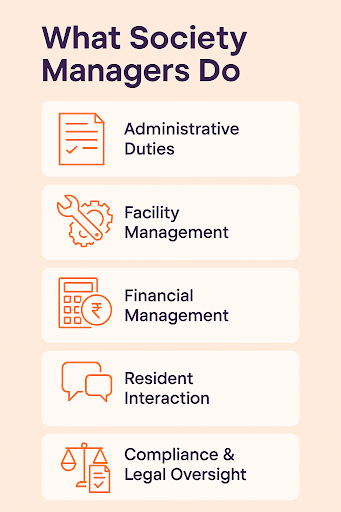
1. Daily operations & administration
Every meeting needs minutes. Every vendor needs a contract. Officials want notices. Someone has to track all this stuff and file it properly. During audits or legal issues, you’ll thank God someone kept proper records.
2. Facility maintenance
Cleaning staff need supervision. Gardens need maintenance. Something’s always breaking and needs fixing. Annual maintenance contracts need monitoring. When your elevator stops working or the generator fails, residents call the manager – not you.
3. Financial management
Budgets need planning. Maintenance fees need collecting. People who don’t pay need reminding (politely but firmly). Vendors need paying on time. Accountants need help during tax season. Without proper financial management, societies go broke fast.
4. Resident interaction
Residents complain about everything – noise, parking, maintenance, neighbors. New people move in and need orientation. Others move out and want deposits returned. Everyone wants updates on what’s happening. Managing all these personalities and expectations is honestly the hardest part.
5. Compliance & legal oversight
Fire safety inspections can’t be ignored. Structural audits are mandatory. Sewage treatment needs checking. Society registration must stay current. Labor laws apply to your staff. One missed compliance and you’re in serious trouble.
Tools and software society managers use

Most managers use apps now for communicating with residents. Visitor management systems track who comes and goes. Service requests get logged digitally instead of random phone calls.
Accounting software keeps financial records straight and generates reports automatically. Digital notice boards replace those paper notices that always fell down. Complaint tracking systems ensure nothing gets forgotten.
Put it all together and you get proper management systems instead of chaos.
Common challenges faced
- Residents expect different things. Some want immediate fixes, others complain about costs. During monsoons or festivals, everyone gets extra demanding.
- Collecting overdue payments without creating enemies requires serious diplomatic skills.
- Committee members often interfere or have unrealistic expectations.
- Vendors sometimes don’t show up or do shoddy work.
- Emergency situations – floods, power failures, medical emergencies happen at the worst possible times and need immediate handling.
Skills required to be an effective society manager
- Communication skills matter more than anything else. You’re constantly talking to residents, vendors, committee members, and officials. Poor communicators fail quickly in this job.
- Problem-solving under pressure separates good managers from mediocre ones. When three things break simultaneously during a festival weekend, panic doesn’t help – creative solutions do.
- Technology skills are becoming essential. You can’t avoid computers, smartphones, and management software anymore. Basic knowledge of housing laws and regulations prevents expensive mistakes.
Qualifications and hiring tips for RWAs
Most societies want college graduates, preferably with relevant diplomas in property management or business administration. Professional certifications help but aren’t always necessary.
Background verification is crucial – they’ll handle money and have building access. During interviews, give them real scenarios. How would they handle a major water leak? What if residents refuse to pay maintenance? How do they deal with difficult people?
Decide whether you want your own dedicated manager or prefer outsourcing to a management company. Your own manager gives personal attention but costs more. Management companies provide backup support and standard procedures.
FAQs
Is hiring a manager legally required?
No, but practically necessary for anything over 50-100 units. Volunteer committees simply can’t handle the workload effectively beyond that size.
Salaries range from ₹25,000 to ₹60,000 monthly, depending on location, society size, and experience. Mumbai and Delhi pay more than smaller cities.
Can residents become managers?
Yes, but they must quit any committee positions first. Otherwise, conflicts of interest become inevitable.
How do facility managers differ?
Facility managers focus mainly on building maintenance and infrastructure. Society managers handle broader responsibilities including finances, resident relations, and administration.
What if the manager doesn’t perform?
Submit written complaints to your managing committee. If problems persist, contact your state’s society registrar or housing authority.
Conclusion
Good society management makes everyone’s life easier. Residents get better service, committee members avoid daily headaches, and property values stay stable. The investment usually pays for itself through smoother operations and fewer conflicts.
Most importantly, professional management prevents small problems from becoming major crises. Prevention costs less than fixing disasters later.