

The Central Park South Society can be likened to the Phoenix rising from the ashes in the aftermath of the Chennai floods in 2015. The natural disaster opened the residents’ eyes to the unfortunate reality of waste management in India. What followed is a story that can inspire many societies around the country.
The apartment complex is spread over 2,86,344 sq ft with 172 apartments in 11 blocks. It is difficult to miss as it is centrally located and has direct access to the main road. But this location proved to be a bane during the 2015 floods when the society was among the worst affected apartment complexes in the city. More than 5 feet of stormwater entered the complex and wreaked havoc.
“The floods did however, make us sit up and question why this happened. Some of the answers were very obvious. Unplanned development, encroachment of wetlands which are natural sinks, poorly designed drainage systems, increasing landfills, and so on,” says Sumitha Iyer, resident waste warrior, who led a brave new movement from the front. The society decided to solve its problem from the roots rather than fix it superficially.
From awareness to action
Even before the flood,s the society members had understood that waste segregation was the way forward to reduce our ever-growing landfills. They had a process in place for segregating household waste but it entailed separating dry waste only. There was no provision for wet waste management. “After the floods, we decided to take it to the next level by implementing 3-way segregation”, Sumitha says.
Getting started
They adapted the 2bin-1bag model, which was introduced to them by a Bangalore-based waste management company called WasteWinn. This model uses two-coloured bins (green and red) to collect organic and reject/hazardous domestic waste, respectively, and a bag to collect the recyclables. Once the implementation plan was formulated, the core team carried out an extensive door-to-door campaign to educate the residents, housekeeping staff, and domestic hel,p such as house help and cooks. For the first 50 days, active resident-volunteers accompanied the housekeeping staff to every house to clear the doubts and re-educate residents wherever required.
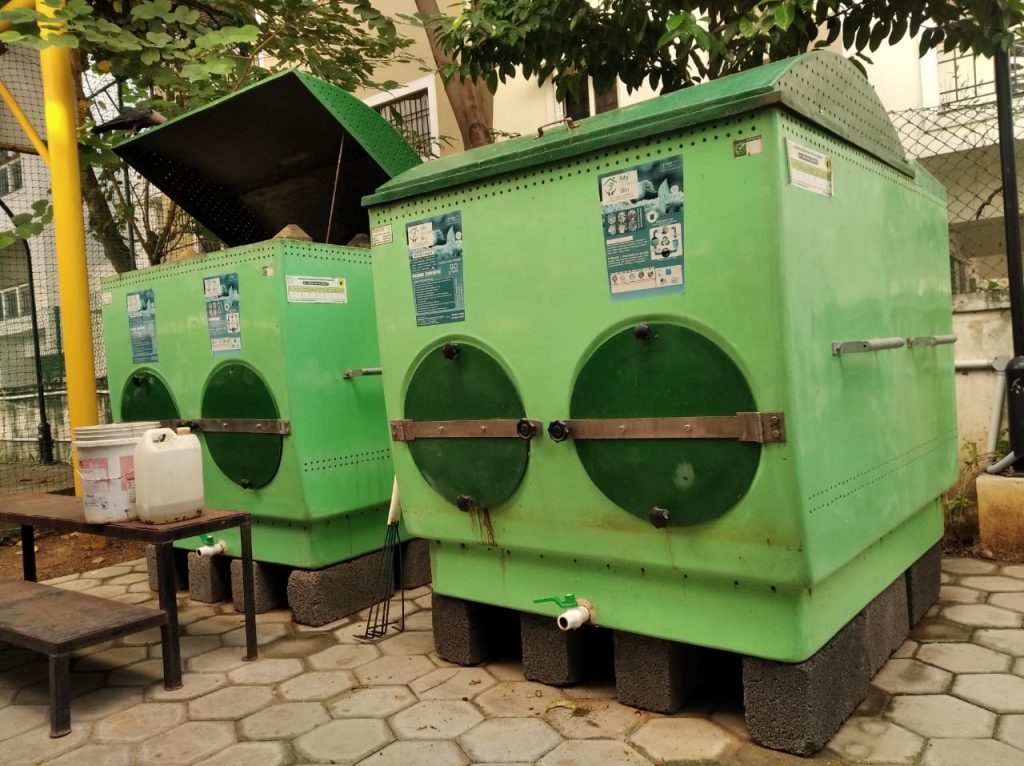
Central Park South Society produces about 80-100 kg of organic waste every day, making it a bulk generator required to handle wet waste management and disposal onsite. After the awareness generation campaign was done, the team began the research and groundwork in order to begin composting. They eventually zeroed in on My Green Bin composters, investing in two composting units of 2,000 litres capacity each. The composting process was started in earnest.
Trench composting (burying waste directly into trenches in the garden) was initiated as well. The team used one part of the organic waste in trench composting, wherein a pit about 4X4 with a depth of 2-3 ft was dug, and every day about 20 kgs of organic waste was dumped into it. This was then covered with dry leaves and mud. This process is continued till the pit is full and closed.
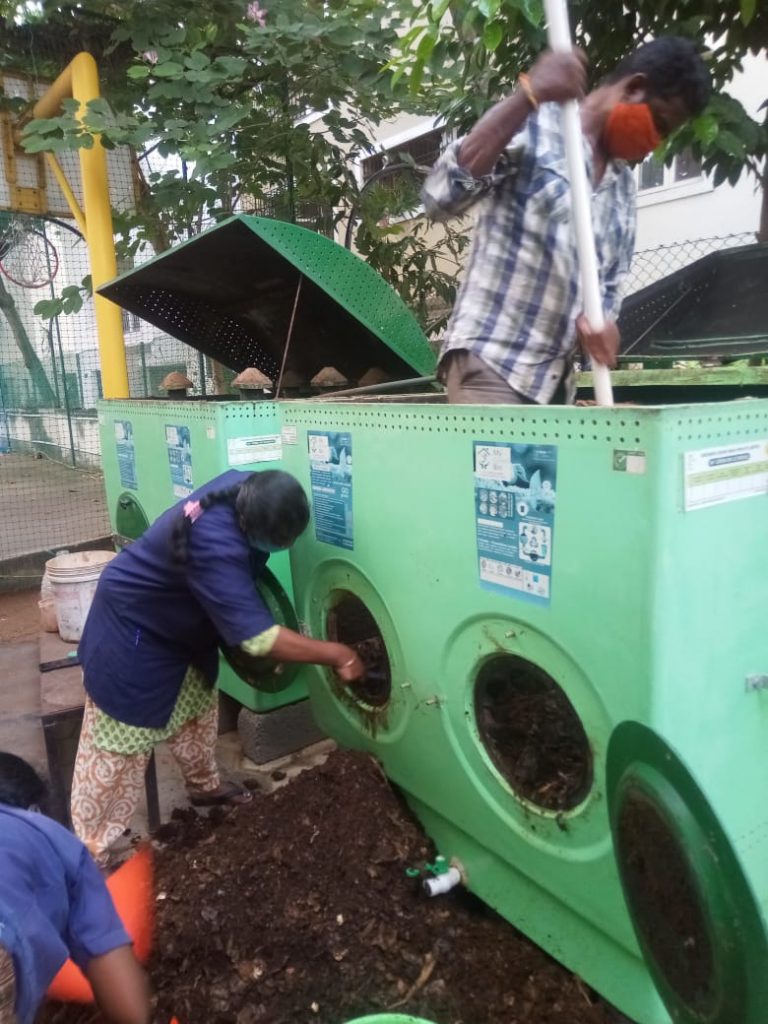
The team of volunteers worked closely with the housekeeping staff to ensure the smooth functioning of the composting system. Reports were sent daily via a WhatsApp group between the block representatives and the housekeeping staff. The team members continued to educate newcomers since it was imperative to keep the positive momentum going without missing any links in the chain. The society also monitored the different aspects of the whole process to see if any corrective measures were required. The wet, recyclable, and other waste was regularly weighed and recorded.
Tasting success
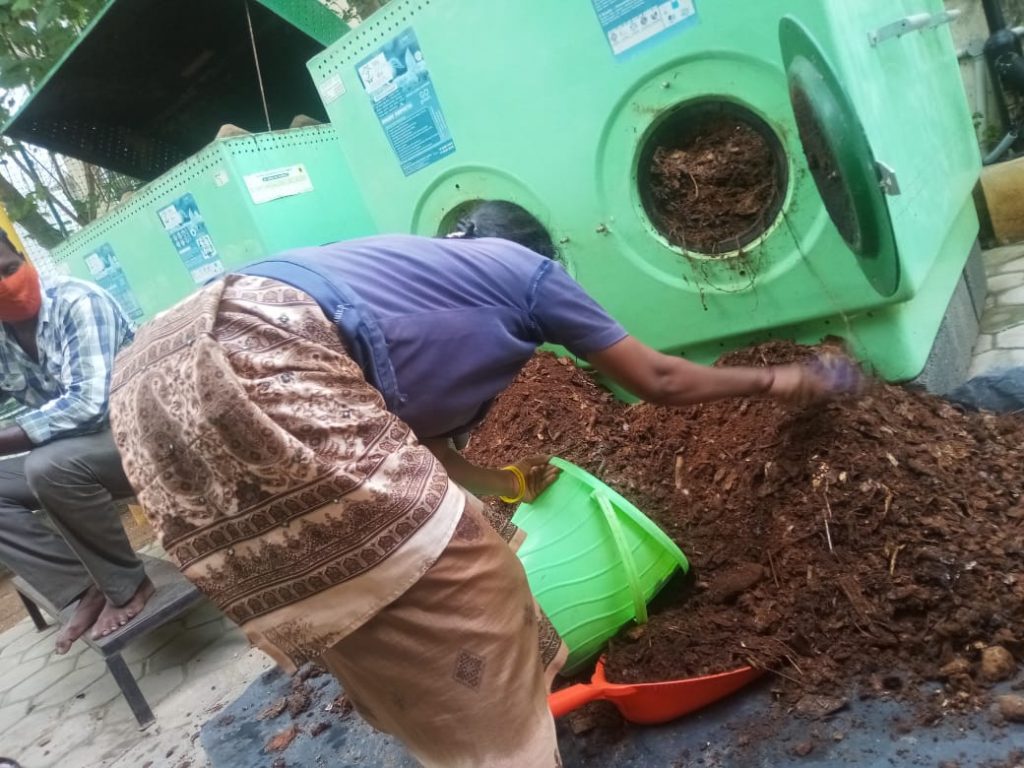
At first, there were challenges such as bad odour, but after tweaking the composting procedure and identifying loopholes in the system, the process took off smoothly.
Today, Central Park South Society produces about 300-400 kgs of compost per month. The society provides the compost to the residents for free. The compost is also used for vegetable gardening and for building a green belt of plants around the buildings. Dry waste is recycled. The society gets Rs 2000-3000 per month from the sale of its recyclables. The proceeds are distributed among the housekeeping staff as an incentive.
Sumitha says, “Our efforts are bearing fruit. Residents who were hesitant earlier are now active participants in this initiative. Most importantly, it’s overwhelming to see our kids learning the right practices of waste management at a young age. The real icing on the cake is when we received the Green Award from the Chief Minister of Tamil Nadu last year. This award was instituted by the Tamil Nadu Pollution Control Board for RWAs doing exemplary work in the field of solid waste management, among other things.
The society, led by Sumitha and team, plans to sustain its efforts and expand them further. They are already minimising the amount of hazardous waste generation and sharing their waste management practices with other apartment complexes that are willing to start their own journeys towards green living.
Lessons for other societies
“Composting is not an exact science. Sometimes we need to learn by trial and error to get the process running smoothly. Communities looking to do in-house composting should not give up when there are small hiccups. Always try to find practical solutions and keep it going,” says Sumitha.
She recounts the initial hurdles in convincing fellow residents to segregate waste into 3 categories. “Those who were used to using plastic liners had to now spend some time and effort to put the waste in the correct bins or bags. They had to clean their bins every day as no liners were allowed. Sanitary and medical waste had to be wrapped in newspapers before disposal, while all recyclables had to be cleaned and dried before placing them in the disposal bag. All this requires patience and perseverance, especially since it is a long-term behaviour change. But the residents showed true dedication to the cause from inception to execution.
Central Park South Society has successfully created a waste management system that not only works efficiently but also serves as a fine example of the spirit of a community that never gave up on the collective vision of clean and green India.
Introduction
In March 2020, the World Health Organisation (WHO) declared COVID-19 as a pandemic. This declaration meant that the SARS-CoV-2 coronavirus was a matter of global concern and was affecting millions of people daily. Today, there are various ways of determining if a person is infected by the SARS-CoV-2 virus.
Antibody tests require medical experts to obtain the patient’s blood samples for testing, and there is a chance that someone previously infected with a mild case of the disease might not have antibodies. Another way of testing for COVID-19 is antigen testing. Antigen testing is the fastest testing method for COVID-19 as it involves a rapid test kit, which is typically used along with a nasopharyngeal swab to get results in under 15 minutes. Lastly, we come to the most commonly used testing method known as the RT-PCR test, which has proven to professionals that it is the most accurate COVID-19 test to date.
What is RT-PCR?
RT-PCR, also known as a molecular test, is a test for COVID-19 designed to detect the genetic material of SARS-CoV-2 using a technique called Reverse Transcription – Polymerase Chain Reaction (RT-PCR). The patient’s samples are collected by a trained professional through nasal swabs or oral swabs inserted into the back of the throat.
The type of RT-PCR used by modern scientists to detect SARS-CoV-2 is called real-time RT-PCR. Real-time RT-PCR has previously been used to diagnose diseases like Ebola and Zika fever. It is the preferred choice of most scientists worldwide because it is a more efficient variation of the conventional RT-PCR test. In real-time RT-PCR, the use of fluorescent markers to detect targeted genetic material allows professionals to see the test results almost immediately. On the contrary, the conventional method will only give you results at the end of the test.
What is Ct Value in RT-PCR Tests?
Ct stands for cycle threshold, which is a value reflected in an RT-PCR report that helps professionals determine the amount in which the virus is present inside the patient’s body. After collecting the swab samples from the patient for an RT-PCR test, professionals extract the Ribonucleic Acid (RNA) and convert it into Deoxyribonucleic Acid (DNA) using Reverse Transcription. After converting the RNA into DNA, multiple copies of the specific DNA are made through various cycles until SARS-CoV-2 is present in a detectable amount. The number of RT cycles required to reach an amount perceptible in the test is called the Ct value in an RT-PCR test. A lower Ct value in PCR tests indicates that the patient is more infectious than others. On the other hand, a higher Ct value in RT-PCR means that the patient is less contagious and has a lesser quantity of the virus in their bodies. Scientists believe this theory because samples having more of the SARS-CoV-2 pathogen present in them will require less amplification to reach enough copies of the pathogen for detection.
What Are The Factors Affecting Ct Value?
Although the Ct value in a person’s RT-PCR test indicates how much of the SARS-CoV-2 pathogen they have been carrying in their throats, several other factors can also cause variations in the Ct value shown in the results. Due to this, the Ct value can not determine how sick a person is or what course of treatment a doctor should offer to them based on their viral load. The factors that affect Ct Value in patients are:
- What was the amount in which the SARS-CoV-2 pathogen was present in the person’s throat during sample collection?
- What is the effectiveness of the collection method used to obtain the sample?
- What were the storage conditions of the sample after collection?
- What was the time of sample collection?
- What was the type of sample used for testing (nasopharyngeal, saliva, sputum, and so on)?
Why is The Ct Value Important in RT-PCR Tests?
According to the Indian Council of Medical Research (ICMR) in New Delhi, the patient will be considered positive for COVID-19 if the Ct value is below 35. This number means that if the SARS-CoV-2 pathogen gets detected in the patient’s DNA sample after 35 cycles or earlier, the patient will be considered positive for COVID-19.
Not too long ago, the state of Maharashtra, which has the highest number of COVID-19 cases amongst all Indian states, wrote a letter to the ICMR requesting them to lower the benchmark Ct value required for a patient to be deemed positive for COVID-19. The globally accepted Ct value for RT-PCR results ranges between 35 and 40 globally.
Having the current benchmark of 35 cycles means that more people, even with a lower viral load, will also test positive for COVID-19. Therefore, ICMR had to reject Maharashtra’s request to lower the threshold. The reason stated by the ICMR was that reducing the required CT value of RT-PCR tests would result in many comparatively milder cases going undetected, leading to many infectious patients going undiagnosed, which would, in turn, result in increased transmission of COVID-19. Doing this would result in a false decrease in the positive cases. Many patients with a lower viral load of SARS-CoV-2 in their bodies can also be severely ill without being diagnosed with COVID-19.
Do Severe Cases Have Lower Ct Values?
The Ct value tells us how much of the virus is present in the person’s body. Having a lower Ct value does not indicate that a person will be sicker than someone with a higher Ct value. There are cases where people have a viral load high enough to be detected in a low number of cycles but show no symptoms of COVID-19 whatsoever. The Ct value tells us about the viral load of SARS-CoV-2 in the patient’s throat and not the lungs. Getting to know the Ct value of a patient helps doctors determine how infectious the patient is, not how severely they are affected by COVID-19.
What to do if Someone Near You Has a Low Ct Value?
Thanks to security management apps such as MyGate, you can easily find out if someone in your society has been diagnosed with COVID-19 or is showing symptoms of the disease. If someone has a Ct value below 35, they will test positive for COVID-19. The infectivity of these patients is lesser than patients with comparatively lower Ct values. If someone near you has a lower Ct value than average, you should take more precautions than you normally would since the chances of you getting infected are much higher due to the high viral load of the patient.
Contact tracing is particularly important for patients who show a lower-than-average Ct value in pcr, as having a lower value in Rtpcr means they can spread the virus more than other infected patients. The quarantine of such patients should only end once their RT-PCR tests show a Ct value high enough for them to not be a danger to society.
Conclusion
With newer, more infectious strains of the SARS-CoV-2 virus, such as the Omicron variant sprouting up in different parts of the world, it is extremely important for us to know what the Ct value in an RT-PCR test means. Due to the highly infectious strains of today, it is becoming increasingly common for patients to have Ct values that are much lower than 30. This means that the SARS-CoV-2 virus has evolved to become more infectious than it was before, and we need to be extra cautious about our habits and activities.
You may all know how to read some of your blood reports. What you may not know, however, is how to read the RT-PCR test results. It can be confusing, especially if you are not familiar with the terminology. In this blog, we will break down what each term means and what it tells you about your test results. So, let’s get started.
What is coronavirus?
Coronaviruses (CoV) are a large group of viruses that can cause a wide range of illnesses, from common colds to acute respiratory tract infections. Symptoms of the infection can include pneumonia, acute respiratory syndrome, and even death.
A coronavirus is a virus that can cause respiratory infection. The most common infection detected is the common cold. In some patients, more serious diseases were diagnosed, such as SARS. The coronavirus is so named because it has a crown-like (corona) appearance when viewed under a microscope.
China’s Hubei Province’s city of Wuhan reported mysterious cases of pneumonia on December 31, 2019. Symptoms of the disease were first identified as COVID-19 by the WHO on January 7, 2020, which was due to a new coronavirus (2019-nCoV). More than 210 different countries and territories have been exposed to the virus after spreading out from the Wuhan region of China.
The symptoms of coronavirus infection include fever, headache, and muscle aches. The illness is usually mild, and most people recover without treatment. However, the infection can be more serious in some cases and may lead to pneumonia.
The symptoms were similar to those of the common flu and, in some cases, there were no symptoms at all because it is a new disease. Detecting and preventing the spread of Covid-19 was difficult; so, Covid-19 tests became mandatory for every traveller.
Diagnosis of Covid-19
Coronavirus is diagnosed by taking a sample of mucous from the nose or throat and testing it for the presence of the virus. This can be done using various techniques, including viral culture, RT-PCR assay, and immunofluorescence assay.
The RT-PCR assay is the most sensitive test for diagnosing coronavirus, as it can detect even small amounts of the virus. This assay involves using a reverse transcription-polymerase chain reaction (RT-PCR) to amplify the viral DNA so that it can be detected.
The assay results will help your doctor decide on the best course of treatment. If you have a positive result for coronavirus, your doctor may prescribe antiviral medications to help you recover. If you have a negative result, your doctor may still recommend taking antiviral medications as a precaution.
How to read coronavirus test results
The coronavirus result determines the presence or absence of a particular virus in a sample. The RT-PCR report is a laboratory report that documents the results of a reverse transcription-polymerase chain reaction (RT-PCR) assay to detect a particular coronavirus.
A positive result indicates that the virus is present in the sample, while a negative result indicates that the virus is not present. An equivocal result means that the test cannot determine whether the virus is present or not.
However, a negative result does not necessarily mean that the virus is not present; it may only mean that the virus count was too low to be detected by the assay.
RT-PCR test process
The RT-PCR process begins with RNA extraction from a tissue or cell sample. RNA is a type of molecule that carries the genetic information of cells. Next, a particular enzyme called reverse transcriptase converts the RNA into DNA. The DNA is then amplified, or copied, using a process called polymerase chain reaction (PCR). The amplified DNA can then be detected and measured.
Reading an RT-PCR report
To read an RT-PCR report, you need to understand what each of the terms in the report means. The report will include the following terms:
- Test name: The name of the test that was performed
- Sample type: The type of sample that was tested
- Positive result: A positive result means that the virus is present in the sample.
- Negative result: A negative result means that the virus is not present in the sample.
- Equivocal result: An equivocal result means that the test cannot determine whether the virus is present or not.
- CT value: The cycle threshold (CT) of the SARS-CoV-2 coronavirus is determined during RT-PCR testing. When an RT-PCR test is performed, RNA is extracted from a patient’s swab. RNA is then converted into DNA and amplified using amplification technologies.
- Viral load: This denotes the amount of viral RNA in the sample. This is reported as a number (e.g., “positive at 10 copies/mL”). An infection requires a certain amount of virus to take hold in every infectious disease. How much virus an individual can handle is determined by their immune system. Regardless of non-pharmaceutical interventions (NPI), such as physical distance, masks, well-ventilated spaces, or quarantine, the higher the viral load, the greater the risk of serious disease, hospital admission, and transmission to others. It is likely that a patient with a lower virus load is not capable of transmitting viruses.
- The report will also include a diagram of the RT-PCR assay, which will help you to understand how the test was performed.
Are there any risks involved?
RT-PCR is a safe and widely used laboratory test. There are no known risks associated with the RT-PCR process.
How can I get an RT-PCR test done?
An RT-PCR test can be administered by a healthcare professional. If you are concerned that you may be infected with the coronavirus, you should speak with your doctor about getting a test. There may be a fee associated with the test, but most insurance plans will cover it.
In light of the Covid-19 pandemic, a coronavirus RT-PCR test result is an important piece of information that can help people determine one’s risk of exposure. Always consult a healthcare professional if there is any doubt about whether or not someone has been infected with the coronavirus.
Ultimately, a coronavirus RT-PCR result should always be interpreted in conjunction with other information, such as symptoms and recent travel history.
What does the RT-PCR report mean?
The numbers in an RT-PCR Report indicate the likelihood that someone has been infected with the coronavirus. The higher the number, the more likely it is that someone has been infected. A lower number means that the person is less likely to have been infected.
Final takeaway
You can tell if you’ve been infected with the coronavirus by looking at an RT-PCR report. Understanding an RT-PCR report can help you and your loved ones protect their health.
Three vaccines are used in India’s vaccination program, including Oxford University – AstraZeneca’s Covishield vaccine (manufactured by the Serum Institute of India), Bharat Biotech’s Covaxin, and Russia’s Sputnik V.
However, it is important to note that these numbers are not always 100% accurate. You must always consult the doctor to know what your reports mean.
If you are looking to buy a house, you will know that there is a ton of jargon and terminology that you have to familiarize yourself with. One such term is ‘Plinth Area’. The meaning of plinth area is defined by the Indian Standard (IS) 3861-2002 as the “constructed covered area calculated at the floor level of the basement or of any storey”. It is also referred to as the ‘built-up’ area.
But, practically, how do you calculate the plinth area? And why is it important? Let’s get into the meaning, inclusions, and exclusions you need to be aware about when looking at property.
What is plinth area?
It’s important to fully understand the meaning of plinth area if you are a prospective homebuyer or even if you are buying commercial property. The term ‘plinth area’ or ‘built-up area’ is used when referring to the area of a home or property. When the plinth area is mentioned, it is usually around 10% to 20% more than an apartment or a flat’s carpet area (the usable floor area). This is because it is measured as the covered built-up area at the floor level of any floor in a building or the building’s basement floor level. So it includes the carpet area as well as the area taken by walls (both internal and external), elevator doors and other areas in the building too such as the parasitic area.
How to calculate plinth area: Plinth area rate estimate with example
A plinth area cost estimate is done according to the building’s plinth area. This cost estimate is derived by multiplying the building’s plinth area with the current plinth area rates (based on buildings with similar characteristics in similar locations).
The Plinth area formula is Building cost = Plinth area X Plinth area rate.
The result will be the approximate building cost. Each storey in a building will get its own plinth area estimate before the entire property gets an approximate cost according to those individual plinth area costs.
Here is a plinth area cost estimate example. If the plinth area of a building is 1000 square metres and the plinth area rate is Rs 4000 per square metre, then:
Building cost = Plinth area X Plinth area rate
That is, Building cost = 1000 square metre X Rs 4000 = Rs 40,00,000
What is not included in the plinth area of a building?
According to the IS 3861-2002, the list of areas below are not to be included in the plinth area of a building:
- Area of the loft
- Cornice, architectural elements, etc
- Projections such as sun breakers that are vertical, box louvre or projecting slabs for flowerpots
- Area of the terrace
- Service and spiral staircases, landings, open platforms, turrets, machine rooms and structures such as domes and sunshadesthat go above terrace levels
- Area of cantilevered porches
- Areas for seating in auditoriums, halls, theatres, etc.
- Garbage chutes greater than two square metres and other sanitary shafts of that size inside the building
What does the plinth area of a building include?
According to the IS 3861-2002, the list of areas below are included in the plinth area of a building:
- The area in total of all the building storeys at the floor level. If two buildings have a shared wall, half of the wall will be included in each building’s plinth area.
- Electric, telecommunications and firefighting necessities, as well as garbage chutes and sanitary infrastructures of less than two square metres within the building.
- Staircase room that is on any level but the terrace level
- Parasitic area and multi areas at the level of the building terrace
- Elevator opening area
- Porch areas and machine room but not cantilevered areas
- Air conditioning ducts and lift landing and lift well
- Open projections of veranda, balconies and parapets. If the area is covered by projections, then the entire area will be included in the plinth area. If the space is not protected by projections, then only 50% of the area is included in the plinth area.
Plinth area vs Carpet area: What is the difference?
Plinth area: It is the built-up area that is measured at the floor level of the basement of a building or any storey of the building.
Carpet area: Measured from wall to wall, it is the area of what is useable in a room, ie the total area in square feet that a carpet can be laid down.
Plinth area: Plinth area is also called built-up area.
Carpet Area: Carpet area is also called livable area or usable area.
Plinth area: It includes the building carpet area, wall area of internal and exterior walls, parasitic area, area of elevator opening, etc.
Carpet area: It does not include the area of the inner and exterior walls of the building. Carpet area the built-up area with the area of the walls subtracted.
Plinth area: The plinth area is usually around 10-20% larger than the carpet area.
Carpet area: The carpet area is usually around 10-20% smaller than the plinth area or built-up area.
What is the difference between plinth area and built-up area?
The terms plinth area and built-up area are used interchangeably. Both refer to the area covered at the floor level of any floor in a building or the building’s basement floor level. This area includes what is covered by internal and external walls of the building. Often, plinth area is more commonly heard when referring to standalone houses such as villas. Built-up area is generally used more often to describe the square footage of apartments and flats.
What is the difference between plinth area and floor area?
Carpet area, floor area, plinth area… you would have heard these terms used a lot when looking to buy property.
Carpet area: It is the useable area of a room – the total area in square feet that a carpet can be laid down.
Floor area: It is the total area of the floor within the walls. To put it simply, the floor area is the plinth area without the area that is occupied by the walls. Area covered by pillars and other supports are not taken into account when calculating floor area.
Plinth area: It is the total area that lies within the exterior dimensions of the walls of a building at any floor level.
What is the difference between plinth area and covered area?
As mentioned above, the plinth area is the built-up area that lies within the exterior dimensions of the walls of a building at any floor level. It usually measures at 10% to 20% higher than the calculated carpet aarea.
Covered area refers to the area under the roof of the building. This includes structures such as the walls, balconies and pillars. When measured, it is usually around 8% to 10% greater than the calculated carpet area.
The average person will agree that the office commute is the most tiresome and time-consuming part of their day. With rising air pollution levels and traffic-congested roads, it is vital to find a sustainable solution to beat the problem. A large number of gated communities and common office spaces make the community carpooling a viable option. With a little organisation, residents can easily find co-passengers travelling towards their destination. Apps used for community management can also be used to organise the same. Given the common pick-up point, there is no commute confusion and the ride-sharing presents ample opportunity to socialise and fraternise with fellow residents.
What is Community Carpooling?
Community Carpooling is an innovative transportation idea that allows anyone to share their personal car with other members of the community during a commute. This is a great idea for people heading in the same direction.
Why use community carpooling?
1. Traffic-free roads
With a population of 1.3 billion people, more than 4.4 million passenger cars are sold in India each year, most of which are concentrated in metropolitan cities. This alarming number contributes to congested roads and longer commutes. If a large number of residents adopt community carpooling as their main mode of transportation, this could contribute to relatively freer roads and keep traffic in check.
2. Save on fuel costs
With ever-rising fuel prices, splitting the fuel cost with fellow passengers is a smart way of managing your transportation costs. Alternatively, the group could create a schedule to rotate their personal vehicles throughout the week.
3. Help the environment
By using a common car, you are not only reducing your dependence on non-renewable sources of energy but reducing greenhouse gas emissions. A small step like this considerably reduces air and sound pollution and makes your surrounding more livable while keeping your community carbon emissions in check.
4. Reduced stress on parking
With a high number of cars, public spaces and office buildings are burdened with providing sufficient parking infrastructure. An organised community carpooling group limits the number of cars that need to be accommodated and reduces strain on the space.
5. Get more out of your commute
If the carpooling group rotates drivers, other passengers have a chance to catch up on work, listen to podcasts, read a book or complete other tasks during the commute especially if the commute is a long one. This also minimises commuter stress and alleviates your mood.
6. Socialise with your community
Commuting with people from the same residential society allows you to meet new people living in close proximity, which makes the commute a less boring one.
How to organise carpooling?
1. Encourage residents
The society admin or management committee should initiate the conversation around carpooling. Educate your residents about the benefits of carpooling and actively encourage the same in your community.
2. Circulate forms
Circulate digital forms to gauge how many residents are interested in community carpooling. Make use of the responses to create the groups. The Mygate app includes communication management features that allow you to discuss such matters on the app. The management could also organise polls on-app to ensure all points are considered.
3. Organise into groups
Residents can organise into groups according to the area of their daily commute. This allows residents to create their own carpooling groups according to their place of work, schedule and convenience. Members could also use the society management app to form a group and discuss the carpooling details with other residents.
4. Set the rules
Once the residents have organised into groups, they can decide on whether the group will have a designated driver or alternating drivers, the pick-up and drop-off locations, how fuel costs will be split, how long the group will have to wait before starting the commute etc.,
5. Schedule the rides
The groups can choose to schedule the rides at a fixed time every day or notify others in their group when they are starting their commute. The members should, however, be sure to communicate the timings to fellow riders to avoid any confusion.
6. Maintain decorum
Ensure you maintain decorum when travelling in another car. Ensure you are punctual, avoid making loud phone calls, keep the surroundings clean so as to not inconvenience the co-passengers.
Community carpooling has a number of benefits that have a positive social and economic impact. With a growing number of residential societies and common office spaces, adopting community carpooling for your daily commute is not a difficult task, all it requires is a little coordination and cooperation. Organise a carpooling group and minimise commute stress.
Apartment owners would promptly agree when we say that at least a quarter of their total maintenance bill is the expense of the light bill for common areas. Residential buildings with high-end amenities like air-conditioned corridors, fully equipped gyms, and heated swimming pools would bear even higher maintenance charges. However, the simple truth of the matter is that at least 20 to 30% of the overall electricity bill can be reduced by conscientious choices, mindful practices, and stricter usage monitoring.
Common areas that utilise electricity are staircases, elevators, community halls, swimming pools, and parking spaces. Additionally, societies also use diesel generators and water pumps in plenty.
The tragedy is that multiple users and no real repercussions cause an amount of lack of motivation as the bills pile up without anyone being held accountable. Such is the curse that comes with the blessings of community living, people get apathetic towards common goals and the whole society ends up paying for it. The RWAs and MCs need to spread awareness among residents, maintenance staff and internal committee members to curtail electricity usage while simultaneously employing below listed measures to see practical results.
Install solar panels
You can consider installing an off-grid or grid-tied rooftop solar system specially for running common areas of the society. This will be a one-time investment with approximately 15 years of zero utility bill (excluding maintenance and upkeep). During the daytime, all energy needs will be directly met by the sunlight, the rest is taken care of by battery storage. Backup batteries (or main supply) can always be used in case of cloudy weather. The government gives a 30% subsidy on solar system installation.
Change light fixtures
Swap your older energy inefficient filament light fixtures and incandescent bulbs with LED lights which consume less power due to inbuilt semiconductor technology. Check energy star rating as well as luminous efficacy (ratio of luminous flux to power). High luminous efficacy is considered anywhere between 120 and 180 lumens per watt, which can be found on the packaging. LED lights are known to use up to 75% less energy than regular light bulbs. To light up gardens, gyms and pools too you can use bright LED floodlights which use 10-12 watts of electricity while giving the higher output of light.
Install motion lights
Some areas in your apartment complexes, like the staircases and corridors, may not be well lit. Even if they are, the lights are always on even while residential footfall is less, resulting in wastage of electricity. Motion sensor lights can detect movement a few meters in 360° direction, sensing presence through infrared/heatwaves and turn on automatically while staying deactivated during the day. They can be installed in all common areas since they’re not expensive. Additionally, in building reception and offices, you can install motion sensor switches for light and fans so that no electricity is wasted when someone leaves and forgets to switch off the light and fan.
Reassess the boiler room
There may be defective, overused or old equipment in the boiler/utility room of the apartment complex that may be consuming more electricity than required, e.g. chillers, heat exchangers, HVAC system, electric water pumps, DG sets, battery generators, etc. Get them fixed or repaired and maintain them regularly to avoid overuse of electricity.
Invest in smart energy meters
Under the Smart Meter National Program, the government intends to replace 25 crore traditional meters with smart meters. Besides the program, you can privately install a smart meter specifically for the common energy monitoring. A smart meter is a digital device that can transmit energy consumption information at regular intervals so you can monitor excessive usage, and make sure there is no pilferage. Some useful features are remote connect/disconnect, anti-tamper and fraud detection, IoT-enabled (can be operated via an app), and plug and play models. Billing efficiency is expected to get better by 75-100% through the deployment of smart meters since they entail minimum billing errors and increase cost-effectiveness.
Use energy-efficient appliances
Whether it be communal water coolers, electric floor scrubbers, or energy-guzzling vacuum cleaners or ACs, facilities management staff or managing committee members should replace all energy inefficient equipment with energy star products. Also, if you’re using a water pump to fill water tanks, it’s wise to install automatic water level controllers that would shut down the pump once the tank is at full capacity.
A gated community can also form energy monitoring teams whose sole responsibility would be a charter that lists down best practices to reduce energy consumption. As part of the agenda, duties can be delegated to team members to monitor usage in each area, e.g. the smart meter readings can identify which areas are using the most power and the person responsible can implement countermeasures. Slowly but surely, positive results would manifest.