

The Information Technology (IT) business is prospering in today’s digital age, and India has emerged as a worldwide IT hub. With several places across the country offering intriguing employment prospects, it’s critical to investigate the top IT job destinations. This article will help you make an informed career choice by providing an in-depth study of the finest IT cities in India.
Over the years, India’s IT industry has grown dramatically, attracting computer aficionados from all over the world. With so many places vying for your attention, this guide will assist you in navigating the various panorama of IT career prospects in India.
1. Bangalore
Bengaluru, sometimes known as the ‘Silicon Valley of India,’ is India’s largest information technology (IT) hub. It is home to major global technology companies, including Infosys, Wipro, and TCS, as well as numerous startups. The rise of several educational institutions, such as the Indian Institute of Science (IISc) and Indian Institutes of Technology (IITs), has contributed to the city’s popularity in the IT sector.
Karnataka’s government has also made significant efforts to promote innovation and entrepreneurship. Furthermore, Bengaluru boasts a beautiful climate and cosmopolitan culture, which attracts tech experts from all over the world.
IT companies in Bengaluru can be found in regions such as Electronic City, Whitefield, Koramangala, Marathahalli, HSR Layout, and BTM Layout.
2. Hyderabad
Hyderabad, popularly known as ‘Cyberabad,’ has emerged as India’s second most important IT metropolis. It is the Indian headquarters of tech behemoths such as Microsoft and Google. It has achieved infrastructure advancements, fostering an atmosphere suitable to the expansion of IT enterprises. HITEC City, a complex with multiple IT parks, is also located in Hyderabad.
Hyderabad is well-known for its strong transport system and well-developed real estate industry, which is a big draw for IT businesses looking to establish a presence. The state government has developed a number of initiatives to help the IT industry grow, making it a desirable location for IT companies and workers.
3. Pune
Pune, popularly known as the “Oxford of the East,” has established itself as a major IT powerhouse in India. Pune is home to campuses for well-known IT firms such as Infosys, TCS, and Tech Mahindra. It has an excellent infrastructure and transit amenities, making it an appealing destination for IT experts. IT companies in Pune can be found at Hinjewadi, Magarpatta City, Kharadi, Hadapsar, Baner, Aundh, Viman Nagar, and Yerwada.
4. Chennai
Chennai is another city in India that has seen fast expansion in the IT industry. It is home to Tidel Park, one of Asia’s largest IT parks. Leading IT firms including as Cognizant, TCS, and Infosys have a presence here.
IT enterprises can be found in Taramani, Old Mahabalipuram Road (OMR), Guindy Industrial Estate, DLF IT Park, Ambattur Industrial Estate, Siruseri IT Park, Perungudi, and Porur.
5. Mumbai
Mumbai isn’t just about banking; it’s also a magnet for IT jobs. The city’s lively culture and numerous prospects make it an appealing option.
6. NCR
The Delhi National Capital Region (NCR) includes the cities of Delhi, Gurgaon, and Noida. It provides a combination of government and commercial sector IT jobs.
7. Kochi
Kochi, often known as the ‘Queen of the Arabian Sea,’ is quickly becoming a popular IT location. It is home to Infopark, a 260-acre IT park filled with numerous multinational IT and ITeS enterprises. Its strategic position, infrastructure, and plenty of well-educated, tech-savvy workers have drawn investors from all over the world. Furthermore, the city’s cosmopolitan culture, high standard of living, and environs create an ideal living experience for IT professionals, paving the way for it to become India’s Silicon Valley.
Kochi has an IT presence in Infopark, Kalamassery, Palarivattom, Vazhakkala, Cheranalloor, and Edapally.
Bill generation is probably the most important activity within society accounting on a monthly basis. The accountants / managers generally have to invest a considerable amount of time due to the complexities involved in calculating values for all the houses within the society. The usual use case may include –
- Area and rate based billing for maintenance
- Unit consumption based billing for utility (electricity and water)
- Slab based billing if the electricity provider dictates it
- GST exemption above Rs 7500 for maintenance
- Previous penalty inclusion within the bill and more
- E-Invoice generation for B2B house
While all of the above can easily be automated through Mygate, it is always better to recheck the item values post the invoices have been generated!
Until now, Mygate has been offering an invoice ‘Preview’ feature which helps the admin confirm the design, values and format of bills one house at a time.
This preview tool has always been super useful in improving the confidence level of the admin before billing. However, the limited nature of this option does not allow verification of invoice amounts in bulk for all houses.
To enhance the ERP experience and reduce the nervousness of our users, we have introduced a new invoicing flow in addition to the older one – ‘Generate (Publish Later)’.
Using this new method provides the admins with the following benefits:
- The bills get generated as usual, but DO NOT GET PUBLISHED TO THE RESIDENTS right away. This ensures that there is still a chance for review before people start making payments against their invoices.
- Given that the invoices get fully generated in the backend, the admin can safely use the following reports for a bulk verification –
- Bill excel download from Invoice History
- Bill PDFs download from the Invoice History
- Invoiced values along with house opening & closing from the MIS Report
- Final due values of each house from the Dues Report
- If there is a correction needed to the new created bills, the admin can –
- Safely delete (reverse) the whole invoice batch before generating a fresh set. This is advisable if there are issues in a good number of bills
- Pass credit notes if only a few houses have issues.
Once the admin is satisfied with the generated invoice batch, he can PUBLISH these bills to the residents from the familiar Invoice History page.
Ideally, both generation and publish operations should be completed by the society office within the same day. However, even if the admin forgets to trigger that latter, the system will publish the pending batches on their respective due dates (at 10pm).
*Other important points to note:
- Settlement from existing advance only triggers after the invoices have been published to the residents. This is not done before to ensure that the system does not have to delete extra entries if the whole batch is faulty.
- E-Invoice generation only triggers after the invoices have been published to the residents. The same reason as above applies here as well. Hence, you will be able to view the QR Codes on bill with IRN numbers only after the publish operation.
- Invoices cannot be sent to residents via Emails or SMS/Push Notifications until they are published.
- Residents will have a visibility of the unpublished invoice’s total amount in the app. This appears as a read-only figure under ‘Total Dues’ within the Society Dues module. Payment against this value is, however, not permitted!
The old invoice generation method has not been removed and will continue as it it under the name ‘Generate (Publish Now)’.

Any event celebrated on a large scale has negative environmental impacts since it produces a great deal of waste. Parties and gatherings generate a massive amount of waste from leftover food, single-use plastic bottles, cutlery, cups and plates, decorative material, and other rubbish. When dumped into landfills, this waste causes more stress on an already compromised urban waste management system.
According to the Global Hunger Index, India wastes food worth Rs 244 crores per day; the number is likely to be much higher during events and festivals. India processes only 10% of its food waste while single-use plastic like wrappers and PET bottles contribute at least half towards the plastic processing industry which is projected to grow to 22 MT per year by 2020.
As bulk generators of waste, housing societies can be part of the solution by conducting zero-waste festivals and celebrations. They can plan their festivals and events with two considerations:
- Produce less waste by using eco-friendly products
- Dispose the waste responsibly by composting and recycling
Here’s how to make your society’s event a zero-waste one
Consider catering supplies
If you’re hiring a catering service, collaborate with them to use reusable serving supplies such as stainless steel/glass/ceramic cutlery and crockery. Eco-friendly, biodegradable supplies like leaf plates are also an excellent option for societies who have already begun composting on-site.
Single-use plastic should be a complete no-no. This includes plastic cups, plates, spoons, PET bottles, food wrappers and packaging.
If it’s a DIY style event without catering, buy bulk grocery/food packets instead of small ones so that packaging waste is limited. You could also invite guests to bring their own cutlery or BYOE (Bring Your Own Everything including plates, napkins and bottles). Alternatively, you can rent reusable cutlery, plates and cups from a supplier in your city.
If biodegradable plates and cups are used, they should be responsibly composted on-site or segregated and handed to the waste collectors. But again, it’s going to add to the total amount of municipal waste. The idea should not be to reduce your society’s waste by giving it away to the government but to produce minimum waste to begin with. Any event that you may have should not be a burden on civic authorities or neighbourhood societies in terms of waste disposal.
Set up food waste stations
It’s important how you plan to process leftover food. This can be done by setting up food waste stations as close to the buffet table as possible because this is where most food waste is likely to be generated. Estimate the number of guests and set up at least two waste stations per 50 people. While setting up these stations, you have two options:
You can either instruct the guests themselves to dump the leftovers in a trash container and place the plates/cutlery at specially designated areas.
Or
You can ask them to leave their plates/cutlery at designated areas from where an appointed member of the housekeeping staff will segregate the waste and wash the utensils.
In either case, you’d have to place a volunteer to keep watch by the waste station to make sure that wet waste is being disposed of in an orderly fashion.

Place waste bins at regular intervals
Besides placing waste bins at food stations, you must place three colour-coded trash receptors at strategic places based on the number of guests.
To make segregated disposal the responsibility of the guests:
- Label the green bin as ‘FOOD WASTE ONLY’
- Label the blue bin as ‘DRY WASTE ONLY’
- Label the red bin as ‘HAZARDOUS WASTE ONLY’. Only this bin will have non-chlorinated garbage bin liners.
This distinction will help the society to easily segregate waste. Even if you don’t serve food in single-use plastic plates, guests may bring in outside food and create other types of waste so it’s important to have bins for all kinds of waste. Guests should be instructed to dump food in the green bin first and throw the wrappers/containers in the blue bin placed next to it. Drinks should be disposed of separately and the TetraPaks can be thrown in the blue bins.
Any sharp objects like broken glass, metal scraps, broken cutlery, decorative items, broken tools, scissors, aerosol cans, disinfection kits, PPE supplies, etc., should be wrapped securely and thrown in the red bins.
Outsource waste management for your event
Some societies have also been hiring catering vendors who also handle waste disposal as a package service. Frankey Pereira, who is part of the Managing Committee of Green Acres Co-operative Housing Society, a 382-unit society in Thane, says, “We’ve begun segregating and composting on a daily basis in staggered phases. But we hire a vendor for our Annual Day. They charge around Rs 280 per plate but also serve in reusable crockery, and provide cleaning and waste disposal services, something we need until wet composting systems are fully adopted and functional throughout the society.”
Societies opting for vendors should check that the agency follows standard segregation compliance and has eco-friendly catering supplies. Apart from caterers, any waste collection agency should be selected after ensuring they are empanelled with the local municipal corporation.
Logistics of a large-scale gathering
It takes conscious planning to organize waste-free events for a housing society, but it’s entirely possible and manageable with certain ground rules.
Lakshmipraba U S, a Bangalore-based sustainability expert and proponent of green living for 9 years, says, “There are multiple rentable reusable cutlery banks across cities, run by passionate citizen initiatives.” She is herself the founder of RentACutlery in Bangalore, which has prevented over 2 lakh disposable supplies from ending up in landfills. In her 560-unit society, Lakshmipraba has been highly successful in executing zero-waste events for 1,500 guests who attended the Republic Day celebration.
“We did everything ourselves, including appointing home chefs who prepared food for 21 food stalls”, she says. Dishes were served in leaf plates with wooden spoons and drinks were served in bagasse tumblers. We placed big water canteens with tumblers across the venue and encouraged guests to bring their own water bottles. This measure prevented 800 PET bottles from being dumped in landfills. No tissues were provided and guests were instructed to bring handkerchiefs.
The leftovers were composted in-house, too. She explains, “We dug a pit near the trees and used crushed leaves for the base. Drums of food waste were piled one after another with more leaves in between. Around 300-350 kgs of food leftovers and cutlery were composted. We were left with only one drum of plastic waste at the end of the event on a 5-acre property.”
Expert tips for food waste management
- If you’re serving snacks, refrain from buying plastic packaged foods off the shelves like chips, biscuits, and cola. Instead, serve freshly-cooked food and juices/beverages in reusable crockery or earthen cups
- Instead of buying paper napkins, go for real napkins (preferably darker shades) so they can be washed and reused at the next event
- Instead of plastic water bottles, use large cans and jugs for serving water
- Let guests know in advance that they’re invited to a zero waste gathering/event. Place visible signs throughout the event venue so that guests can be led to the trash cans
- Put up a board with penalty amounts for litterers
- Appoint volunteers to help guests segregate waste and also to keep an eye on litterers
Rules for entertainment
Follow this checklist for guidelines on waste generated from entertainment/ceremonial activities:
- Give gift vouchers, digital payments, or handmade gifts instead of store-bought products that involve packaging. Use newspapers or upcycled bags for wrapping gifts
- For ceremonies and birthday celebrations, don’t use confetti
- Select eco-friendly party favours that don’t need to be packaged or wrapped in plastic
- Don’t encourage fireworks or allow select fireworks that don’t produce too much residues
- Organize simple, physical games instead of art/craft-based activities that may generate waste
- If you’re hiring entertainment from outside, such as music bands, performers, clowns/magicians for children’s parties, make sure they’re well-instructed about waste disposal etiquette in advance.
Etiquette for guests
Send a short list of rules to guests along with the invite stating the following:
- No gift wrap allowed
- No outside food and drinks allowed
- Disposable items like balloons, use-and-throw party hats, goggles, etc. are not allowed
- Food is not to be wasted, so take portions as per requirement
- Maintain social distancing and mask rules
- PPEs should not be thrown anywhere inside the event premises
Event decoration and disposal
Don’t use plastic flowers, lanterns or other use-and-throw decorations. Make use of old glass jars, decorative hangings, reusable string lights, lanterns, chimes, centerpieces to beautify the venue. Housing societies with composting provisions can use real flowers.
To-do list for MC/RWA
- Send paper invites and envelopes or e-vites
- Ask the guests to RSVP so you can estimate the number of attendees and plan accordingly
- Train housekeeping staff/hired help in waste disposal etiquette
- Mandatorily follow 3-way waste segregation
- Arrange for a housekeeping team internally to collect all the waste at the end of the event and have it placed in segregated bins for waste agencies
- Have wet waste kept separately if you compost on-site
Waste-free festival hacks
- Replace large idols with smaller, eco-friendly ones free of chemical colours
- Use natural, plant-derived colours during Holi
- Avoid traditional fireworks or use eco-friendly Green Crackers.
- Exchange handmade, wrapper-free gifts/mementos/prizes for events
- Circulate zero waste rules for events in society group chats and social media.
- Reuse flowers/petals/leaves used for festival decoration for mulching during gardening/composting
- Choose a real tree over a fake Christmas Tree
What does the law say about waste management at events?
In the matter of organizing events, the exact language according to the Solid Waste Management Rules 2016, states:
“No person shall organize an event or gathering of more than 100 persons at any unlicensed place without intimating the local body, at least 3 working days in advance and such person or the organizer of such event shall ensure segregation of waste at source and handing over of segregated waste to waste collector or agency as specified by the local body.”
This can be understood as follows:
- Waste segregation is mandatory whether the number of event attendees is more or less than 100.
- Societies with over 100 units, producing over 100 kgs of waste and with an area over 5000 sq mt, will have to compost their wet waste (including that generated by the event) on-site.
An event being organised in a public place (not inside the residential society) requires permission from local authorities. However, waste segregation according to Solid Waste Management Rules 2016 still applies to such events before handing over waste to the ULB.
Cautionary rules for societies organizing events during Covid-19
The Ministry of Home and Urban Affairs has issued Standard Operating Procedures on preventive measures to contain spread of COVID-19 during festivities. It talks about Sanitation and Hygiene in following words:
- Effective and frequent sanitation within the premises shall be maintained with particular focus on commonly touched surfaces/areas including lavatories, drinking and hand washing stations/areas.
- Cleaning and regular disinfection (using 1% sodium hypochlorite) of frequently touched surfaces (doorknobs, elevator buttons, handrails, queue barricades, seats, benches, washroom fixtures, etc.) to be made mandatory in all public utility common areas.
- Visitors and staff should be advised to dispose of used face covers / masks in covered bins available at the premises. The waste may be disposed of in accordance with the hazardous waste disposal guidelines.
In the wake of the pandemic, housing societies have been organizing small, low-key gatherings. Some have replaced buffet set-ups with boxed meals so that social distancing is maintained. As well-intentioned as that move is, it presents societies with the extra challenge of segregating food leftovers from the boxes, plus the waste from the disposable boxes. Buffet-style catering can still be followed with reusable cutlery while monitoring distancing measures and wearing masks and gloves. Sanitizers should be placed at entry/exit points and buffet tables so that they’re easily spotted.
Housing societies can appoint a separate waste management committee along with volunteers to handle all aspects of event celebrations. Residents must join hands and overcome the initial resistance to celebrate eco-friendly festivals. Planet-friendly events turn into a labour of love and bring the community together when done right.
As dire as India’s waste management scenario seems, there is a tremendous opportunity for nation-wide execution of practical and scalable solutions to meet the challenges.
Municipal solid waste in India comprises more than 40-60% biodegradable waste, 30-50% inert waste and 10-30% recyclable waste. To put a positive spin on these figures, at least half of India’s waste can be disposed naturally, efficiently and collectively by waste generators like housing societies, institutions and businesses on-site.
Housing societies, being bulk waste generators, play a major role in helping the city manage its waste. With a few on-site composting solutions, or even by responsibly segregating their waste, they can greatly reduce the burden on urban waste management infrastructure.
Let’s dive deeper into the current waste management challenges faced by housing societies in general.
Challenge #1: No segregation at source
Waste collection in housing societies takes place mostly through the local government or its empanelled vendors. In most cities, the lack of segregation at individual household levels presents several major challenges:
- Government in unable to segregate and process 100% of the collected waste
- Segregation is done under unsafe and hazardous conditions, posing health hazards and injuries to waste collectors
- Mixed waste is dumped in landfills
- Due to lack of infrastructure and poor enforcement of laws, waste piles up on the streets, in vacant sites and drains
All this begs the question,’why don’t societies segregate their waste?’
The main reasons are:
- Lack of awareness about segregation and waste management rules
- Habit of open dumping
- No strict rules that penalize non-segregation
- Availability of collectors who don’t refuse mixed waste
Tips for achieving 100% waste segregation
Select environmentally-conscious and responsible adults from the society or members of MC/RWA to form a waste management committee to conduct the following:
- Hold (virtual/physical) demonstrations in the society for residents, domestic help and housekeeping staff to understand and practice segregation
- Create awareness about the categories of household waste so that every home knows what items fall under dry, wet and hazardous waste.
- Form a support group online/ on WhatsApp to answer residents queries on waste
- Discourage non-segregation and reward residents who achieve 100% segregation
Challenge #2: Incorrect/inadequate segregation techniques
Even when residents have started to segregate waste at home, they don’t always follow the right procedure all the way to close the loop.
Wrong practices include:
- Source segregation without source reduction
Residents simply segregate without minimising the amount of waste generated.
Solution: Practice the 4 Rs (refuse, reduce, reuse, recycle)
2. Hazardous waste is not sealed and labeled
Waste passes through multiple hands before final disposal. If domestic hazardous waste (diapers, sanitary napkins, glass shards, chemicals,etc.) is not labelled it ends up causing illness and injuries to waste collectors.
Solution: Wrap hazardous waste securely, double bag it with a label and seal it tightly.
3. Excessive use of garbage liners/bags
Dry and wet waste are separated in two garbage bags, doubling the volume of plastic waste.
Solution: Compost wet waste at home or cover it with newspaper before dumping. Dump the dry waste directly without garbage liners in the municipal waste collection truck.
4. Incorrect disposal of e-waste
Waste such as tube lights are carelessly disposed of, often mixed with other kinds of waste. Broken tube lights are a major source of mercury poisoning.
Solution: Hand over all e-waste separately to the collection agency. RWA can organise e-waste collection drives at regular intervals.
Challenge #3: Slow adoption of in-house composting
Three major obstacles stand in the way of individual/community composting:
- The misconception that composting is smelly and attracts maggots and flies
- Lack of interest and low enthusiasm
- Budgetary constraints
What are the possible solutions?
Waste committee members should lead by example and start composting wet waste at home or at a smaller scale in a common area initially. Show small, incremental sprints towards successful composting to generate interest and participation gradually. Laws of collective behaviour suggest that if someone sees their neighbours doing something together, they’re compelled to join in to be socially included. Once enough momentum is gathered, the society can invest in larger community composting systems. For societies that need to compost on-site, vendor based composting solutions are an ideal first step.
Budget limitations concerning community composting can be addressed by starting low cost/DIY home composting solutions at first and scaling them up in the future.
Related reading: Everything you need to know about community composting and its benefits to housing societies
Challenge #4: Lack of monitoring in housing societies
This can be considered the most important factor that decides the success of your waste management practices. Societies are often found starting waste reduction, segregation and composting measures with enough involvement in the beginning but slowly lose interest and resort to old habits of mixing waste and producing more waste.
Waste monitoring can be done in the following ways:
- Appoint housekeeping teams to accompany waste collectors on random days of the week to ensure that every household is segregating waste as per rules. The findings/defaulters can be reported to the MC for further action
- Composting societies can also appoint volunteers, guards and housekeeping staff to make sure that no wet waste is being thrown into municipal waste in the absence of information and supervision.
- Repeat offenders must be given official warning and if non-compliance persists, they should be fined according to internal policies set by the MC/RWA.
Problems faced by the government with respect to housing societies
According to the former in-charge of BMC’s SWM Project, Pundalik Awate, “There are around 40,000 bulk generator societies identified in Mumbai, of which 10-20% are following all compliances while 20% have been notified to start following Solid Waste Management rules. Some societies avoid the mandate by claiming they don’t fall under the bulk generator classification, i.e. they produce less than 100 kg of waste. Some others are in the process of following the mandate.” There’s no clarity, however, on the 60% of societies who are possibly violating segregation and in-situ composting rules or are struggling to get the compliance measures off the ground.
The municipal corporation of Mumbai has already allowed the office-bearers of housing societies to fine their residents for non-segregation. The amount of penalty is fixed after getting the general consensus of all residents and is based on the size of the society and the number of repeat offences.
According to Kamlesh Singh of Swayam Swachatta Initiative Limited (SSIL), a government empanelled waste management agency for South Delhi, gated communities here have achieved 50-70% waste segregation. However, to bring it up to 100%, RWAs must be cooperative with agencies and think of waste management as their responsibility. Residents must not see waste management as an additional unwanted chore in their routine. “Bringing about a behavioural change is a slow and steady process”, he says.
“The penalty for not segregating waste is Rs. 200 for every default whereas RWAs can also be penalised Rs. 10,000 in a month if they fail to deal with waste in accordance with the Rules. But, waste can easily be deposited in the Auto-Tippers plying on the streets as they get stationed at ‘halt-points’. For this, there are no charges to be paid by the user. This is a street level collection service provided by SDMC/SSIL.”
Bangalore has been making steady strides towards solid waste management but not without its challenges. Nalini Shekhar, Co-founder and Executive Director of Hasiru Dala, a Bangalore-based social impact organization and waste collection agency says, “Apartments that have engaged with responsible service providers who insist on proper compliance, have a segregation level of 98%. There is 60-80% segregation in most wards, with high participation in solid waste management.”
She recounts the challenges of at-source segregation, “In Bangalore, the system is set for collection of dry and wet waste separately in 38 wards and now that needs scaling up. Dry waste is collected by waste-pickers / Self Help Groups but the dry waste processing infrastructure is too small for the level of collection we are doing. Since segregation is getting better, the decentralised infrastructure should catch up. Another major challenge is that the payment for service providers is never made on time, some dry waste collectors/waste-pickers have to wait for as long as 25 months!”
Key approaches for housing societies to manage waste better
- Consider waste management a civic duty, not a burden or a useless chore.
- Apply strict penalties for non-segregation within the society.
- Build awareness towards waste management by making it a priority, not an afterthought.
- Have a budget for segregation infrastructure like colour-coded bins and awareness generation material. Start collecting funds for composting in-house.
- Educate residents about correct classification of what is considered wet, dry and hazardous waste.
- Have residents experienced in home composting mentor others
- Conduct sessions on the importance of segregation through interactive measures, surveys, debates and other immersive activities.
- Have a society leaderboard for the most efficient waste segregating households and update it weekly/monthly.
- Incentivise households that show positive improvement in segregation.
- Invite local/national sustainability experts and environmentalists to speak at your society and invite neighbourhood societies as well.
Story – MJR Pearl, Bangalore turns 200kgs of wet waste into 2 tons of compost monthly
As Nalini Shekhar says, “Responsible waste management costs money but housing societies should consider it as investment for the next generation.” Waste segregation and management have not been anyone’s priority, be it individuals, residential societies or the government, which is why the progress is slow and results are unimpressive and inconsistent nationwide.
There are, however, a number of waste warriors, impassioned citizens, self help groups, environmental NGOs and even progressive housing societies who have been slowly and gradually planting the seeds of sustainable change. The challenges of waste management may be complex and bewildering for housing societies, but they are certainly not insurmountable when all hands are on board.
Garbage may not mean much for those who are blind to its worth, but for Bangalore’s MJR Pearl Apartments, Kadugodi, garbage is gold. This eco-conscious apartment complex turns 200 kgs of daily wet waste into 2 tons of compost every month.
How do they do it? With a resident community composting expert and supportive households that showed unity in reaching a shared goal of sustainable waste management and disposal.
The society, MJR Pearl was established in 2017 and sits on 5 acres of land and houses 413 units on its premises. They have allotted 50 square metres inside the premises to create a BBMP-mandated decentralised waste management facility.
Waste management scenario before composting
Prior to community composting, the society had a massive composting machine bought at a cost of Rs 8-10 lakh, but it had stopped functioning. Additionally, the society used to also spend Rs 40,000-50,000 on labour, power, maintenance, repair, and composting ingredients. After the adoption of a completely natural technique of composting, they get 100% organic compost with a singular cost for manpower, which is around Rs 12,000-15,000 per month for one compost handler.
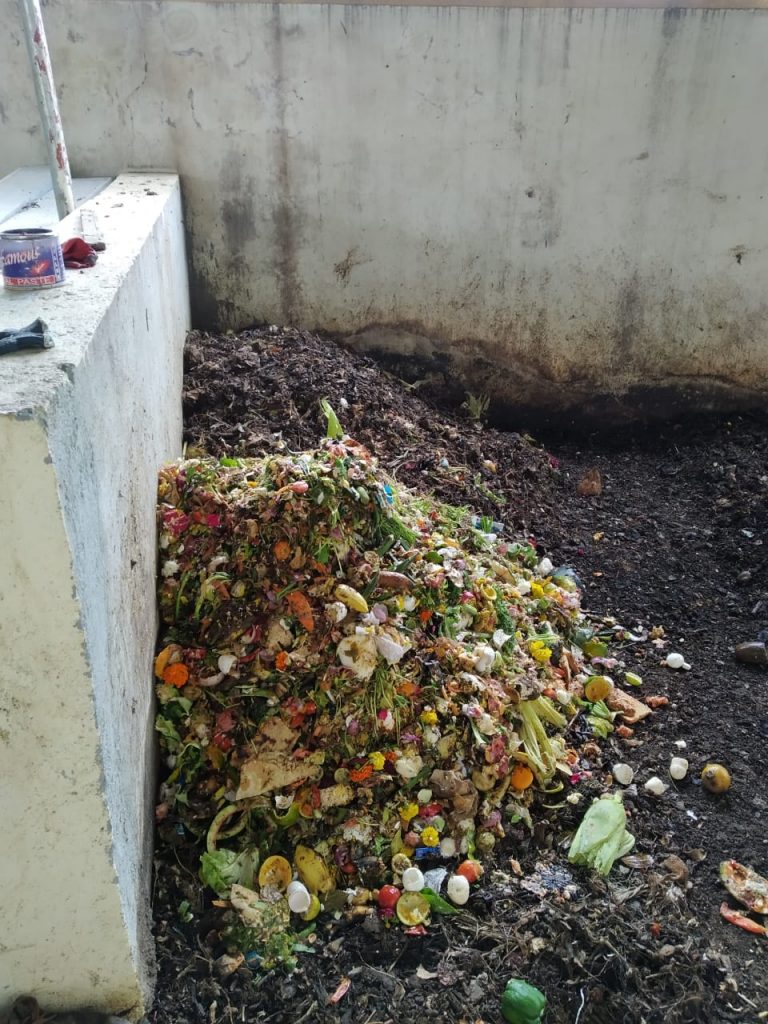
Muralikrishna Pattaje, member of the society, IT professional and composting enthusiast, championed the green practices in MJR Pearl. Owing to his previous tryst with community composting, Muralikrishna was used to producing around 700 kgs of compost per month for six years. He moved into MJR Pearl, already armed with prior experience and skills to make the community composting operation a success.
“The managing committee at MJR Pearl is highly conscientious and supportive when it comes to hands-on waste management and disposal onsite. In fact, there was already 100% waste segregation among all the units. However, the wet waste was being disposed of by a vendor instead of being composted. Funding was not a big challenge because we didn’t invest in expensive in-vessel composting systems. We did everything ourselves and thanks to cohesive efforts of the residents and the MC, our community composting endeavour took off and is being carried out successfully.”
Our earlier composting machine was huge but all it did was crush the waste, not compost it. Moreover, since no air and sunlight were available; it created anaerobic conditions and foul smells, he says.
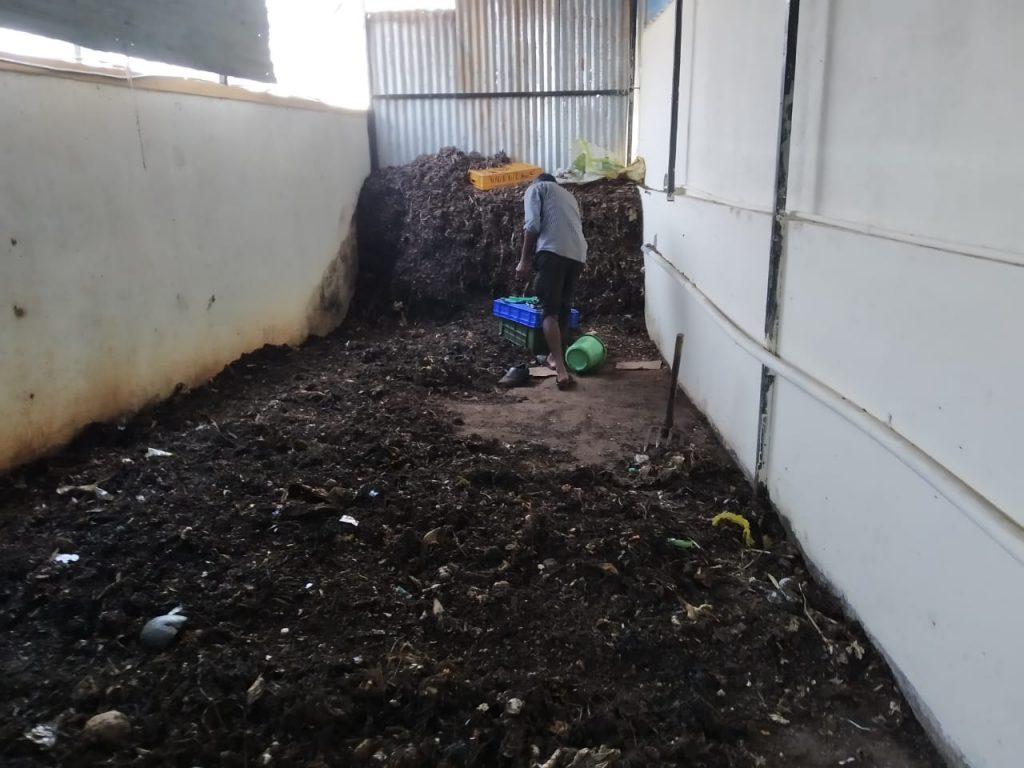
The planning stage
Figuring out how to compost at a large scale, selecting composting models and services and estimating the costs is always a major challenge for any society starting their own composting operation. “But at MJR Pearl, the planning went quite smoothly since the Managing Committee was already willing to lend help. Besides, I was familiar with the specifics thoroughly so setting up was easy,” says Muralikrishna.
The implementation
As there was no lack of space in the premises, the society has created a centralised wet waste management solution that uses natural aerobic composting. Segregated waste is collected from each household daily. It is then dumped into a rectangular enclosure with walls and left for composting with the right ratio of nitrogen (wet waste), carbon (dry cardboard, dry leaves or sawdust), water, air and sunlight. The pile needs to be rotated regularly for proper flow of air and sunlight so that there is enough heat and the microbes can grow. “We don’t use worms, yeast or chemicals for accelerating the process. The enclosure is a large rectangular room which is rain-proofed from the top, but is built to allow adequate air flow”, Muralikrishna explains. The room is enclosed by walls on two sides. The mix is kept for a month and rotated regularly for a month until the compost is ready. It is then filtered and the large chunks that remain are reused for the next batch.
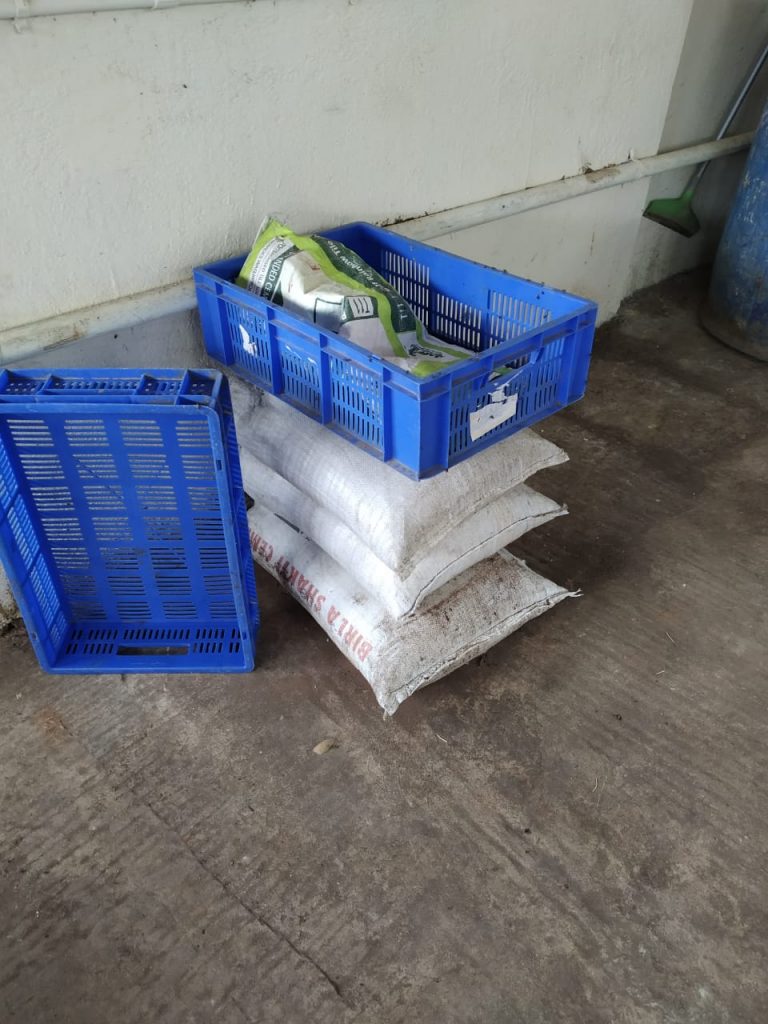
The first batch prepared in May this year produced 300 kgs of compost. In five months, MJR Pearl has made 2 tons of compost. The entire process is handled using gardening tools for mixing and two plastic crates for filtering. No leachate is produced since it pollutes groundwater. At the same time, turning the pile ensures no foul smell is created and residents are not inconvenienced. A trained handler is appointed by the society to carry out the entire execution and maintenance.
Challenges faced
Initially, there were a few hiccups such as bad odour since it was the very first attempt. Later, this was resolved. The residents are not actually involved in the process but they help by segregating their waste responsibly. Overall, they are satisfied with the wet waste management system. According to Muralikrishna, in addition to funding and segregation, societies usually face labour problems as there is a limited pool of experienced and interested workers.
The compost produced at MJR Pearl is of good quality and is used for gardening. The leftover compost is sold to nurseries and distributed among residents. Muralikrishna also offers his expertise to societies looking to start their wet waste management initiative in-house. His intention is to expand composting solutions to other interested societies. “Composting is a green practice essential to creating a positive environmental impact and it saves residential societies a lot of money if done right,” he concludes.
Today, not a single bit of wet waste leaves MJR Pearl’s premises. The residents of MJR Pearl are happy campers, who contribute to the nation’s waste management problems and use best practices in compliance with the Solid Waste Management Rules. Fortunately, the availability of land and aeration within the premises and the determined efforts of a few like-minded individuals have created a success story that other societies can be inspired by and replicate in their own community.
Images courtesy of Muralikrishna Pattaje.
Waste management is often seen by residential societies as a tedious and difficult task, to be put in the back burner until it becomes a crisis. Luckily, some pioneering societies awaken early and take proactive steps towards sustainable waste management. Their efforts are proof that small and realistic methods over time can go a long way in making a positive difference towards keeping reducing the burden of the garbage in our cities.
Anand Society and Tarangan Society in Thane, Mumbai are uniquely inspiring success stories, unlike any other in the country. Both have managed to create long-lasting solutions to their waste problem. With their perseverance and innovative ideas, they are a beacon for other housing societies.
Anand Society came into being in 2014 and houses 58 units while Tarangan Society, established in 2016, has 120 units. Here’s a look at their journey towards sustainable in-house composting.
Pre-composting waste management situation
Neither society was compliant with Solid Waste Management Rules nor were any waste management rules being enforced by the Managing Committee. Segregation at source was not taking place and piles of mixed waste used to be collected by the local municipal corporation in trucks. Door-to-door waste collection was managed by the housekeeping staff and there was no involvement of the residents, either in segregation or in any in-house waste management.
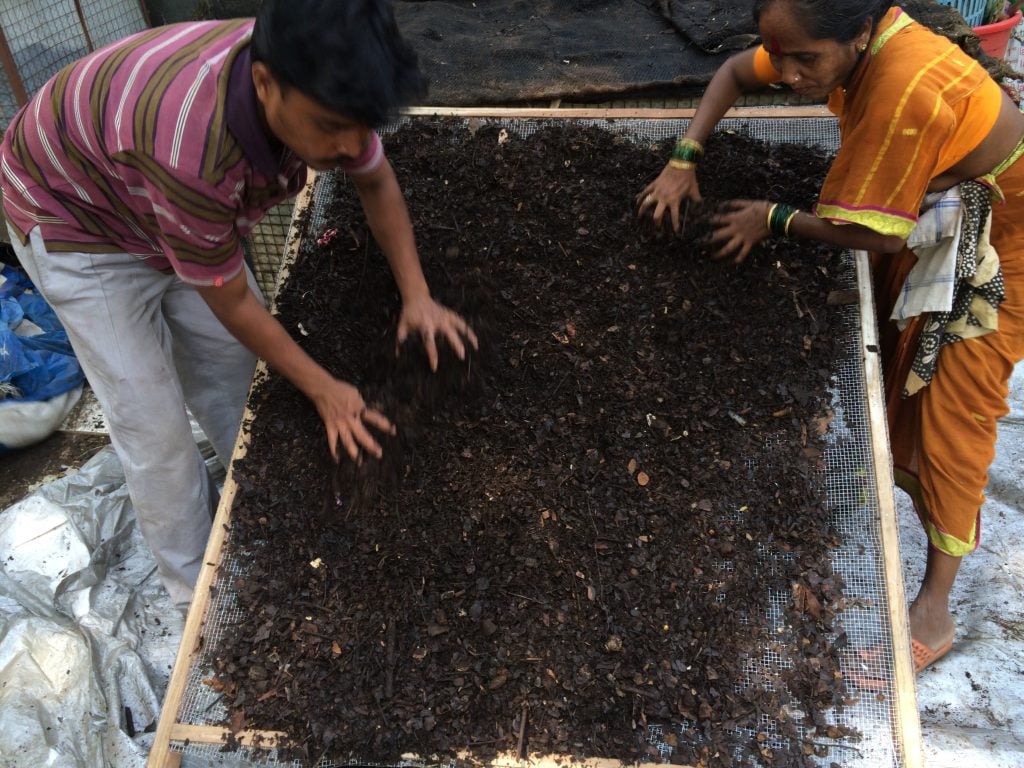
Involving all stakeholders
In 2017, Dr Lata Ghanshamnani, an Ophthalmologist and Founder of Rnisarg Foundation, an NGO dedicated to waste management and sustainable living in cities, launched the waste management project at Anand Society where she is a resident. She began by conducting an awareness programme for residents of Anand and Tarangan Societies to understand the basics of waste management and to inform them of their responsibility as waste generators. Once there was enough traction, the planning began.
Dr Lata integrated four stakeholders in the strategy:
- The Managing Committee was approached for providing space and funding
- Residents were instructed to segregate dry, wet and hazardous waste
- Housekeeping staff was trained on ensuring daily segregation, composting techniques and sending dry waste for recycling
- The Municipal Corporation was kept in loop to support and encourage housing society members with appreciation, tax rebates and other incentives
After the approval came through and the space was designated, two members made contributions towards vermicomposting bins. “We adopted vermicomposting initially and used it for two years because there weren’t many readily available solutions at the time. Biocomposting was adopted later. With biocomposting, there was a learning curve, however a fully functional and effective system was achieved eventually after continuous efforts for around two years”, says Dr Lata.
Interestingly enough, the 2 societies set up their bio-composting unit by winning place in Swachh Society Awards – an inter-society contest to recognize and reward clean and green residential housing societies in the Mumbai Metropolitan Region. Anand Society was awarded Rs 5 lakh cash prize while Tarangan won Rs 50,000, with which an investment in a bio-composting unit was made.
Getting started
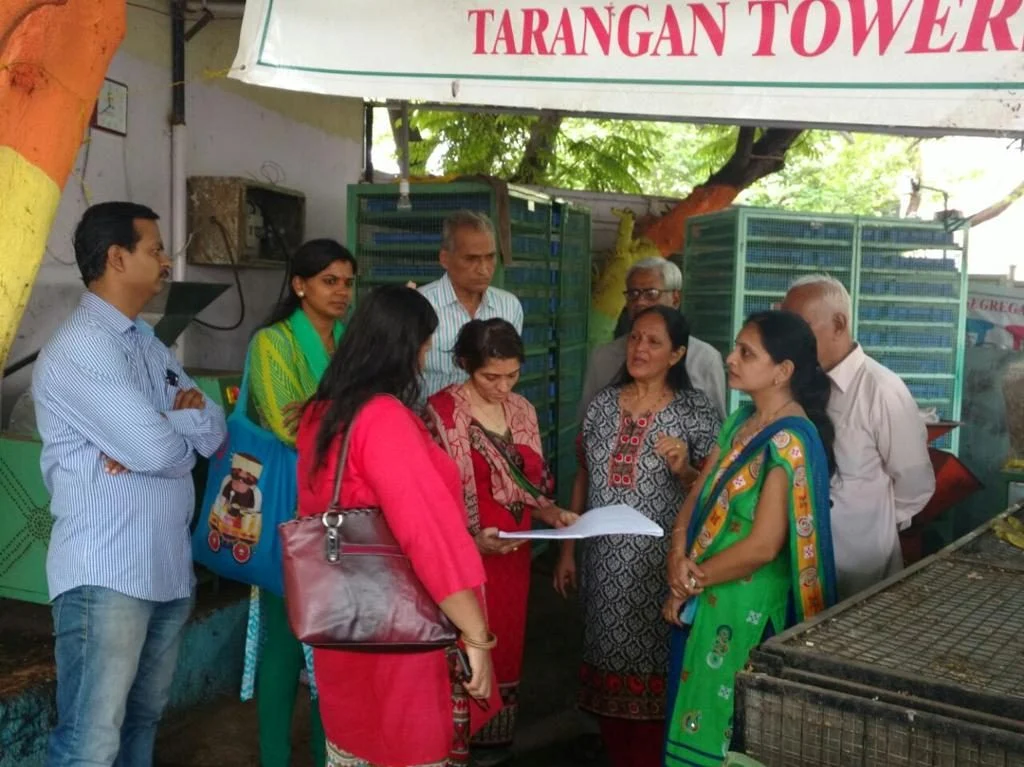
Both the societies installed a bio-composting unit called Bhoomi Butti. There were many trials and errors before a suitable location was identified and a foolproof method of composting was achieved. The bio-composting unit consists of a shredder, currying system with racks to place trays and a big stainless steel bin for the composting process. Since two years, the system has been working well on auto-pilot mode with regular upkeep financed with a part of the monthly maintenance fees.
The housekeeping staff has been thoroughly trained to carry out composting activities professionally. They also receive additional payment every month for doing this job. The society has also financed the purchase of separate dustbins for three-way segregation.
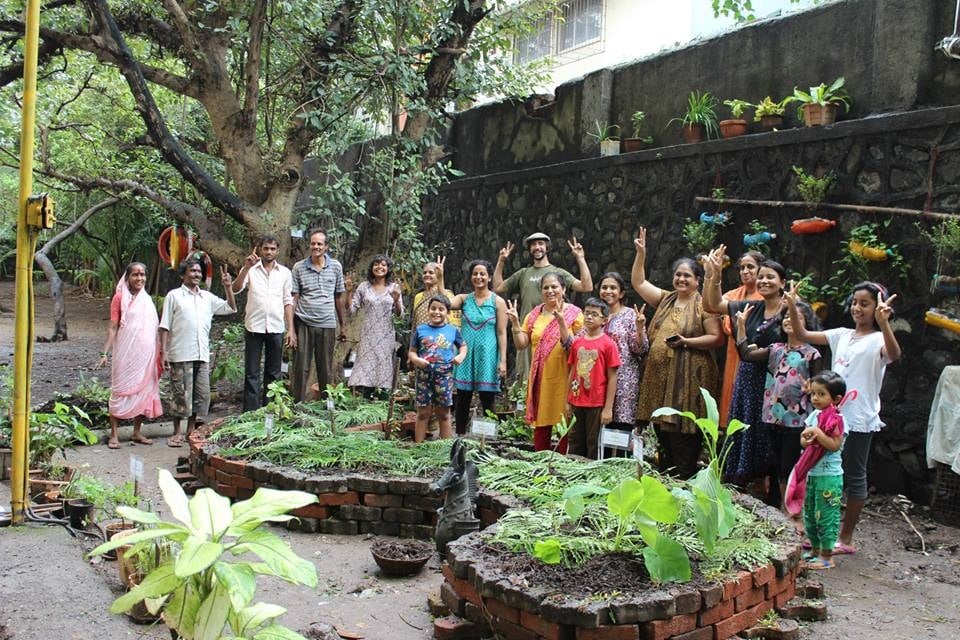
The entire process isn’t just handled by MC and housekeeping staff alone. The residents have been engaged too. Education about the importance of segregation and composting was handled by the children of the society. Each child was an ambassador who carried the message of sustainable waste management to their homes.
The success of community composting in these two societies has a distinct flavour to it. Since it wasn’t just carried out as a mandate, but as a shared duty, it became an immersive experience for residents of all ages. They have not only participated in the efforts to set up and run the composting unit, but have also made waste management best practices a part of their lifestyle. The consistent efforts over the last six years have unified everyone and brought about a palpable change in the overall quality of life. Residents feel pride in having made the right step in the direction of a clean and green India.
Overcoming challenges
There were challenges in the beginning, some expected, some unexpected, but these were handled with practical strategies.
“The initial location of the composting unit in the society’s compound was an eyesore to many. So we grew an organic garden around it to beautify the place and create a natural and fresh aesthetic. When we started bio-composting, the smell was also a problem initially. So we decided to move the system to the terrace and that worked out well. It is now odour-free and no one has any complaints,” says Dr Lata.
However, the biggest challenge was to make the entire system financially viable. This is because of the availability of municipal waste collection services that don’t refuse mixed waste and collect it for free. If such wrong practices become a habit, no one feels compelled to get together and pay money for something they’d have to be accountable for. But gradually, mindsets must be changed and responsibilities should be shared equally by the citizens and the government.
Anand Society generates 30 – 35 kgs of wet waste daily while Tarangan Society generates around 120 kgs, one-third of which is turned into compost. The compost is used by the society and is also donated for free to residents. They also sell the compost to friends and family at Rs 10 per kg.
The societies and the stakeholders, aided by Dr Lata’s guidance, intend to sustain the waste management and disposal efforts and continue them well into the future, while expanding their activities to other societies who are willing to take the lead in composting. Dr Lata advises housing societies. “Accepting your responsibility as a good citizen is the first step in waste management. The rest can be handled with planning and commitment. The key takeaways for societies planning to venture into composting are not giving up at the first sight of obstacles. Sometimes, the lack of participation or the challenge of financial planning can take a toll on your perseverance. But finding workarounds is always better than giving up. As long as awareness and a responsibility towards waste management are your guiding motivation, everything can be resolved, says Dr Lata.
All’s well that ends well, and in the case of Anand Society and Tarangan Society, the journey towards sustainability has been especially rewarding because it has made the entire community more resilient, responsible and collaborative.
Images courtesy Dr Lata Ghanshamnani.